


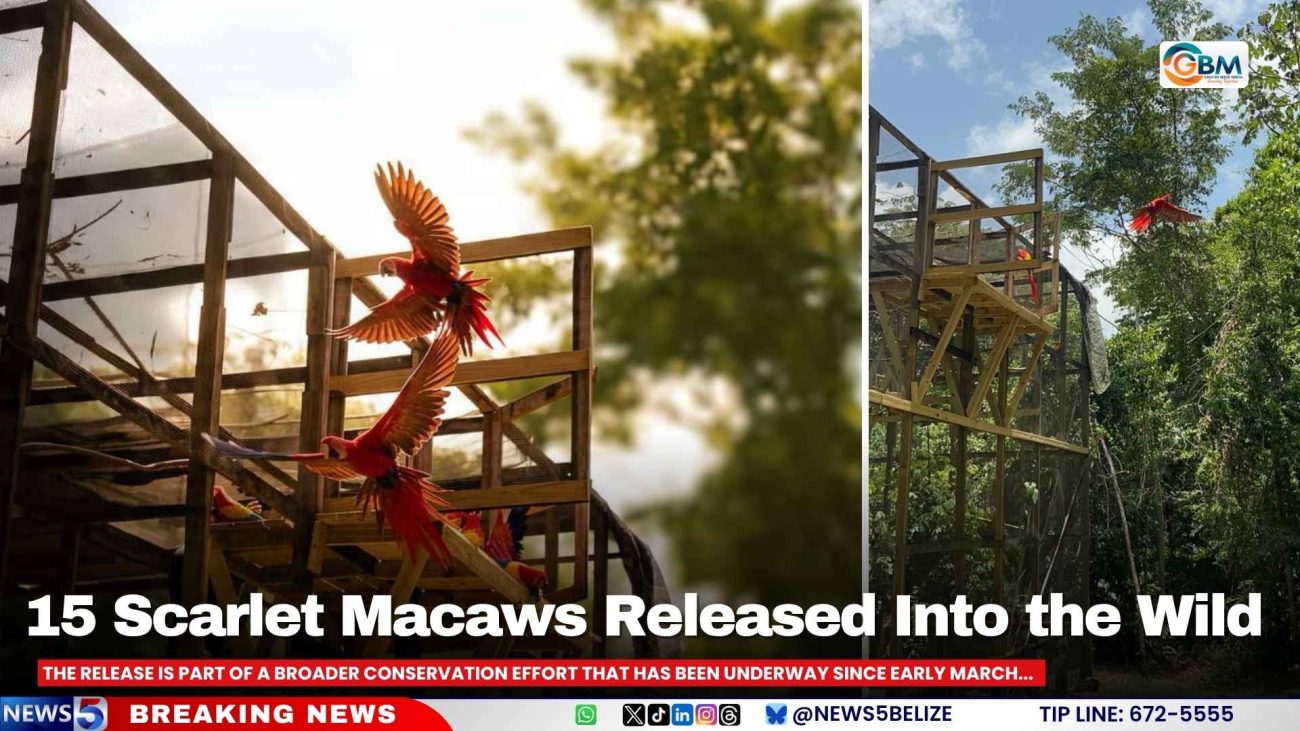
15 Scarlet Macaws Released Into the Wild
Fifteen scarlet macaws returned to the wild on Monday after being released by the Friends for Conservation and Development (FCD) alongside the Forest Department.
The birds were rescued and spent an average of one hundred days in a specialised laboratory before their release. Each rescue decision followed a strict protocol set by the Forest Department, typically triggered by high-risk situations, such as three chicks sharing a single cavity, where poaching or death becomes far more likely. In-situ management of this kind is treated as a last resort in caring for Belize’s macaw population.
Once rescued, the birds were fed and cared for in the lab before being moved to a flight cage, where they practised flying and built the strength needed to survive on their own in the wild.
On Monday morning, the moment came for them to leave. As the cage door opened, the macaws first flocked to their fruit and nuts before carefully taking flight, one by one. Some flew off into the distance, while others lingered close to the cage. For a while, the forest was filled with the sound of squawking parrots finding their way.
The release is part of a broader conservation effort that has been underway since early March, when FCD’s Research Unit began biological monitoring of macaws in the wild. So far, twenty-four macaws have successfully fledged from their natural cavities. That effort relies on maintaining a constant presence near nesting sites, both to monitor the chicks’ growth and to deter poachers looking to steal them before they can fly.
Despite that presence, two chicks were lost to poachers this year. These chicks are known to be smuggled into Guatemala by poachers known locally as “guaqueros”.
To combat the illegal wildlife trade driving these losses, FCD and the Forest Department maintain a binational taskforce that shares information and coordinates interventions. Even so, officials say it remains difficult to know exactly how many macaws are lost to trafficking each year.