


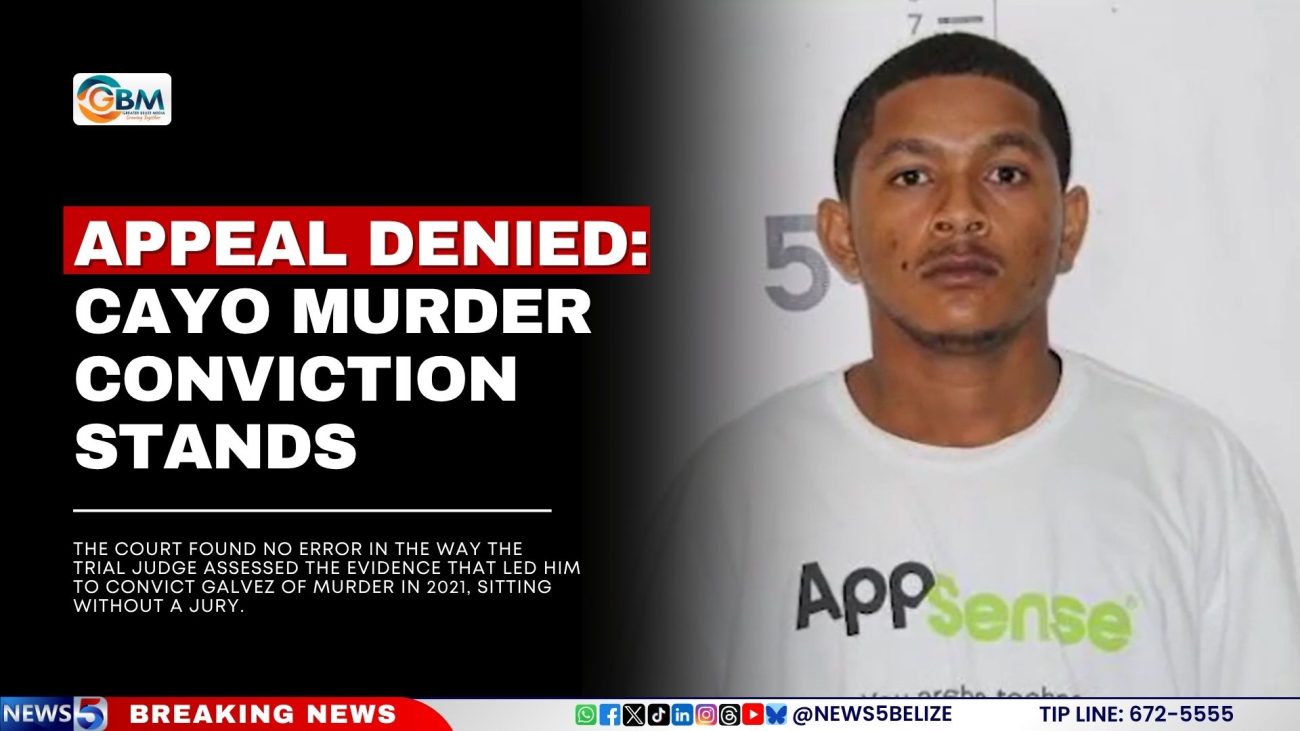
Appeal Denied: Cayo Murder Conviction Stands
Belize’s Court of Appeal has dismissed the appeal of Dean Galvez against his murder conviction and life sentence for the 2018 fatal shooting of Ronnie Omar Cassasola Jr. in San Mateo, Cayo District. The court rejected arguments that the trial judge wrongly relied on eyewitness identification evidence.
The court found no error in the way the trial judge assessed the evidence that led him to convict Galvez of murder in 2021, sitting without a jury.
According to the prosecution’s case, Galvez and his companions clashed with members of the Cassasola family and their acquaintances at the Pedrigal Bar on the night of May 5, 2018. After the groups left the bar, tensions continued as the Cassasolas headed home until Galvez allegedly drew a firearm and opened fire, retreated, then returned and fired a second round of shots. Cassasola died of a gunshot wound sustained during the incident.
Five witnesses who knew Galvez identified him as the shooter, testifying they saw him at a distance of 20 to 30 feet under streetlight illumination.
Galvez denied being at the scene, testifying he ran for cover elsewhere when he heard gunshots. His alibi witness largely corroborated his account but diverged from Galvez’s own version of events on a key detail (whether Galvez jumped a fence while fleeing), a discrepancy the trial judge found undermined the alibi.
Galvez’s lawyer, Norman Rodriguez, argued the trial judge erred in treating the eyewitness evidence as sufficient proof of guilt. He pointed to a forensic report indicating the fatal shot came from behind the victim, argued the trial judge failed to properly distinguish between “identification” of a stranger and “recognition” of someone already known to a witness, challenged the judge’s finding that poor lighting did not undermine the identifications, and argued no formal identification parade had been held.
The prosecution, led by Director of Public Prosecutions Cheryl-Lynn Vidal, countered that the trial judge had thoroughly applied the established legal safeguards for identification evidence – known as the Turnbull guidelines – and that the witnesses’ long-standing familiarity with Galvez, combined with favourable lighting and an unobstructed view, made their evidence reliable.
The Court of Appeal’s judgement devotes substantial attention to the legal framework governing identification evidence, tracing the Turnbull principles requiring judges to warn against the risk that even an honest, convincing witness can be mistaken and to scrutinise factors like distance, lighting, duration of observation, and prior familiarity.
The judges also addressed how these safeguards apply differently in a judge-alone “bench trial” compared to a jury trial, noting that a judge sitting without a jury need not recite every legal principle in formal terms so long as the reasoning as a whole shows the essential issues were properly addressed.
Reviewing the trial judge’s own written reasons, the appellate panel found he had expressly warned himself of the risks of mistaken identification, examined the lighting, distance, and duration of each witness’s observation, visited the crime scene to assess sightlines, and explicitly weighed inconsistencies in the evidence — including a witness’s failure to initially mention seeing Galvez draw the firearm — before concluding the evidence remained reliable.
In the absence of a formal identification parade, the court held this did not automatically make the conviction unsafe since the eyewitnesses already knew Galvez personally and the case turned on recognition rather than identifying a stranger, making a parade of limited value. Similarly, the court found the trial judge did not treat the in-court “dock identification” of Galvez as independent proof, but only as consistent with the witnesses’ earlier recognition of him.