


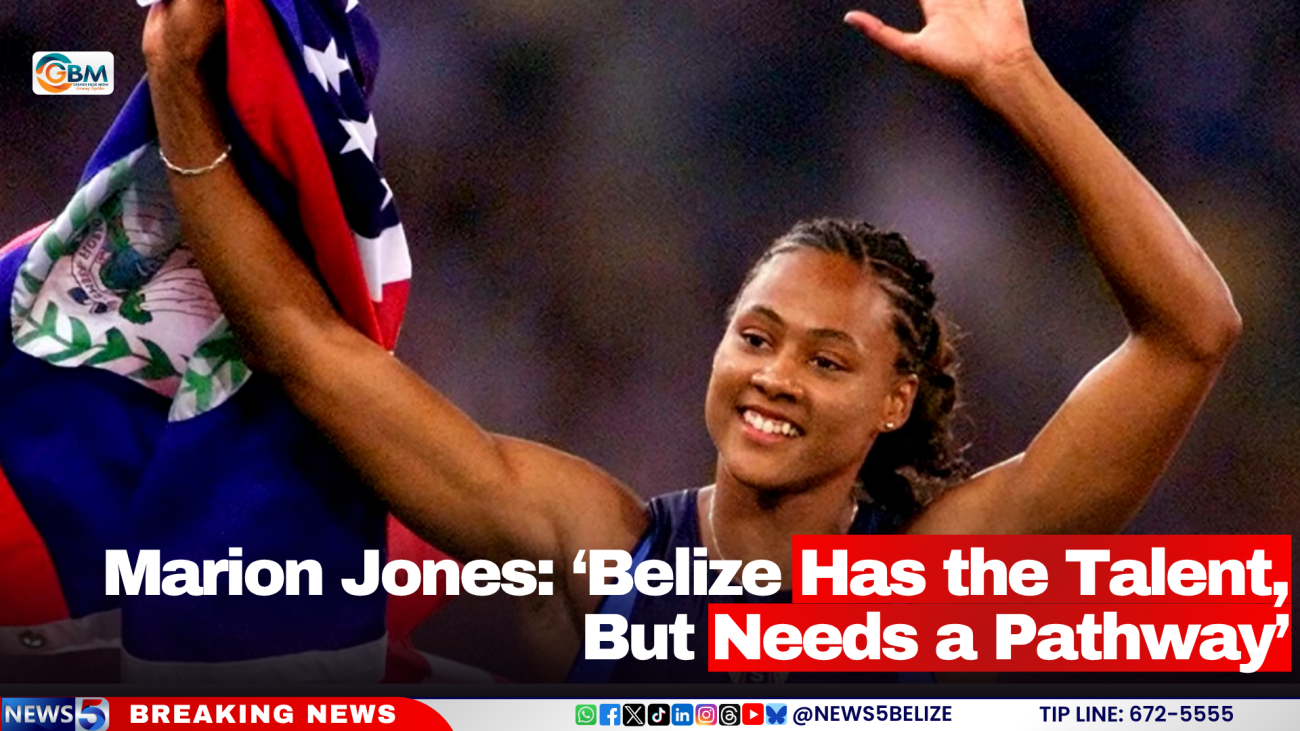
Marion Jones: ‘Belize Has the Talent, But Needs a Pathway’
Belizean athlete Marion Jones says Belize has the ability to produce world-class athletes, but it needs a long-term national strategy to identify, develop and support that talent.
Jones is back in Belize after 20 years for the first National Sports Summit, taking place Wednesday and Thursday at the Belize City Civic Centre, where she is to deliver a keynote address.
Speaking on Open Your Eyes, Jones said her physical distance from the country never meant she stopped following what was happening here, but she wanted her return to be meaningful.
Jones also reflected briefly on the controversy over her use of performance-enhancing drugs, which led to her being stripped of her five medals from the 2000 Sydney Olympics. She acknowledged the poor decisions she made and the disappointment they caused her family and Belizeans who had celebrated her.
Jones said she now wants to use those experiences to give back to Belize and help build better opportunities for the country’s young athletes. “I am here to open the dialogue, to continue the conversation on developing a pathway to success for our athletes because the talent is here,” Jones said.
“There is no national strategy when it comes to sport, when it comes to funding, when it comes to coaching certifications and empowering our coaches with the tools on how to build world-class athletes,” she said.
She called for the National Sports Council, Belize Olympic Association and the Commonwealth Games Association to work together on a strategy that can continue from one administration to the next.
She pointed to Jamaica, The Bahamas and Barbados as examples of smaller nations that have consistently produced world-class athletes.
Jones said the pathway must begin in childhood, with physical literacy and basic movement skills introduced in schools across the country.
“We need to identify physical literacy amongst our young people,” Jones said. “The issue that we’re having is that we are trying to develop athletes by the time they turn 12 and 13 and 14 years old. And it is too late.”
That early development, she said, must be matched by stronger support for coaches, including certification and the tools they need to help develop athletes.
Jones said funding must also come from beyond government. She called on the private sector and Belizean diaspora to contribute not only money and facilities but also mentorship, university connections and opportunities for Belizean athletes to train abroad.
Jones said the changes will not happen overnight. Rather than focusing on immediately producing an Olympic gold medallist, she wants Belize to build the foundation for sustained international success.
Jones said she does not want the summit to be a one-time conversation but the beginning of lasting change in Belize’s sports system. “I don’t want when I leave here in a week for this just to be a blip in the news,” she said.