


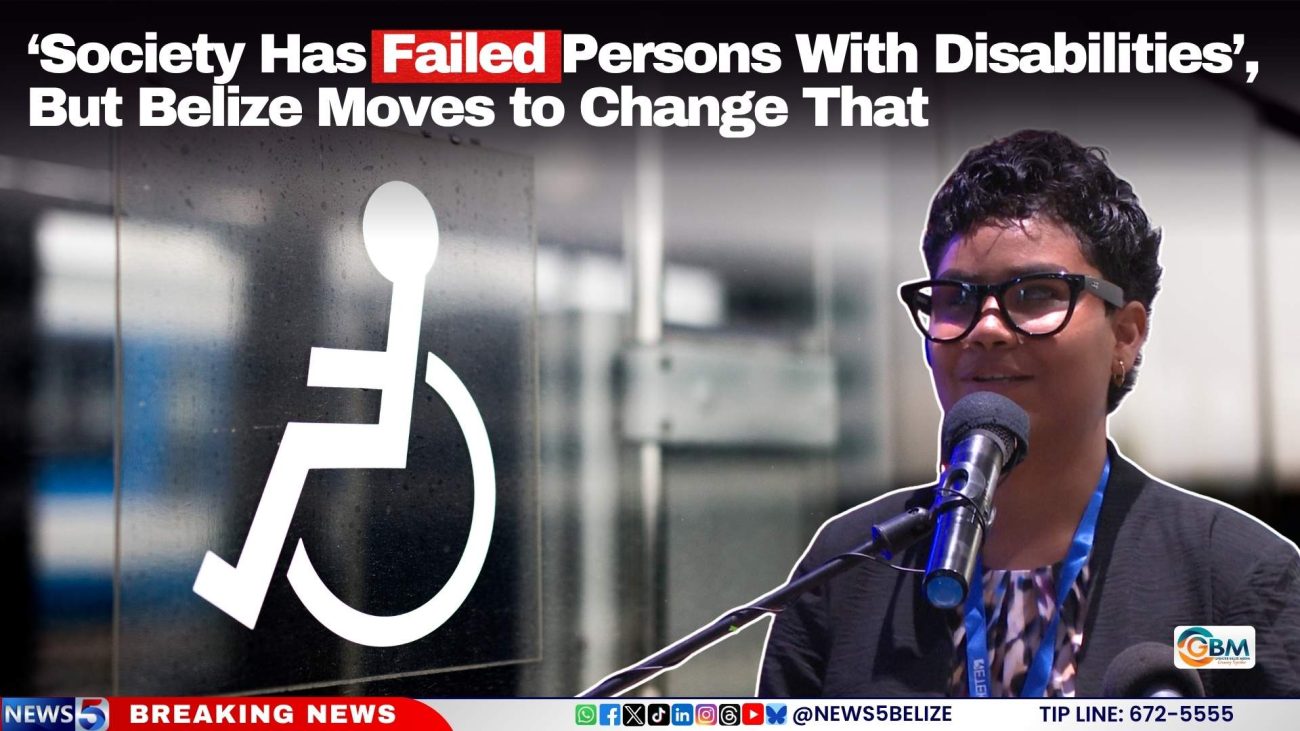
‘Society Has Failed Persons With Disabilities’, But Belize Moves to Change That
“Disability does not affect only one individual, it touches an entire family, and therefore it touches a nation.” Special Envoy for the Development of Families and Children Rossana Briceño said those words at the launch of Belize’s new National Commission for Persons with Disabilities on Thursday.
The Commission begins a new phase in the implementation of the Disabilities Act, 2024. It was officially unveiled by the Ministry of Human Development, Family Support and Gender Affairs under the theme “Together Towards Inclusion.” The launch brought together persons with disabilities, government officials, civil society organisations and representatives from key national institutions.
The commission’s work will focus on advancing the rights of persons with disabilities in areas including education, employment, healthcare, accessibility and protection from discrimination.
Commissioners held their first working session, reviewing The Disabilities Act, 2024 and the Commission’s Terms of Reference and beginning discussions on strategic priorities. During the ceremony, members received their Instruments of Appointment, formally taking on their roles under the Act.
“This commission represents one of the most important steps in the implementation of the disabilities act,” said Minister of Human Development Thea Garcia-Ramirez. She added that while the law establishes the framework for protecting those rights, “it is through our collective actions” that those rights can be reflected in the everyday lives of Belizeans.
Meanwhile, Special Envoy Briceño drew sharper attention at the barriers persons with disabilities face, and how that reflects on the wider public, stating, “When persons with disabilities are excluded, the problem is not that they have failed to fit into society, the problem is that society has failed to remove the barriers that prevent them from participating fully.”
For Alison Fisher, a blind young Belizean, the hope is that the new Commission will help make inclusion something persons with disabilities experience rather than simply a principle written into law.
“Yes, I am blind, but blindness is only one part of who I am,” Fisher said. “I hope that this commission will help create a Belize where every child and young person with disability can confidently say I belong, I have a voice, I have opportunities, and I can achieve.”
The commission is expected to help coordinate efforts across government and other sectors to make inclusion more tangible in Belizean schools, workplaces, communities and public services.