


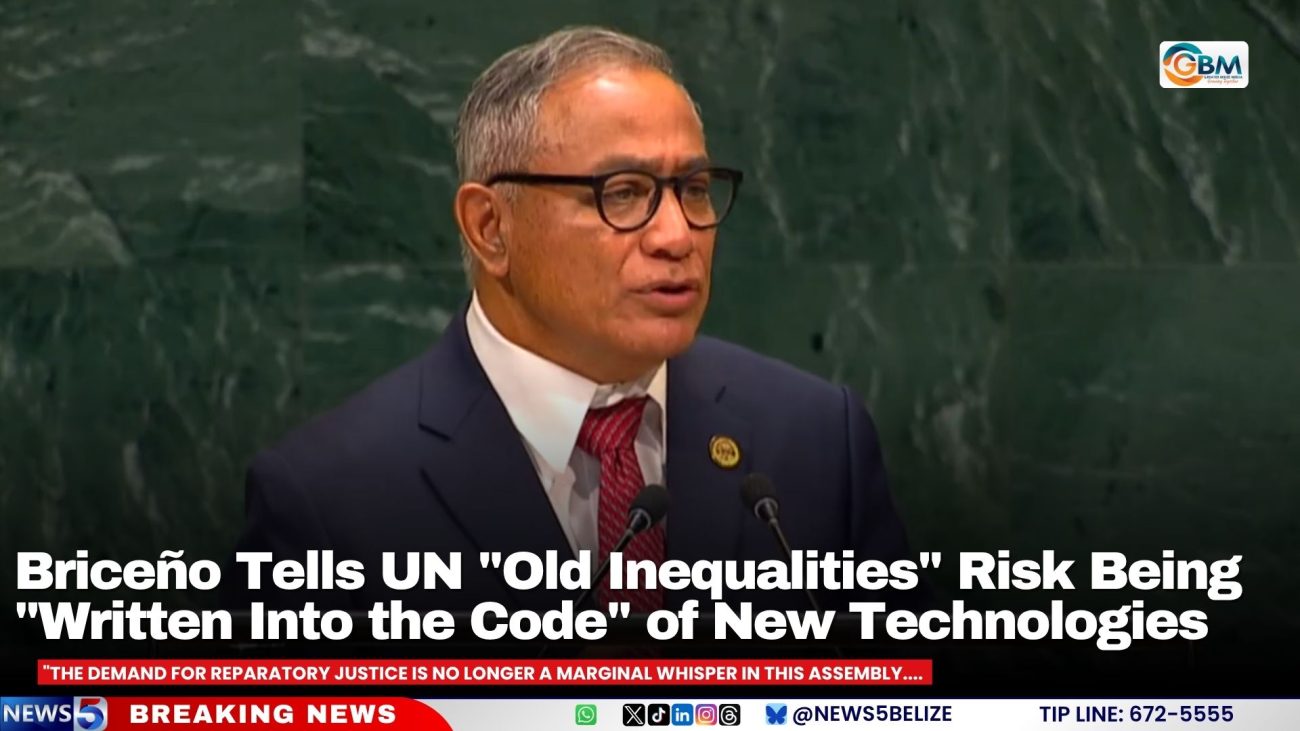
Briceño Tells UN “Old Inequalities” Risk Being “Written Into the Code” of New Technologies
Prime Minister John Briceño delivered a pointed message on historical inequality and reparatory justice during his UN General Assembly address. He warned that the structures of colonial-era exploitation risk being replicated in the emerging technology-driven global economy.
“The demand for reparatory justice is no longer a marginal whisper in this assembly. It is here at the center, and it is not going away. This assembly has rightly and finally declared slavery as the gravest crime against humanity. But this recognition is only the beginning of an obligation, and the obligation is that we must not build the next chapter of development on the foundation of the last.”
Briceño argued that independence did not fundamentally change the economic structures inherited from the colonial era. “If we are to be honest about that foundation, then we would acknowledge that the wealth of the industrial age largely came from the labor of enslaved and colonized peoples, and its rewards flowed almost entirely away from them. When independence came, the flags changed. The structures did not. The terms of trade did not change. The cost of capital did not change. Who sits at the table when the rules are written did not change. The imbalance was not undone. It was inherited.”
He warned that the rapid pace of technological change presents a similar risk today. “Now we stand at the threshold of yet another transformation. Technology is moving faster than any framework we have yet devised to govern it. Will we do it differently this time, or will we do it again? Because the question before us is not whether any new inequalities may arise. It is whether the old ones will be written into the code, into who owns the data, who sets the standards, who captures the value, and who, once more, is left to carry the cost.”
Briceño insisted that a fairer outcome remains possible, but requires deliberate choices. “We do not have to accept that outcome. A development framework is a choice. It can be designed to serve the common good and measured against what our people actually need: dignity, opportunity, and a fair share in what they help to create. Or it can be left to reproduce what came before and call it progress. We have the knowledge to choose the first path. What is needed now is the will.”
He also called for reforming how international finance treats small, climate-vulnerable states like Belize. “Belize does not seek special treatment; we seek accurate treatment. Income per capita does not reveal how much of an economy sits in a hurricane’s path, what it costs to serve dispersed communities, or how quickly a climate shock can reverse fiscal gains. The Multidimensional Vulnerability Index must become a working instrument across the international financial system in eligibility for concessional finance, in debt sustainability analysis, and in the decisions of the institutions that allocate capital.”