


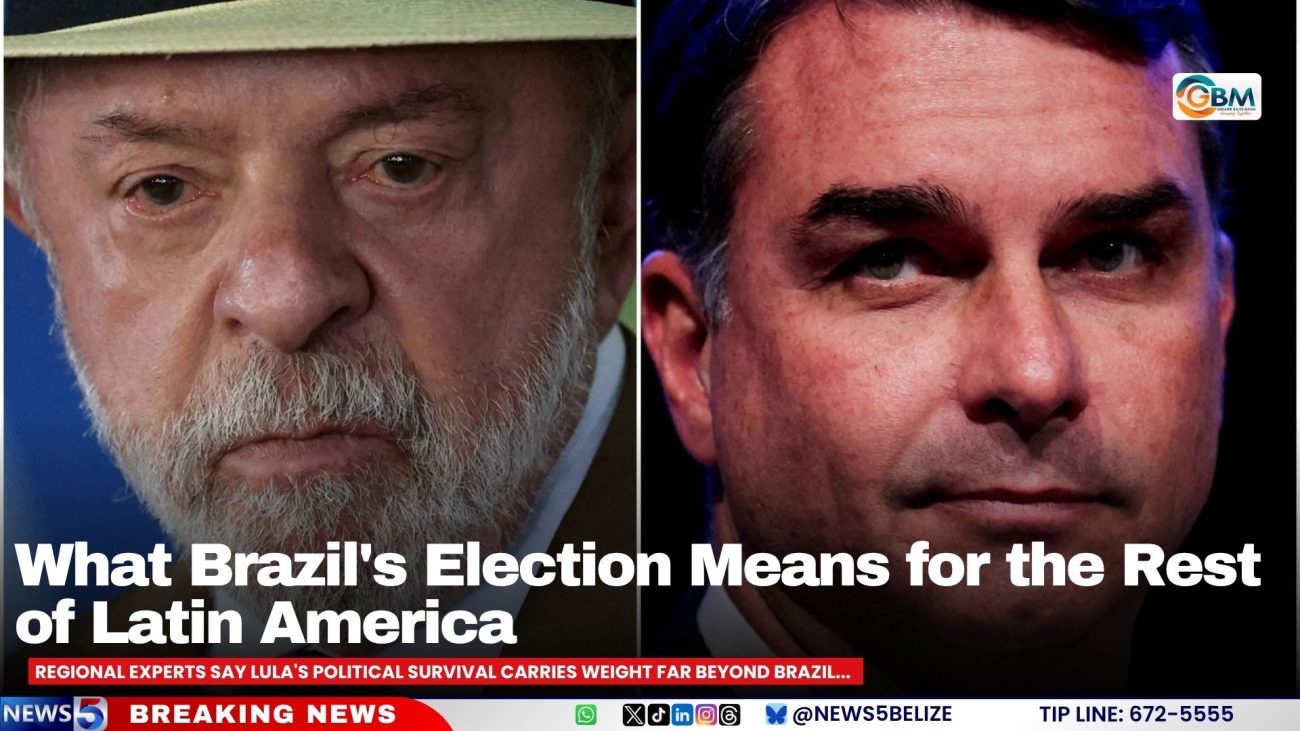
What Brazil’s Election Means for the Rest of Latin America
Brazil’s tightest presidential race in years could reshape political alliances across Latin America, as the region’s recent rightward wave approaches its biggest test yet.
Polls show a technical tie between 80-year-old President Luiz Inácio Lula da Silva, seeking reelection, and opposition candidate Flávio Bolsonaro, son of former President Jair Bolsonaro, who is barred from running after being disqualified for abuse of power and convicted over an attempted coup. Most analysts expect a runoff.
Regional experts say Lula’s political survival carries weight far beyond Brazil. “Lula da Silva is undoubtedly the only statesman with global reach in a Latin America of mostly emerging faces with limited international weight,” Venezuelan academic and former ambassador Alfredo Toro Hardy told CNN. “His eventual departure would leave a clear void.”
Lula addressed the UN General Assembly last week with one of the summit’s most quoted lines, directed at Washington: “Brazil doesn’t fit in anyone’s backyard.”
Political scientist Juan Pablo Scarfi, of Universidad de San Andrés in Buenos Aires, says a Lula loss would cost the region more than one leader, though he noted Lula’s influence has already faded due to a less favorable international climate. “If Lula loses, the region would essentially be losing a central figure,” Scarfi said. “He could serve as a counterweight, but the international context is very unfavorable to him.”
The stakes are higher than in 2018, when the region was more ideologically mixed. This time, Brazil votes after nearly two years in which the right, often backed by US President Donald Trump, has gone undefeated in major Latin American elections. Argentine President Javier Milei, one of Washington’s closest regional allies, has publicly backed Bolsonaro, as Trump has as well.
“A Bolsonaro victory would expand the MAGA club in Latin America,” Toro Hardy said, pointing to Brazil’s vast rare earth reserves, an area where the US lags behind China. He argued a Lula loss would be a win for China’s regional position.
Florida International University political scientist Eduardo Gamarra frames the election as the end of a three-decade cycle rooted in trade integration and liberal democracy dating to the 1994 Summit of the Americas. “This makes Lula da Silva, in a way, the last of the presidents who, despite being left-wing, was part of that Latin American vision of integration,” Gamarra said.
Still, he cautioned the right’s winning streak hasn’t delivered stability. “Just as this pendulum reaches its highest point, it enters a deep crisis. The Trumpist coalition in Latin America is very fragile.”
As for who might fill a leadership vacuum if Lula loses, analysts were skeptical Mexican President Claudia Sheinbaum would take on that role, given how tightly Mexico’s foreign policy is bound to its northern neighbor. Milei has worked hardest to position himself as the right’s regional face, but Scarfi doubts Bolsonaro could match Milei’s alignment with Trump even in victory.
The stakes extend to Mercosur as well. Scarfi called the trade bloc “born during the era of the Washington Consensus” but historically a counterweight to closer US trade ties. Under near-total alignment with Washington, he warned, that counterweight “could become a thing of the past.”