



Belize Transforms Colonial Symbol into Cultural Space
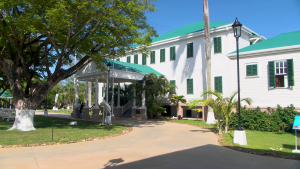
Once reserved for colonial governors and the elite, Government House now opens its doors to the people whose ancestors helped build and maintain it. More than two centuries after its construction, the historic mansion has become the House of Culture, a space where Belizean art, music and untold stories take center stage. In this week’s edition of Kolcha Tuesday, News Five’s Britney Gordon explores how Belize transformed a symbol of colonial power into a celebration of national identity.
 Britney Gordon, Reporting
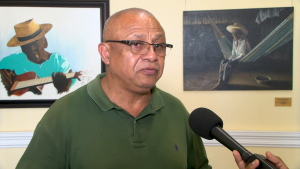
For generations, decisions that shaped Belize were made inside these halls, but most Belizeans could only look in from the outside. Today, Government House tells a very different story. Its rooms are filled with local paintings, sculptures and historical exhibits, while its grounds welcome the public for some of the country’s largest cultural celebrations. Built in 1814, the mansion once represented colonial authority and exclusivity. Since becoming the House of Culture, however, it has taken on a new purpose: giving space and visibility to Belizeans whose voices were historically pushed aside. Giovanni Pinelo, Public History Officer at NICH, describes the change as an important act of decolonization.
Giovanni Pinelo
Giovanni Pinelo, Public History Officer, NICH
“It was exclusive. And so as of 1998 the building itself is declared, um, a space for, for the voiceless. A space where people who had been marginalized are now able to actually come and visit, to come and take part in official ceremonies, to come and take part in several events that highlight the, the story of Belize.”
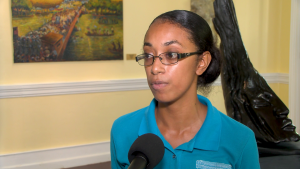
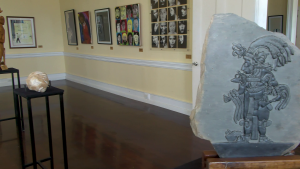
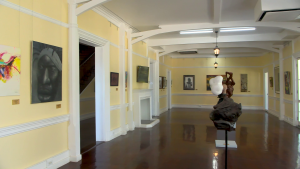 That transformation extends beyond the building’s symbolic meaning. Government House is also home to the Museum of Belizean Art, where visitors can explore paintings, sculptures and other works that capture the country’s history, identity and creative talent. Tour guide Leanne Baeza says the museum gives Belizean artists a prominent platform while helping visitors understand the stories behind their work.
Leanne Baeza
Leanne Baeza, Tour Guide, Museum of Belizean Art
“When it was renovating, we start to bring in all of our Belizean artists, which is Mr. Cayetano. He was one of the first artists that brought his arts here, and then we put it on the wall. So whenever tourists would come in and they would ask about these arts, we have a lot of our tour staff who works in here would accommodate with us and tell them more what it is about.”
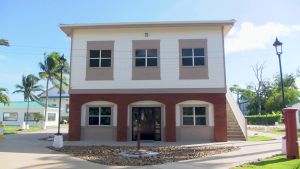 Following years of restoration, the House of Culture reopened in November 2018, breathing new life into one of Belize City’s oldest landmarks. But Pinelo says the building’s real history goes beyond the governors and officials who once occupied it. It also lives in the craftsmanship of the African ancestors who built, maintained and preserved the structure.
 Giovanni Pinelo
“What the colonial architecture reveals is the skills, the capacity, the potential, the know-how of the common people. You ever asked yourself the question, ‘Who built this structure?’ It may have been directed by somebody else, but it was our own African ancestors whose skills in carpentry, whose skills in knowing how to place different arches, in knowing how to hang the double windows, would have played a key role. And it was them who, even as servants, played a role in maintaining the structure itself.”
Government House now honors the ordinary Belizeans whose skill and labor helped shape the nation. During Pan Yaad, its historic grounds come alive as leading steel bands blend Belize’s past with its vibrant culture. For Baeza, working there means learning more about the country and sharing its story with visitors.
 Leanne Baeza
“I’m pretty much in love with it because each, as I mention, as getting to know more about the history of Belize, I’m learning. So whenever tourists would come, and locals, I would be able to tell them more about our beautiful country and more arts that would be coming in here.”
Beyond the mansion, the compound includes a former carriage house, servants’ quarters, NICH offices and landscaped grounds that host cultural activities throughout the year. Together, the old and newer buildings reflect the property’s transformation from an exclusive colonial estate into a public space that celebrates Belizean history, creativity and pride. Government House may have been built as a symbol of colonial power, but today, Belizeans are reclaiming its halls and telling the story in their own voices. Britney Gordon for News Five.
Attention readers: This online newscast is a direct transcript of our evening television broadcast. When speakers use Kriol, we have carefully rendered their words using a standard spelling system.
Watch the full newscast here: