


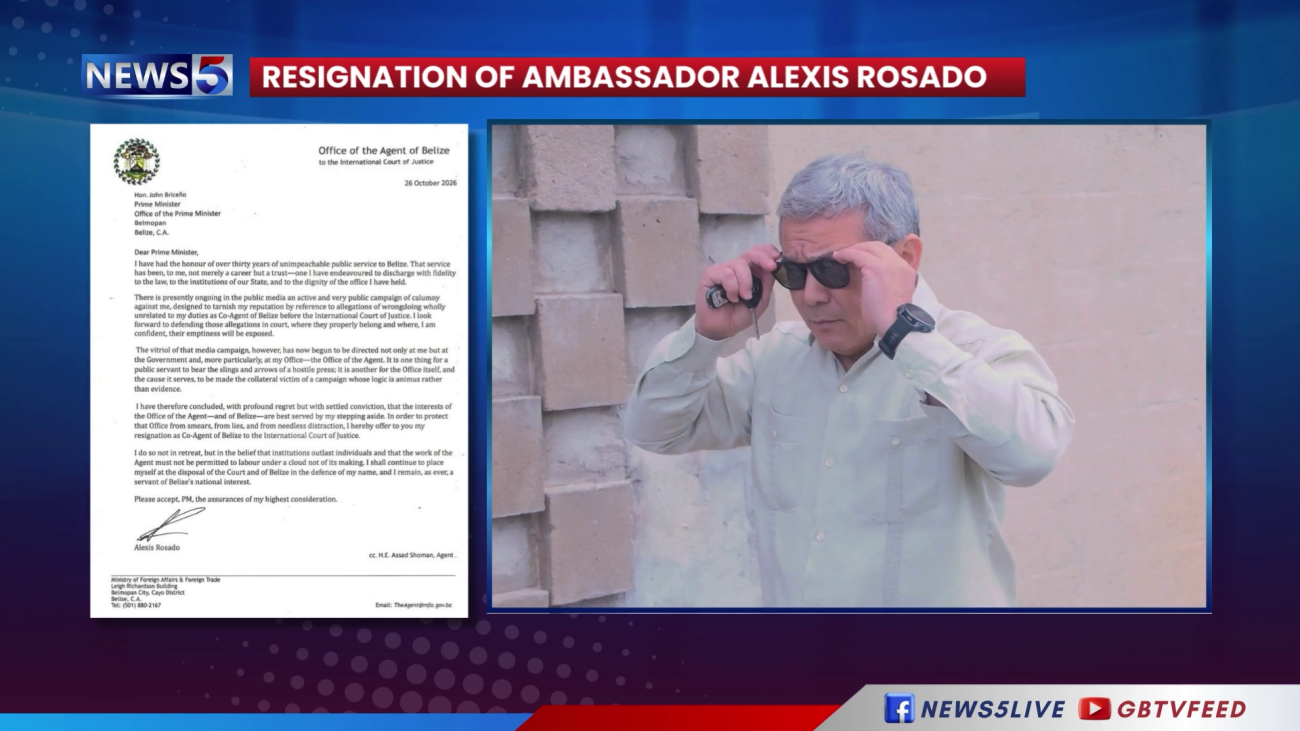
Alexis Rosado Steps Aside but Defends His “Unimpeachable” Record
Alexis Rosado says he resigned to protect Belize’s interests, but his departure letter reads as much like a defense of his reputation as an explanation of why he is stepping aside. After mounting pressure over his continued role in Belize’s case before the International Court of Justice, the veteran diplomat insists he has served the country with an “unimpeachable” record and describes the criticism against him as malicious. But the letter leaves a central question unanswered: why did it take this long for him to conclude that the criminal proceedings could distract from one of Belize’s most important international cases? News Five’s Shane Williams examines Rosado’s words, his defense and the questions that remain.
 Shane Williams, Reporting
Alexis Rosado begins his resignation letter not with the controversy surrounding his appointment, but with his three decades of public service. He describes that record as “unimpeachable” and says he is leaving to protect Belize’s interests and preserve the integrity of the Office of the Agent before the International Court of Justice. Yet much of the letter focuses on defending his name rather than acknowledging the public concern that followed him into that office. Rosado portrays the scrutiny surrounding him as a “campaign of calumny,” describing it as an attempt to damage his reputation through malicious falsehoods. He also stresses that the allegations are unrelated to his work as Co-Agent and says he looks forward to defending himself in court. But while Rosado rejects the accusations, his letter does not fully confront the separate issue at the heart of the public debate: whether someone facing criminal proceedings should continue representing Belize in a case of profound national importance.
 After what he calls “careful reflection,” Rosado says he decided to resign because the controversy could distract from Belize’s case before the ICJ. He presents that decision as an act of duty, taken in the country’s best interest. But the explanation raises another question. If the potential for distraction now warrants his resignation, why did he not step aside when those concerns first emerged?
 Rosado remains presumed innocent unless proven guilty, and his resignation does not amount to an admission of wrongdoing. But calls for his removal, including those from House Speaker Valerie Woods, did not require a verdict on the allegations. They centered on public confidence, the integrity of the office and whether the criminal proceedings could undermine Belize’s representation before the international court. Throughout the letter, Rosado makes it clear that he intends to defend his name and expects the allegations against him to be disproven. His departure, he argues, is a principled sacrifice rather than a retreat. That framing protects his professional legacy, but offers little acknowledgment of why Belizeans were entitled to question his continued appointment.
Rosado has now stepped aside, removing the immediate controversy from Belize’s ICJ team. But his resignation letter leaves the public with two competing narratives: a career diplomat protecting the national interest, and a senior public servant who resisted mounting pressure before finally leaving the post. The courts will determine the criminal matter. The debate over accountability, judgment and public confidence will continue outside the courtroom. Shane Williams for News Five.
Attention readers: This online newscast is a direct transcript of our evening television broadcast. When speakers use Kriol, we have carefully rendered their words using a standard spelling system.
Watch the full newscast here: