


Belizeans Work Hard, So Why Aren’t Wages Rising?
Belizeans want relief from high prices, but one cabinet minister says lowering grocery bills will not solve the deeper problem holding back wages and living standards. Cabinet Minister Dr. Louis Zabaneh says Belize must produce more value for every hour worked. His argument is simple, if the country wants higher salaries and long-term prosperity, workers need better training, modern technology and an economy capable of rewarding their skills. But even as the government prepares a cost-of-living plan, another question remains, can Belize create enough opportunities to keep its most qualified workers at home? News Five’s Paul Lopez reports.
 Paul Lopez, Reporting
The difference between struggling and prospering, according to Cabinet Minister Dr. Louis Zabaneh, may be as simple as the difference between a machete and a tractor. While Belizeans feel the immediate pressure of rising prices, Zabaneh is looking beyond today’s affordability crisis. He says the deeper problem is Belize’s low productivity and the limited value the economy produces for every hour of work.

Dr. Louis Zabaneh
Dr. Louis Zabaneh, Cabinet Minister
“I think that again, I don’t mean to become technical, but our level of productivity is very low. For every hour we work, there is not a lot of value added that can translate into increasing salaries.”
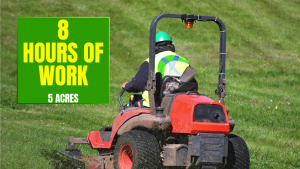
 So, what does low productivity look like? Zabaneh explains it using an ordinary worker and a series of increasingly powerful tools. Give someone a machete for eight hours, and that person can clear only so much land. Replace the machete with a weed eater, and the same worker can cover more ground in the same amount of time. Put that worker on a riding mower, and the output increases even further. But the better equipment comes with another requirement, training.
 Dr. Louis Zabaneh, Cabinet Minister
“You put that person now on a driving mower, you will see in eight hours they will be able to do ten times. But to use that lawn mower they need training again. So, they are building up through training, human capital, and you are combining the physical person, the physical being, with physical capital.”
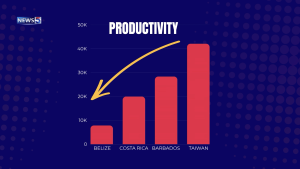
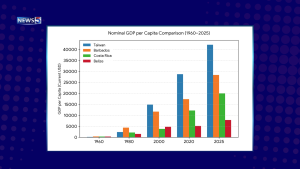
And put that same worker on a tractor, and productivity climbs dramatically. That machete-to-tractor journey helps explain why some countries have built far more economic value per person than Belize over the past sixty-five years. In 1960, Taiwan’s gross domestic product per capita stood at approximately one hundred and fifty U.S. dollars. Today, it stands at forty-two thousand, one hundred and three dollars. Barbados moved from three hundred and forty-seven dollars per person to twenty-eight thousand, three hundred and sixty-five dollars, while Costa Rica climbed from three hundred and thirty-five dollars to nineteen thousand, nine hundred and seventy dollars. Belize recorded the slowest growth among the four countries, moving from three hundred and seven U.S. dollars per person in 1960 to approximately seven thousand, eight hundred and eighty-five dollars today.

Louis Zabaneh
Dr. Louis Zabaneh, Cabinet Minister
“So we want to ask the question: what is it that was done there, compared to what was done here, or in Barbados or Costa Rica, for them to attain that level of productivity?”
Paul Lopez
“That is to say, what is the roadmap that led from the machete to the John Deere?”
 Dr. Louis Zabaneh
“Thank you very much. Absolutely.”
But Belize’s economic challenges cannot be fixed simply by handing workers better tools or putting them through training programs. Belizeans are demanding relief now. Some want the government to reduce taxes and lower the price of essential goods. Others are calling for cuts to ministerial allowances and wider austerity measures. Cabinet met on Tuesday to consider possible solutions, but ministers say every form of relief carries a cost.
Henry Charles Usher
Henry Charles Usher, Minister of Public Service
“Of course, it is always a balancing act. Some people say, let us remove the taxes on this, let us reduce, let us subsidize. But if you do that, you will take away money from other initiatives.”
 The Briceño administration is expected to introduce a cost-of-living plan in the coming weeks. That plan may offer some immediate relief, but it will not answer the larger question: how does Belize build a more productive economy? Zabaneh says that transformation must begin in the classroom. He points to curriculum reform, competency-based education, STEAM programs, improved school buildings and efforts to ensure that children are properly fed and ready to learn.
Dr. Louis Zabaneh
“Some of the things we have done in Belize is to set the foundation. Our education system was not functioning. We had to drill down and discover certain problems that we were told by teachers and educational leaders. We have curriculum overload, too many subjects. I’m up late at night dealing with lesson plans and don’t have time even for myself or family, and go to school all tensed up. Then we have to look at the way how they are teaching. That is where competency-based education comes in, the work on STEAM. Then we realize you have to have a setting where a child is not hungry. And so, those are the things our education minister has been pushing hard, fixing the school building and getting the environment for a child to perform well.”
But education is only one part of the equation. If Belize successfully trains a new generation of highly skilled and productive workers, will the local economy have jobs that match those qualifications? Will businesses pay salaries that encourage professionals to stay? Or will the country continue preparing workers who ultimately leave in search of better opportunities and a higher standard of living? Moving from the machete to the tractor may increase productivity. Keeping the person trained to operate that tractor could prove to be the much harder challenge. Paul Lopez for News Five.
Attention readers: This online newscast is a direct transcript of our evening television broadcast. When speakers use Kriol, we have carefully rendered their words using a standard spelling system.
Watch the full newscast here: