


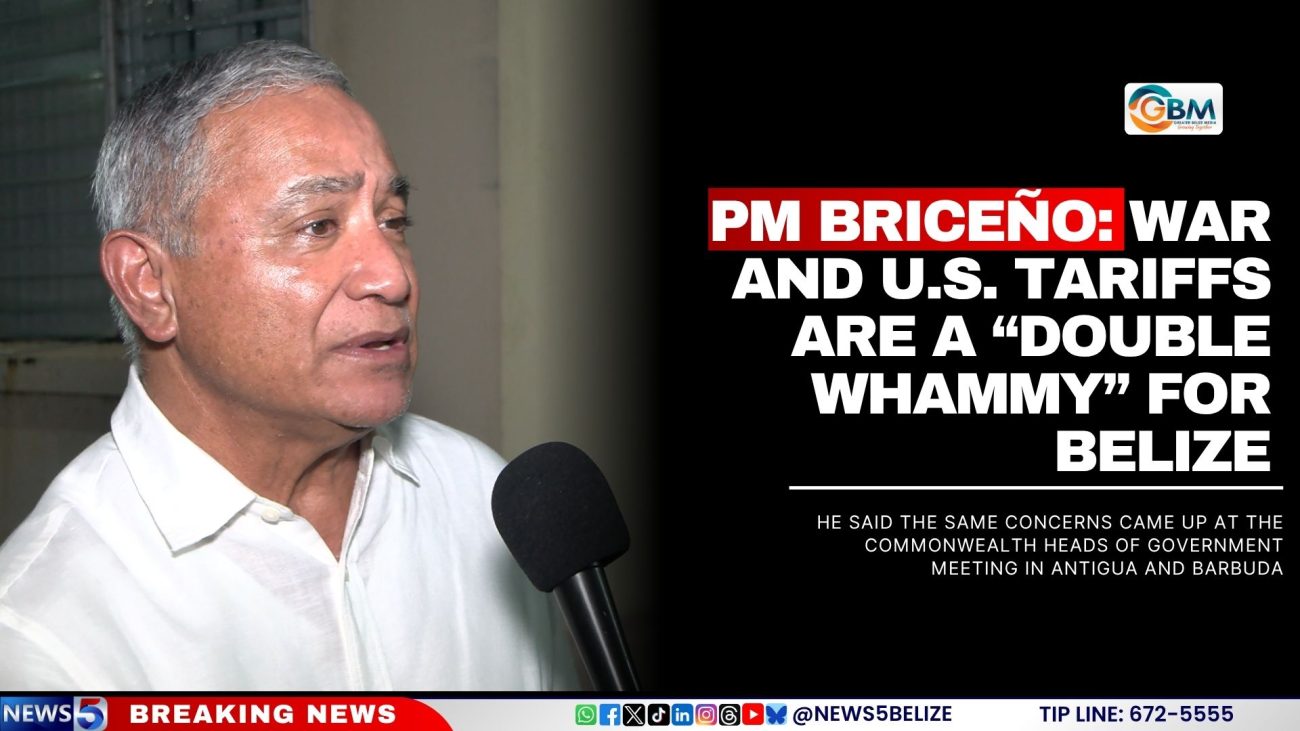
PM Briceño: War and U.S. Tariffs Are a “Double Whammy” for Belize
Prime Minister John Briceño says the wars abroad and tariffs from the United States are hitting Belize twice, and that the government expects to give up about $60 million in excise tax revenue by the end of this financial year to keep prices down.
Briceño spoke exclusively to News 5 after a cabinet meeting and a parliamentary caucus. He said the government has been working on ways to address what citizens are concerned about.
He said the same concerns came up at the Commonwealth heads of government meeting in Antigua and Barbuda, which he attended. According to the Prime Minister, leaders of some of the biggest and richest Commonwealth countries said the war has created a problem for the entire world. “Not only for Belize, but the UK, Australia, Canada, India. All these countries are having the same problem that we’re facing.”
He said small countries like Belize have it harder. “For small countries like Belize, that we have an open economy, it makes it even more difficult.”
The Prime Minister said the uncertainty from the conflict in the Middle East and the war between Russia and Ukraine has disrupted supplies and shipping lanes and caused inflation. He said the U.S. president’s tariffs add to the cost of goods, and that Caribbean countries are affected.
“So we’re getting a double whammy. The war, the conflict, and also the tariffs.”
“And so we have to find ways how we can be able to address these issues.”
Briceño said the government has been going through the budget to see where expenses can be cut, so that it can balance the budget despite the revenue it is giving up through the excise tax cuts. “We, by the end of this financial year, we are going to be foregoing about $60 million.”
He said the government is at about $30 million so far. “And if things stay as they are, the projections are we’re going to lose $60 million.”
On March 25, Briceño said the government was cutting the tax on fuel by $1.25, and noted that the tax is calculated as a percentage of the price. At that time, Statistical Institute figures reported by Greater Belize Media showed consumer prices up 0.4 percent year-on-year in January and February, with average fuel prices lower than a year earlier. Regular gasoline was down 8 percent, premium down 7.2 percent and diesel down 2.9 percent.
On April 10, the Prime Minister said the government had given up about $60 million in revenue, and that relief would be close to $80 million with the cut on premium gasoline.
“It is hurting us,” he said then.
Briceño said this week that the government has to balance giving relief to Belizeans with keeping the budget in order. “That basically what we’re doing, trying to see how we can be able to keep our price, to try to balance the budget, and at the same time, to then to be able to find some kind of relief for our citizens.”