


Real or AI? A Fake WhatsApp Chat Takes Just Minutes to Make, and It’s Getting Harder to Spot
AI is getting so advanced that fake messages and deepfakes now look so real that it is harder than ever to tell what is real from what is fake. For us, a conversation that never happened took about three minutes to make, and it looked just like the real thing. It’s no joke: last year, the Government had to warn the public about an AI-generated video of Prime Minister John Briceño, falsely promoting a suspicious investment scheme. More recently, controversial WhatsApp messages surfaced online, and questions were raised over whether they were real or fabricated. So tonight, we put AI to the test. We took a real conversation, asked a basic AI tool to fake one, and then challenged our own colleagues to spot the difference. We’re not showing you this to teach anyone how it’s done, but to warn you how easy it is. Paul Lopez has the results, and the question is whether you could tell.
 Paul Lopez, Reporting
In the age of artificial intelligence, it is not always easy to tell what is real from what is fake. For example, in October 2025, the Government of Belize had to issue a warning after someone generated an AI video of Prime Minister John Briceño telling people to invest their money for a quick return. And this is just one example of how crafty people are getting in generating deep fakes. Most recently, controversial WhatsApp messages that the person named in them says are fabricated surfaced online. Whether the messages are genuine or not, the fact is that with today’s technology, anyone with a device can create a convincing conversation that never happened. So, I did a simple test, using a very basic AI platform, to see how easy it is. To be clear we’re not showing this to teach anyone how to create fake messages. We’re doing it to warn you how easy it is, and to help you spot them.
Paul Lopez
Paul Lopez
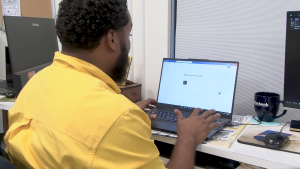
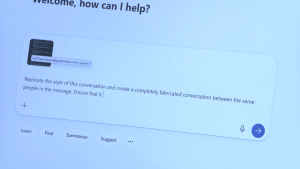
“Let me show you how easy it is to take a real conversation from WhatsApp and generate a completely fabricated conversation using AI. So, I’m using here CoPilot. It is a simple AI platform and I have a real conversation with a colleague of mine and we are talking about a work mistake. I am going to ask it to replicate the style of this conversation and create a completely fabricated conversation between the same two people in the message. I’m also going to be a bit more specific to say ensure that it is replicated as an image and looks like a real WhatsApp conversation as shown the in the image provided.”
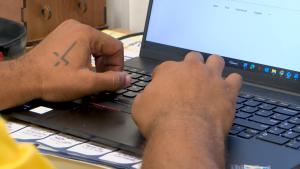
After that basic prompt, Copilot began to do its work. The result was a completely different conversation, with features strikingly similar to the original image. Copilot also included a disclaimer at the bottom of the generated image. We cropped that portion from both the original and the AI-generated image so we could put them to the test.
 Paul Lopez
“It took about three minutes and this is what AI was able to generate, or fabricate for me, and what we are going to do, is speak with a couple coworkers and challenge them to see if they can identify the real conversation from the fake conversation, purely on the WhatsApp images.”
 On my screen, conversation A is AI generated and conversation B is a genuine conversation.
Paul Lopez
“Alright Louis you have been looking at for about thirty seconds, what’s your observations?”
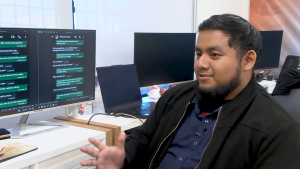
Luis Mattu
Luis Mattu, Digital Associate, GBM
“At a glance, both of them look pretty convicting. But after about looking at it in finer details, I can tell this one is AI generated. The background is in the green part of the message, but I think if something like this is circulating through Whatsapp, Whatsapp compresses the image and messes with the quality, so both of them could be convincing to be the real one.”
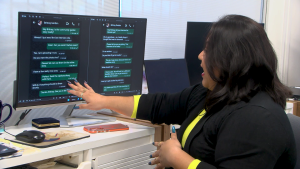
Benita Keme-Palacio
Benita Keme-Palacio, Digital Content Creator, GBM
“This one has some sort of texture within the green that changes from box to box to box. There is also some weird thing going on with the image, over on the profile picture compared to this. But interms of the text I can see, there is some blurriness compared to here. But in the icons section and everything else, it is quite accurate, especially the textured background with the doodle at the back, that is pretty accurate.”
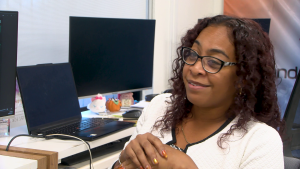
Sheena Smith
Sheena Smith, Graphics Coordinator, GBM
“The difference between the two of them are very subtle. In any event that could have been an AI generated photo that Britney used for her profile picture and if I don’t know that I would not have been able to tell and just looking at the dimensions of the picture themselves it is not something you would normally have if you don’t have a comparison to look at it. So, just based on those two, that is why I choose that one. But to an untrained eye or having nothing to compare it to, definitely I would think that is a real conversation.”
Our Graphics Coordinator makes a very important point. Most fabricated WhatsApp messages are sent without anything to compare them to. So, without a high level of curiosity, one might be tempted to quickly pass them off as genuine. It is also a fact that there are far more sophisticated AI platforms out there that can likely rid an image of all these imperfections. And as AI advances, it may become increasingly harder to tell what is real from what is fake. Reporting for News Five, I am Paul Lopez.
Attention readers: This online newscast is a direct transcript of our evening television broadcast. When speakers use Kriol, we have carefully rendered their words using a standard spelling system.
Watch the full newscast here: