



Belize’s Drinking Culture Hits Dangerous Highs; Experts Sound the Alarm
Belizeans love a good celebration, but alcohol is often at the center of it all. And now, experts say our drinking habits have hit alarming levels. Recent reports show Belize ranks among the highest in the Americas for alcohol consumption, and binge drinking? It’s practically become a weekend tradition. Health professionals warn this is fueling addiction, driving up cases of non-communicable diseases, and even contributing to domestic violence. The problem runs deep because for many, alcohol isn’t just a drink, it’s part of the culture. So, how do we tackle something so ingrained in our way of life? That’s the big question. News Five’s Paul Lopez takes a closer look.
 Paul Lopez, Reporting
Here’s something that should make us all pause, Belizeans are drinking way too much alcohol, and men are leading the charge. The numbers are alarming. In fact, the Director of Public Health and Wellness, Dr. Mellisa Diaz-Musa, says alcohol has now become a major public health concern.
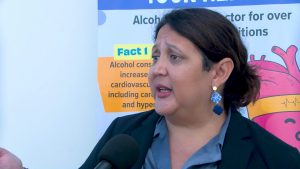
Melissa Diaz-Musa
Dr. Melissa Diaz-Musa, Director of Public Health and Wellness, MOHW
“The data from Belize showed that compared to the region of the Americas, we are graded high in terms of the amount of alcohol we drink. We also considered to be binge drinkers. One data shows that within the last thirty days, binge drinkers had more than five to six units of alcohol or drinks of alcohol in short period of time.”
The numbers tell a clear story, binge drinking has become a go-to pastime for many Belizeans, with people knocking back as many as eight drinks in a single sitting. And it’s not only adults. Many children get their first taste of alcohol before they are ten years old. Non-Communicable Disease Coordinator Doctor Lila Estephan has studied the data.

Lila Estephan
Dr. Lila Estephan, Non-Communicable Disease Coordinator, MOHW
“We have to look at our society and our culture, when we have Independence celebration, when we have a festival, when we have Agric, what do you see mostly, alcohol. You will see a lot of people drinking and it is something we encourage in our society as fun. When we are on holidays what is the first thing you see people posting on Instagram? A pina colada or a margarita and the problem is that we are seeing it in our hospitals. All these alcohol drinks are contributing to our non-communicable disease.”
 And if this were a gender showdown, men are clearly in the lead, they drink more often and in bigger quantities than women. Furthermore, at least eighteen percent of children between the ages of thirteen to fifteen reported that they have been drunk at least once. And, you don’t have to go beyond your neighborhood corner store to identify one of the primary culprits, the cheap, easily accessible, high concentration rum better known as “bad man”.
 Dr. Lila Estephan
“At the end of the day, alcoholism is a disease and an addiction. We cannot blame the consumer. But it makes it much easier and accessible for the person. You are seeing more of their income being spent on these smaller quantities that are cheaper and more potent. Like we cigarettes what we do is we are not trying to encourage the sale of individual cigarettes. Something similar will be taken for alcohol, where I foresee the “big man”, the bad man, “the bad big man”, wont be so easily accessible. So these are some of the approach we are trying to take.”
 The Ministry of Health and Wellness isn’t taking this lightly, they’re looking at the numbers with serious concern. Alcohol is a risk factor for over two hundred health conditions. Beyond the health risk, the fact is that marginalized households are spending a larger share of their income on alcohol. Furthermore, families are falling apart, with alcohol linked to fifty-five percent of intimate partner violence cases.

Cynthia Williams
Cynthia Williams, Human Development Coordinator, Gender Affairs Dept.
“Alcohol is not a cause for domestic violence or gender based violence. It is a factor. And, why is it a factor, because it inhibits persons, it limits that self control and so what happen is that they feel free to act our what are some of their own values and their understanding of what they think they have a right to do and not do.”

Esner Vellos
Esner Vellos, Director, NDACC
“Time in time when we see our clients and try to peel off that onion in trying to figure out why an individual is consuming alcohol, most of the time we see that it is because the parents are in a domestic violence situation or because the individual is in a domestic violence situation.”
From the shocking numbers to the ripple effects on health and society, one thing is clear, those fighting against excessive drinking have a tough battle ahead. Why? Because they’re up against big businesses with deep pockets and massive marketing campaigns. Finding a real solution is easier said than done. Reporting for News Five, I am Paul Lopez.