


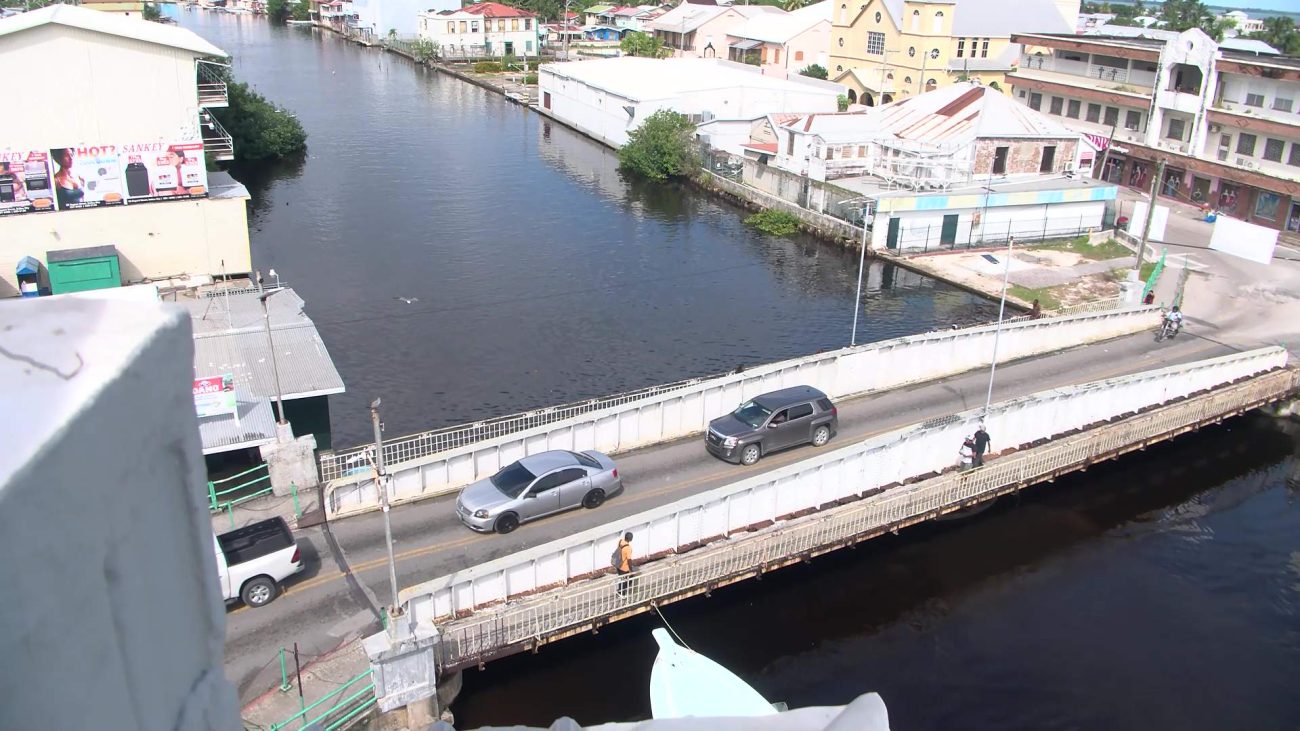
Swing Bridge: 103 Years of Belizean History!
In the new year, Belizeans will begin preparing to say farewell to one of the country’s most recognizable landmarks. The Belize City Swing Bridge, installed in 1923, stands as a living piece of history and remains the last manually operated swing bridge in Central America. Now, after more than a century of service, the iconic structure is set to undergo long-awaited reconstruction. Shane Williams looks at its historic significance.
 Shane Williams, Reporting
The Swing Bridge dates back to the early twentieth century, constructed at a time when Belize City was rapidly expanding. According to historian Nicholas Sanchez, the bridge, which was initially known as the Grand Belize Bridge, was brought from England and installed by the Jefferson Company of New Orleans, which was already involved in major infrastructure works across the city.
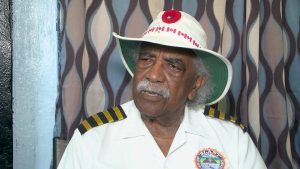
Nicholas Sanchez
Nicholas Sanchez, Historian
“At the time there was the Jefferson Company of New Orleans were working in Belize doing a number of things, the courthouse – rebuilding the courthouse, dredging and filling in Memorial Park and of course building the Belize Store, which was eventually called the Paslow Building and putting in the Swing Bridge that was brought over from England. And it was – they called swing bridge because the others were fixed pan. And this was one that swung and that was done on the 1922, April eleventh, a Tuesday.”
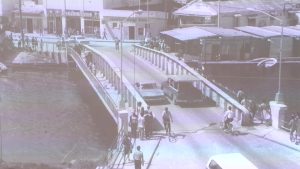
For decades, the Swing Bridge served as the only roadway connection between the north and south sides of Belize City. Its daily operation became part of the city’s rhythm, opening twice a day to accommodate river traffic. Fire engines were strategically positioned on both sides during openings, ensuring emergency response was never compromised while the bridge was swung.
 Nicholas Sanchez
“They used to take a fire engine. We had some beautiful old La France fire engines, and they would take one over the bridge and they would park it by Mule Park should in case there was a fire on the south side while the bridge was being swung. They wouldn’t have to close it quickly. So the bridge was there, it was swung at five-thirty in the morning and five-thirty in the evening.”
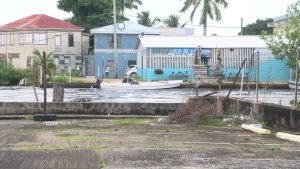 As part of the upcoming reconstruction, which is expected to take more than two years, a temporary crossing will once again be installed at the corner of North Front Street and Hydes Lane. This is not without precedent. Similar temporary bridges were used in the past whenever the Swing Bridge was taken out of service, particularly following damage from powerful hurricanes.
Nicholas Sanchez
“They had at the Hydes Lane over across – there was a crossing there while it was being repaired while the bridge was being repaired. And that was there for a while then they repaired the bridge and then after that was repaired, they removed that crossing there and put the swing bridge back in action.”
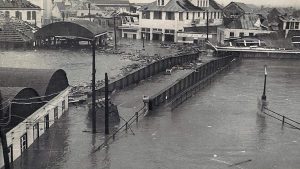 But the history of the Swing Bridge is not without tragedy. In the aftermath of Hurricane Hattie, while the bridge was undergoing repairs, a temporary pontoon bridge was installed. On June 14th, 1962, that pontoon bridge capsized with more than a dozen people, sending them into the Haulover Creek. Several lives were lost in what remains one of the darkest days in Belize’s history. It was an incident so serious it prompted a Commission of Inquiry. Today, while a marker near the Swing Bridge shows how high the floodwaters rose during Hurricane Hattie, there is no memorial dedicated to the victims of that tragic pontoon bridge accident. Despite its hardships, the Swing Bridge holds deeply personal memories for generations of Belizeans.

Francis Fonseca
Francis Fonseca, Minister of Foreign Affairs, Foreign Trade, Education & Culture
“I can myself recall watching this what I then describe as a ceremony, to me it was a ceremony as a small child, with awe dozens of times as a child growing up in Belize City.”

Prime Minister John Briceño
Prime Minister John Briceño
“News flash, I’m from orange Walk Town but when I came to sixth form I used to watch it also Foreign Minister. I used to live on Far West Street, right off George Street. So I used to walk there or on my bicycle. It was always quite a spectacle to watch, especially in the evenings when I was coming back from school.”
The Swing Bridge’s legacy extends beyond Belize. In 1980, it made its Hollywood debut in the Christopher Walken film The Dogs of War, placing the historic structure on the international stage. As discussions continue about the bridge’s future, one thing is clear: it cannot simply be discarded. While it cannot be relocated like the old Haulover Bridge, many believe the Swing Bridge deserves preservation, perhaps as a museum piece so future generations can understand its place in Belize’s story. Shane Williams for News Five