


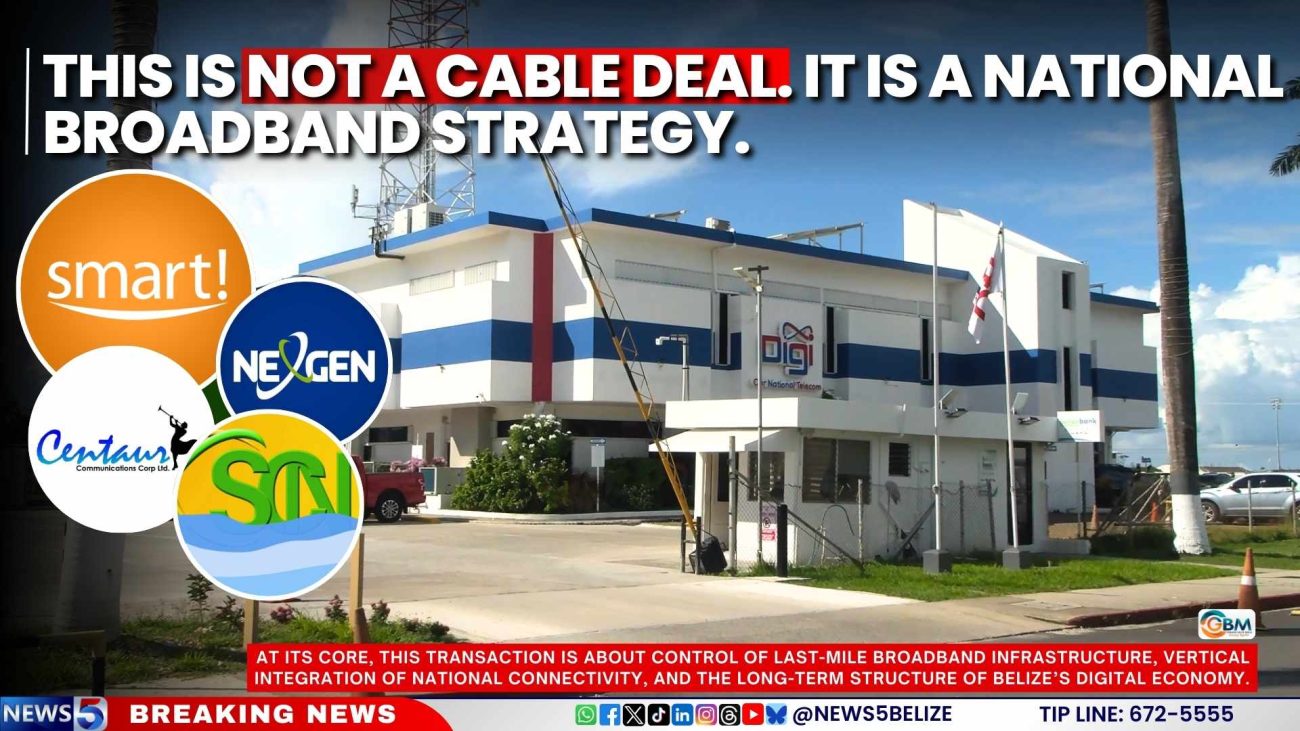
This Is Not a Cable Deal. It Is a National Broadband Strategy.
By Dr. Andrew E. Trumbach
Finance Executive and Academic
andrew@trumbach.com
In recent months, significant public attention has focused on the proposed acquisition by BTL of several cable and broadband operators, including Speednet Communication limited (Speednet), Centaur Communications Limited (Centaur) , and CTI/NexGen. Much of the debate has centered on concerns about competition, monopoly, governance, and transparency. While these are legitimate issues, this framing misses the deeper strategic and economic reality of what is truly at stake.
If approached properly, this transaction represents the creation of a national broadband infrastructure platform—the foundation for Belize’s continued evolution into a modern digital economy.
The real risks in this deal are not strategic. They are practical. In any major infrastructure consolidation, opacity erodes trust, while disclosure and clear governance build confidence. For that reason, BTL should be prepared to present a clear implementation framework addressing governance, conflicts of interest, competition concerns, and regulatory oversight in policy-credible language. Regulators, for their part, should clearly articulate their role in ensuring that consolidation does not harm consumers or innovation.
It would also be helpful for the company to publish a public transaction summary explaining the structure of the deal, why acquisition is more efficient than building from scratch, and what the post-transaction investment and integration plan will be.
At its core, this transaction is about control of last-mile broadband infrastructure, vertical integration of national connectivity, and the long-term structure of Belize’s digital economy. It is about investment and modernization. It is about achieving scale to deliver better service quality at lower unit cost. And it is about long-term national competitiveness.

Based on what is publicly known, the reported purchase price appears financially plausible. Using standard telecom valuation methods, the implied transaction multiple appears to fall within a reasonable range for infrastructure and broadband assets. That suggests the economics of the transaction are, at least in principle, defensible.
It has been publicly stated that Moore Belize LLP was engaged to provide valuation services. The firm is affiliated with the Moore Global network, a US$5 billion network with 37,000 professional staff, and its principal is licensed in the United States. As a regulated professional firm, it is subject to independence and professional standards. While the details of the valuation are not public, releasing a high-level summary of the methodology and conclusions—without disclosing proprietary information—would go a long way toward strengthening public trust in the process.
Globally, the telecommunications and cable industries have undergone a profound structural shift. Today, broadband connectivity is the core competitive product. Traditional television services are increasingly a bundle component rather than the main revenue driver.
Demand for broadband has surged due to remote work, cloud computing, video streaming, online education, gaming, and data-intensive applications. The real strategic value now lies in who owns the access network into homes and businesses and who controls the customer relationship for data services.
In the United States, companies like Comcast, AT&T, and Verizon already made this transition. In the Caribbean, regional platforms such as Liberty Latin America have done the same. Belize is simply reaching the same structural inflection point.
Comcast, originally a cable television company, has reinvented itself as a broadband-first connectivity and technology platform. Broadband is now its core profit driver, while television has become a secondary and bundling product. The company has layered on mobile services, streaming platforms, home security, and enterprise connectivity—built on its control of last-mile access.
AT&T and Verizon, historically wireless-centric companies, have pursued scale and convergence by integrating fiber networks, fixed broadband, and enterprise services. Their strategies reflect a simple industrial logic: owning the access network is the strategic choke point of the digital economy.
The consolidation of Cable & Wireless Communications and Columbus Communications provides a strong regional precedent for telecom and cable platform roll-ups in the Caribbean. That transaction combined mobile, broadband, and cable assets across multiple markets into a single scaled operating platform, which was subsequently acquired by Liberty Global and now operates as part of Liberty Latin America. This history demonstrates that well-executed regional consolidation strategies in Caribbean communications infrastructure can create substantial strategic and financial value.

The lesson from the region is clear: small, fragmented markets cannot efficiently support multiple overlapping, sub-scale broadband networks. Over time, fragmentation leads to duplicated capital spending, higher costs for consumers, inconsistent service quality, and underinvestment in upgrades. Belize is not immune to these economic realities.
BTL already owns the national backbone and international bandwidth infrastructure. The missing piece of the value chain is control of last-mile access to homes and businesses. Acquiring this is a classic case of vertical integration—and one that can materially improve the economics and performance of the national network.
This is not a bet on the future of cable television. Those services are in long-term decline everywhere. The real strategic asset is the installed broadband customer base and the access network, combined with the ability to offer integrated, bundled services on a single platform.
The real risks in this transaction are not strategic. They are operational and regulatory. BTL will need to execute integration carefully, particularly around billing systems, customer transitions, and service continuity. It must also work constructively with regulators to ensure that consolidation leads to better service, continued investment, and fair outcomes for consumers.
History shows that many telecom consolidations are strategically sound—but succeed or fail based on execution quality and governance.
In the end, this transaction is not really about television or cable, or even about competition between companies. It is about whether Belize will build the digital infrastructure it needs to compete, grow, and participate fully in the modern digital economy.