


“Budgeting for Belizean Prosperity”: Briceño Tables $1.9 Billion Budget
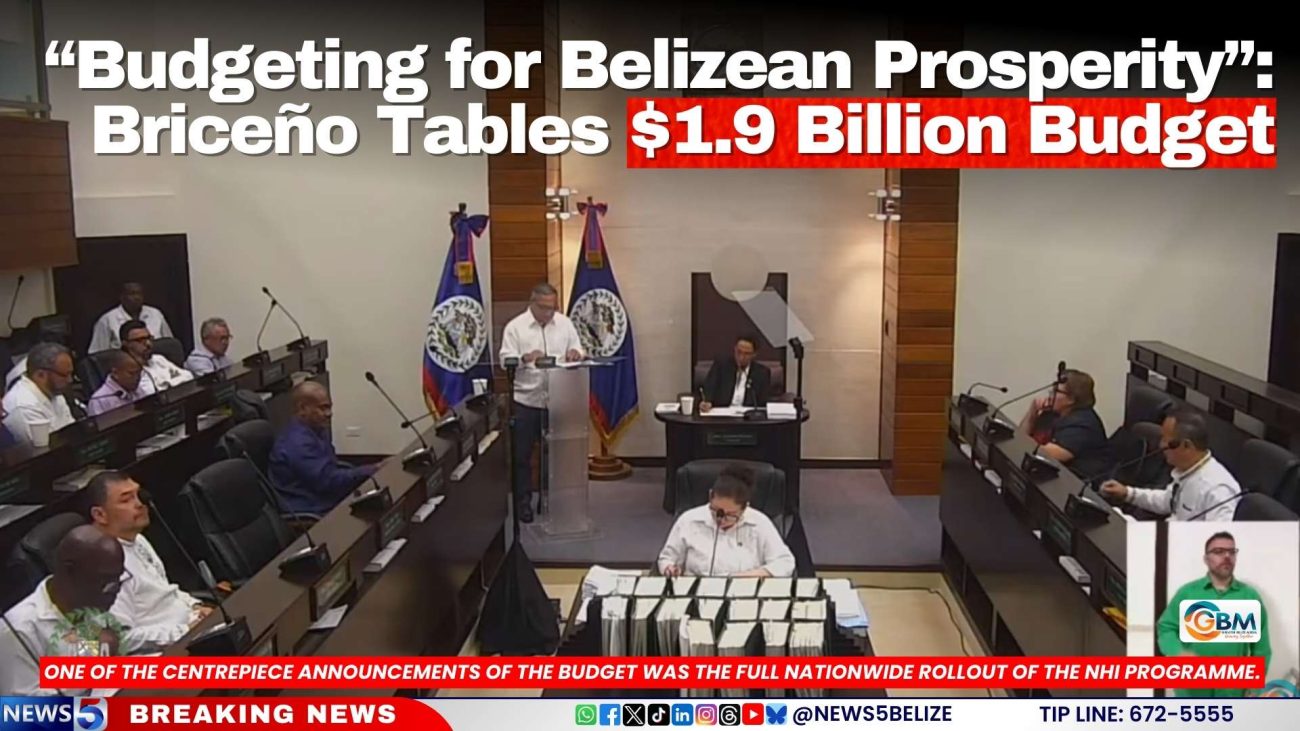
Prime Minister John Briceño delivered his FY 2026/2027 budget speech before the House of Representatives in Belmopan today, themed “Budgeting for Belizean Prosperity.” The proposals total $1.902 billion in expenditures with a record $606.8 million directed to capital investment, representing 32% of total spending. Revenues and grants are projected at $1.792 billion, an increase of $139 million or 8.5% over the prior year. The government projects a primary surplus of 1.07% of GDP and an overall deficit of -1.49% of GDP.
Against a backdrop of global economic uncertainty, the Prime Minister pointed to strong domestic fundamentals. Unemployment fell to a historic low of 2.0% in 2025, inflation eased sharply to 1.1%, and the economy grew by 1.9% last year, with 2.3% projected for 2026. Central Bank reserves stand at $1.1 billion, and the public debt, once above 130% of GDP, has been cut to 66.6%. The government’s 15,000 public officers, teachers, and security personnel will receive a further 4% salary increase worth $28.5 million annually, following last year’s 4.5% increase, bringing total wage and pension commitments to $78.7 million for the year.
On healthcare, the National Health Insurance programme has been fully rolled out nationwide, with the Cayo District becoming the final region to come on board. Once its 80,000 eligible residents are registered, total NHI users will reach 325,000. The budget allocates $57 million to NHI, $52.5 million to Central Medical Stores, and $33.7 million for operational support of the KHMH. A new state-of-the-art hospital in San Pedro Town, funded by a Taiwan grant, received $19.1 million in the capital budget.
The infrastructure program is among the most ambitious ever undertaken. The George Price Highway upgrade, spanning Belize City to Belmopan, is now active across all three lots, with Lot 1 set to begin civil works as early as April 2026 using a US$34.5 million Caribbean Development Bank loan, and Lot 3 already underway since January, financed by the Kuwait Fund. Two Belize City bridges are also being replaced: the Belcan Bridge, funded by Taiwan at BZ$20 million, begins construction in April, while the historic Swing Bridge replacement, backed by BZ$28 million in Japanese grant aid through JICA, gets underway at the end of March.
In education, the government’s Upliftment Project will expand to 27 secondary schools covering over 14,000 students, up from just 947 students when it launched in 2022, a growth of over 1,000%. All students in government secondary schools will now attend for free, and 83% of all secondary students nationwide will receive some form of financial assistance. The US$125 million Millennium Challenge Corporation compact with the United States was confirmed to continue, directing US$53.8 million to education and US$41.7 million to energy.
On energy, the government outlined plans to add over 100 megawatts of new renewable capacity within two to three years, through solar investments backed by the Saudi Fund for Development and a private sector solar programme supported by the IFC. The recently nationalized hydroelectric facilities, rebranded as Hydro Belize Limited, were successfully floated to local investors, with the share offer oversubscribed and raising $134.8 million. On fiscal reform, the Belize Tax Service is to be transformed into a Semi-Autonomous Revenue Authority, electronic invoicing will be introduced, and the government has set a target of reducing public debt below 50% of GDP by 2030.
We’ll further break down the Prime Minister’s budget presentation tonight on News 5 Live at 6 o’clock.

NEWS 5 LIVE – AUDIENCE SURVEY 2026