



A Race Redefined: Ruta Maya Teams Stand Up for Tradition
For twenty-nine years, the La Ruta Maya Belize River Challenge has been more than a race, it’s been the heartbeat of March. Four days of grit, pride, and pure Belizean spirit. Families line the riverbanks, fans pack the bridges, and paddlers fight for every inch of the Belize River. But this year, something felt off. Tension started building long before the final leg. A late decision to change the finish line sparked debate and stirred real frustration. Many paddlers felt tradition was being pushed aside. So, on Day Four, teams weren’t just racing to the end, they were defending the identity of La Ruta Maya. What happened next turned a routine finish into a powerful show of unity and history in motion. News Five’s Paul Lopez reports.
Paul Lopez, Reporting
 As the paddlers of the twenty-ninth La Ruta Maya Belize River Challenge closed in on the official finish line at Grand Resort, you could feel the tension tightening with every stroke. What started as a race was moments away from turning into something much bigger, an unexpected show of unity and quiet protest. After one hour and fifty-seven minutes of grinding through that final stretch, PACT on Trak powered across the finish line first. It was a hard-earned win, driven by experience, teamwork, and pure determination. But the real story was still unfolding on the water…

Francis Usher
Francis Usher, Manager, Pact on Trak
“Amado has paddled the race twenty-two times, and he has won it now thirteen times. Christian has paddled the race seven times and Enrique has paddled six times. This is the first time they’ve paddled together, but they are all very experienced. There was a lot of experience and what we had to do was put it all together as a team, and I think we effectively did that when we started training in November.”
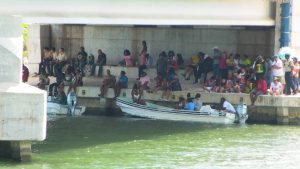 A small but proud crowd gathered inside Haulover Square to welcome the paddlers. Nearby, Grand Resort’s VIP section delivered a polished, high‑end view of the finish. But most fans chose the shaded area under the Haulover Bridge, a free spot prepared days earlier by the Ministry of Infrastructure Development and Housing. There, in the heat, they waited to witness a historic ending.
 As teams crossed the new finish line, something unexpected unfolded. One by one, paddlers quietly refused to stop. They spun their canoes around and headed back toward the traditional endpoint under the BelCan Bridge. They waited until nearly two dozen teams gathered at the mouth of Haulover Creek. Then, with fans cheering them on, they pushed off together. Their bodies were exhausted after four days on the river. There were no trophies at BelCan, no cash prizes, no official ceremony. But it didn’t matter. Hundreds of supporters packed the area around the Civic Center and the bridge, ready to welcome them home.
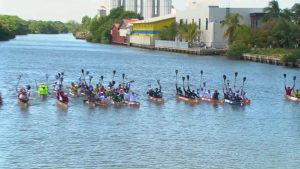 United, twenty-six canoes stretched across the creek, paddling in a powerful show of solidarity. From above, it was quite a spectacle, athletes making a clear stand for tradition. As they neared the bridge, paddlers lifted their paddles high, Belizean flags waving at their sterns. One of the strongest voices calling for this symbolic gesture was Black Orchid’s Carlos Linares. His team went on to place third overall.
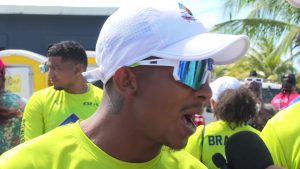
Carlos Linares
Carlos Linares, Black Orchid, Third Place Winner
“A lot of people think we were going to talk. But we walk this — we nuh talk it.”
Finishing at BelCan meant giving up the free food and drinks waiting back at Haulover Square. But longtime fan Raynard Humphreys made sure every protesting paddler had what they needed.

Raynard Humphreys
Raynard Humphreys, La Ruta Maya Supporter
“It didn’t take me much everyone jumped on board. So now this is just a solidarity thing for me. We are contributing the prizes for everyone who is out here. We know they are forfeiting their free meals. So my job is to make sure all these guys get something to eat. And hopefully this sets a precedent for the future, so whoever comes behind knows this is what these guys need. People need to look out for the paddlers.”
Elvin Penner, Vice President of the Belize Canoe Association, felt immense pride as he watched paddlers take their stand.

Elvin Penner
Elvin Penner, Vice President, Belize Canoe Association
“The voice of the paddlers was so loud, it was deafening, without them saying anything. Zero words. But the silence from the organizers was deafening too. The paddlers made a decision; they stood together. We had paddlers from around the world who saw the movement and realized if we don’t take a stand now, where is this race going?”

And that’s the question now confronting the future of Belize’s most iconic river challenge. When the dust settles, will organizers and paddlers be able to come together to protect the race, its spirit, and its tradition?
Francis Usher
“The BelCan, having the crowd come out and having the paddlers come together, was symbolic. I think it was a great thing for Belize City. Now moving forward, we have to pivot and say: how can we all work together?”
Reporting for News Five, I am Paul Lopez.
Attention readers: This online newscast is a direct transcript of our evening television broadcast. When speakers use Kriol, we have carefully rendered their words using a standard spelling system.