

Six Years Later: How COVID-19 Shook Belize and Changed the World
Six years ago, the world changed. On March 11, 2020, World Health Organization Director-General Dr. Tedros Adhanom Ghebreyesus made an announcement that reverberated across every continent, every economy, and every household on Earth: COVID-19 was a pandemic.
For a small nation of about 400,000 people perched at the edge of the Caribbean, dependent on tourism and heavily reliant on cross-border trade with Mexico, the announcement was the beginning of a crisis unlike anything in living memory.
The First Days
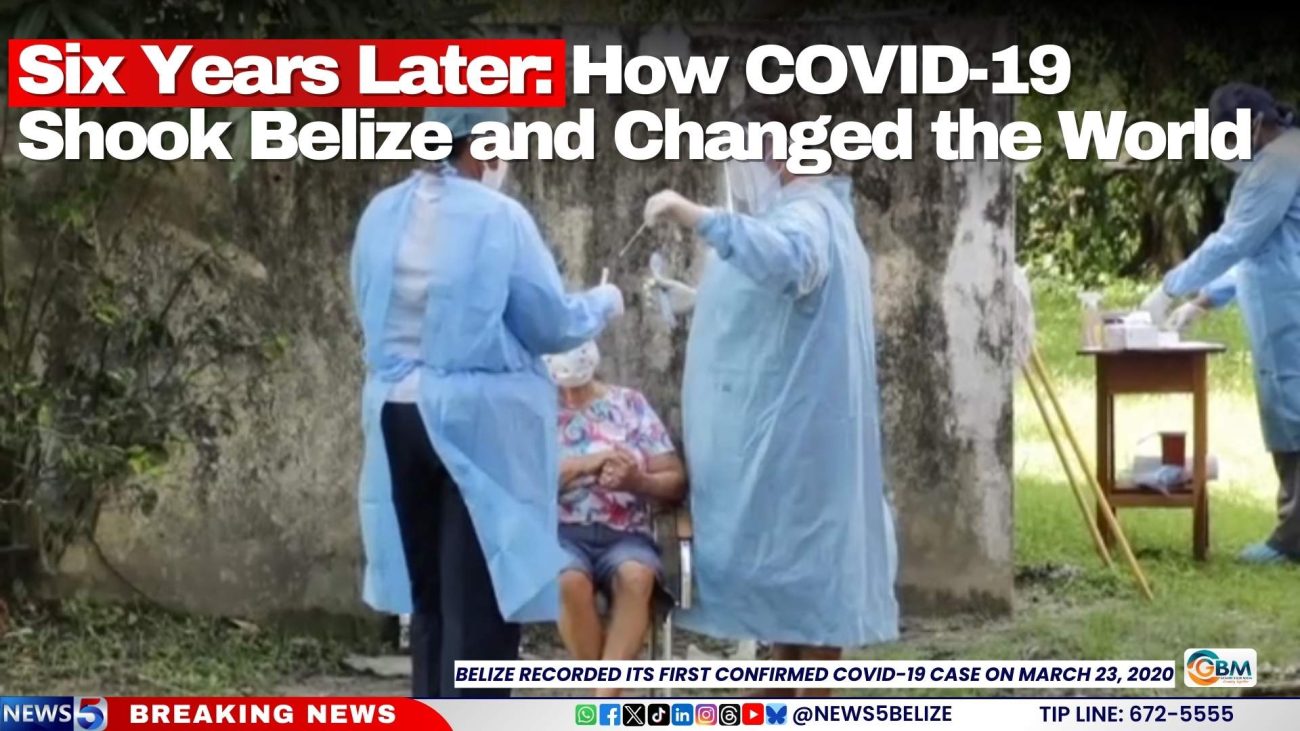
Twelve days after the WHO’s declaration, Belize recorded its first confirmed COVID-19 case on March 23, 2020…a Belizean woman who had returned to San Pedro Town from Los Angeles, California. Within two days, a second case was confirmed. By early April, the country had recorded its first death.
Then Prime Minister Dean Barrow acted swiftly. A State of Emergency was declared for the island of Ambergris Caye (Belize’s tourism jewel) and mandatory quarantine was imposed on residents. Non-essential workers were barred from the streets. The government shut the country’s borders, grounding the tourism industry that contributed approximately 40 percent of GDP and 60 percent of foreign exchange earnings, according to the International Monetary Fund.
In those early months, the containment effort showed results. By the end of July 2020, Belize had recorded just 48 confirmed infections and 2 deaths, as documented by the United Nations Development Programme (UNDP).
But the calm would not hold. A major domestic outbreak erupted in the summer of 2020, spreading rapidly through the country’s northern districts. By October, Belize had surpassed 2,400 confirmed cases. The IMF would later note that Belize ended up with one of the highest case and death rates per capita in the Caribbean.
How COVID-19 Shook Belize and Changed the World
Tourism’s Collapse
No sector suffered more than tourism. Tourist arrivals plummeted by 72 percent in 2020, according to IMF data, devastating hotels, tour operators, restaurants, and the thousands of Belizeans employed in the industry. Belize’s GDP contracted by a staggering 14.1 percent that year. (One of the steepest economic contractions in the country’s history)
The government responded with emergency social programs. The Belize COVID-19 Cash Transfer (BCCAT) provided direct financial support to vulnerable households. Unemployment relief funds were disbursed, food assistance was expanded, and existing programs like the Building Opportunities for Our Social Transformation (BOOST) initiative were scaled up, according to UNDP’s socioeconomic impact assessment.
Public debt soared. The IMF projected it would reach 133 percent of GDP by 2021, a burden that would take years to address. At the same time, the country postponed its national census, diverting those resources toward emergency funding.
Belize’s phased reopening to international tourism began on August 15, 2020, with mandatory testing for all arriving visitors. The cautious restart was among the first in the region, signaling the government’s determination to revive the lifeblood of the economy even as cases remained elevated.
The Health System Under Strain
How COVID-19 Shook Belize and Changed the World 3
Belize’s healthcare infrastructure entered the pandemic already stretched. The Pan American Health Organization (PAHO/WHO), which had been working with the Ministry of Health and Wellness since 2016 to strengthen laboratory capacity, quickly became a central partner in the country’s response.
By January 2021, PAHO/WHO had facilitated the procurement of over 50,000 PCR and rapid antigen test kits, along with 250,000 laboratory supplies, supporting nearly 63,000 tests. The organization also led Belize’s participation in the National COVID-19 Task Force and coordinated risk communications in English, Spanish, Garifuna, and Mopan Maya.
International support proved critical. A US$1 million fund from the Government of India through the India-UN Development Partnership Fund helped procure medical equipment including patient monitors, incubators, delivery beds, and EKG machines. Mexico donated 400,000 doses of the Oxford-AstraZeneca vaccine. The UAE contributed 10,000 doses of the Sinopharm vaccine.
Belize launched its vaccination campaign and, despite limited resources, became fourth-fastest in Central America in vaccination rollout. By early June 2021, the country had administered over 73,000 doses, with the majority coming through the COVAX mechanism…the global initiative for equitable vaccine access.
Recovery, Resilience, and Remaining Gaps
Six years on, Belize has largely recovered. International overnight visitor arrivals surged by approximately 70 percent in 2022, reaching around 371,000…a sign of tourism’s resilience. The IMF’s projection that GDP would only return to its 2019 levels by 2025 proved broadly accurate, with the economy gradually stabilizing.
Yet the pandemic exposed structural vulnerabilities that have not been fully addressed. Healthcare capacity remains a concern. The over-reliance on tourism as an economic engine (a weakness the pandemic laid bare) has spurred ongoing discussions about economic diversification, though progress has been incremental.
The social cost is harder to measure. Jobs were lost, businesses closed, and the mental health toll on Belizean communities, particularly in service-heavy areas like San Pedro and Placencia, remains an open wound. Educational disruptions during school closures affected an entire generation of students, with long-term consequences still unfolding.

Sponsored by RF&G Insurance
The Global Legacy of COVID-19
What happened in Belize was a microcosm of what happened everywhere. Globally, COVID-19 killed millions, upended economies, accelerated remote work, exposed health inequalities, and permanently altered the relationship between governments and citizens.
The pandemic delivered undeniable triumphs. The development of mRNA vaccines, effective against severe disease and death, within 11 months of the virus being genetically sequenced was described by experts as the fastest vaccine development in human history. Diagnostic testing, genomic surveillance, and global data-sharing systems were all dramatically accelerated.
Six years on, the WHO reflects on a mixed legacy. In February 2026, the organization noted that meaningful steps had been taken — including the adoption of a historic WHO Pandemic Agreement in May 2025, the creation of the Pandemic Fund (which has distributed over US$1.2 billion across 98 countries), and stronger genomic surveillance in over 110 nations. However, WHO warned that these gains are fragile, threatened by shifting political priorities and declining investment in public health.