


‘A Thinking City’: Taiwan’s Vision for AI-Powered City Life
The future of city life is no longer theoretical. It is being tested, built and, in some cases, already deployed. This week, News 5’s Benita Keme-Palacio joined thousands of visitors in Taipei, Taiwan, for the 2026 Smart City Smart City Summit & Expo (SCSE) and Net Zero City Expo.
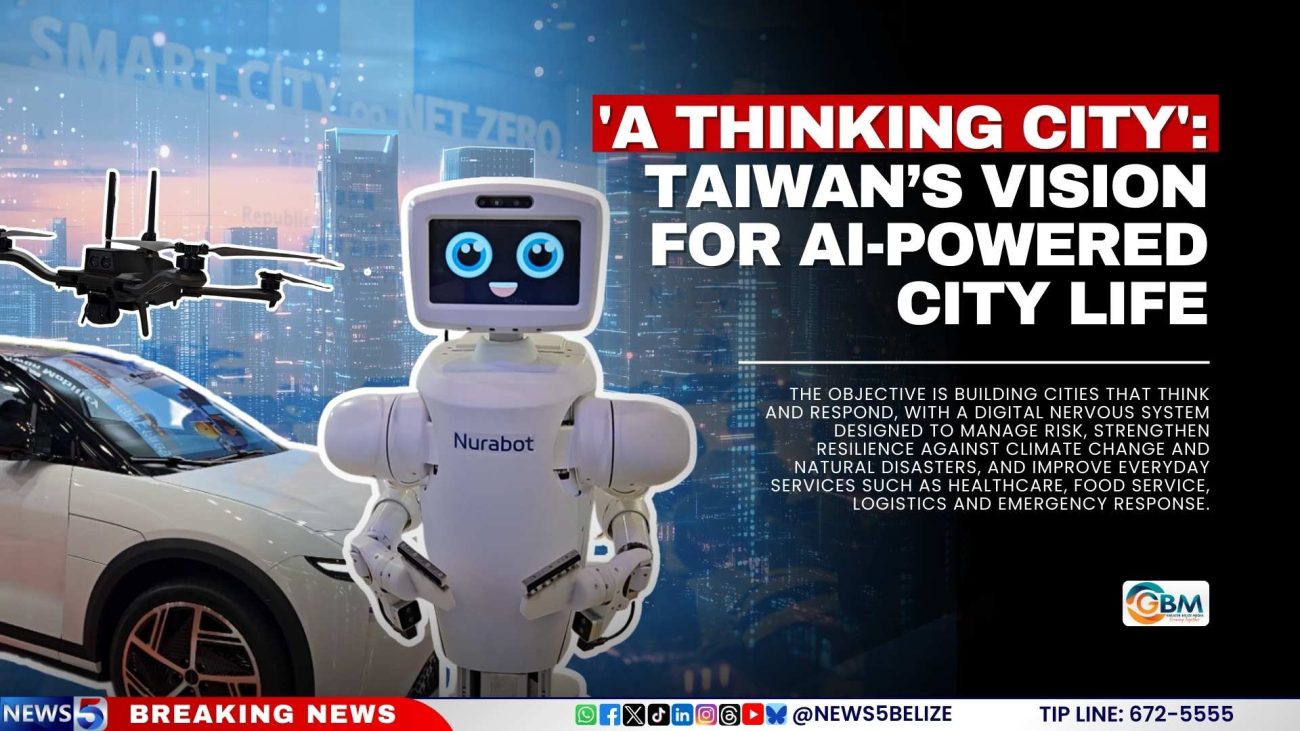
The summit has drawn representatives from 174 cities across 53 countries, and with more than 2,250 booths and over 70 forums, there is a clear focus behind it all. It is about pushing artificial intelligence beyond support roles and into the core of a modern city. The objective is building cities that think and respond, with a digital nervous system designed to manage risk, strengthen resilience against climate change and natural disasters, and improve everyday services such as healthcare, food service, logistics and emergency response.
AI Moves From Tool to Authority
The most striking part of the 2026 summit is how artificial intelligence is being positioned at the AI City Pavilion, which is the centrepiece of the 2026 SCSE. Organisers call it the world’s first integrated “Sovereign AI” architecture. Developed by tech giants like ASUS and Foxconn, it boasts a five-layer digital nervous system designed to give a city its own independent brain.
It starts with the “Sovereign Computing Layer”, which is considered the raw muscle of AI servers, and moves up to locally trained models that understand a city’s specific needs without sending data abroad.
For a developing nation like Belize, this means the ability to build high-tech infrastructure while keeping full control over its own national data.

‘A Thinking City’: Taiwan’s Vision for AI-Powered City Life
Net Zero Becomes a Non-Negotiable
Alongside AI, climate policy has moved from ambition to active enforcement. The Net Zero City Expo runs parallel to the main summit, but the two are tightly linked.
During Tuesday’s opening ceremony, Taiwanese leaders spoke on the island’s 2050 Net Zero Pathway now being rolled out across key sectors, including transport, energy and urban planning. The policy is aimed at driving sustainable development while achieving net-zero emissions, with practical systems already in place such as smart grids, renewable energy integration, low-carbon supply chains and real-time environmental monitoring tools.
Digital twins and 5G networks are also being integrated into infrastructure planning. The vision is to build cities that monitor conditions, forecast risks and respond more quickly, all in real time.
The approach reflects growing global pressure. More than 150 countries, including Belize, along with hundreds of cities and companies, have committed to net zero targets. Urban areas remain central to that effort, given their role in emissions and energy use.
This year’s exhibition is adding to the Net Zero discussion by pushing governments and industries to move toward systems that can be deployed and scaled.
‘A Thinking City’: Taiwan’s Vision for AI-Powered City Life
From Showroom to Street-Level Reality
What sets this year apart is the focus on real-world use. The summit is shifting from polished concepts and toward practical deployment.
Robotics is one example. From four-legged mechanical hound robots to gliding drones, these machines are designed to improve and handle the heavy lifting of logistics, healthcare, and disaster response by tracking atmospheric monitoring and chemical detection at disaster sites.
Firefighting robots and autonomous mobile systems are also on display, developed under the goal of “protecting those who protect us.” These are deployment-ready machines designed to assist during fire emergencies by helping to speed up response efforts while improving safety for both victims and frontline firefighters. Some are equipped to assess dangerous conditions before human responders are sent in.
When it comes to transportation, Belize may be on the cusp of a new transportation phase in the coming years. The recent rollout of the e-mobility pilot project in Belize, complete with electric buses and charging depots, shows the country is taking its first steps toward a cleaner, smarter transit system.
However, at this year’s Summit, Taiwan displayed the next stage of transportation evolution by moving beyond just “electric” to “intelligent”. Using AI-optimised bus routes and “Mobility as a Service”, the technology uses predictive algorithms based on real-time demand, even for those needing transportation in rural areas.

‘A Thinking City’: Taiwan’s Vision for AI-Powered City Life
The Ultimate Safety Net
Perhaps the most vital aspect of the summit is the focus on safety. In a region prone to earthquakes and typhoons, Taiwan’s “smart” label is a badge of resilience. The event features autonomous robots and AI-powered drones capable of mapping disaster zones in a heartbeat.
According to one of the exhibitors, these machines feed live data into predictive algorithms that can anticipate flood risks or structural collapses in seconds.
While Belize faces its own seasonal battle with hurricanes and coastal erosion, this technology presents a game-changing potential. The ability to use AI for real-time atmospheric monitoring and rapid damage assessment could transform how the country protects its coastal communities.
This moves the conversation from disaster recovery after a storm to intelligently outmanoeuvring the elements for countries like Belize. Organisers said that the point of a smart city is not to create a digital playground but rather to build a ‘high-tech lifeboat’.
Is Belize Ready for Smart City Technology?
While Taiwan demonstrates the next level of smart city technology, other nations, including Belize, are taking note and exploring how these innovations could be adapted to meet their own urban challenges.
A delegation from Belize is presently on the ground for this year’s summit. Belmopan Mayor Pablo Cawich, attending alongside Belize’s Ambassador to Taiwan, Katherine Meighan, said the visit is about learning what could work at home.
“I did get a lot of ideas and exposure to technology that can help our municipalities and our country. This enabled me to start implementing some new systems that we are trying to push for in Belmopan. So, I am here again to try and see what ideas we can get to try and take back,” he said.

‘A Thinking City’: Taiwan’s Vision for AI-Powered City Life
The possibilities are promising for Belize, but turning them into reality will first require laying the groundwork. On whether Belize is ready, Cawich acknowledged the challenge of change but said it’s a matter of pushing past it.
“I believe the country is ready… It’s a reality of resistance to change, but I think the people are ready,” Cawich said. “We have to remain hopeful that people will embrace them and will see the benefits and will have higher expectations as we move forward.”
Infrastructure, digital systems, and public awareness will all play a role before these levels of technologies could be introduced in Belize.
Over the next four days, SCSE 2026 will continue to demonstrate how AI and sustainability can work together to become the backbone of smarter, more efficient and resilient cities.
We’ll have daily updates on the summit.

‘A Thinking City’: Taiwan’s Vision for AI-Powered City Life