


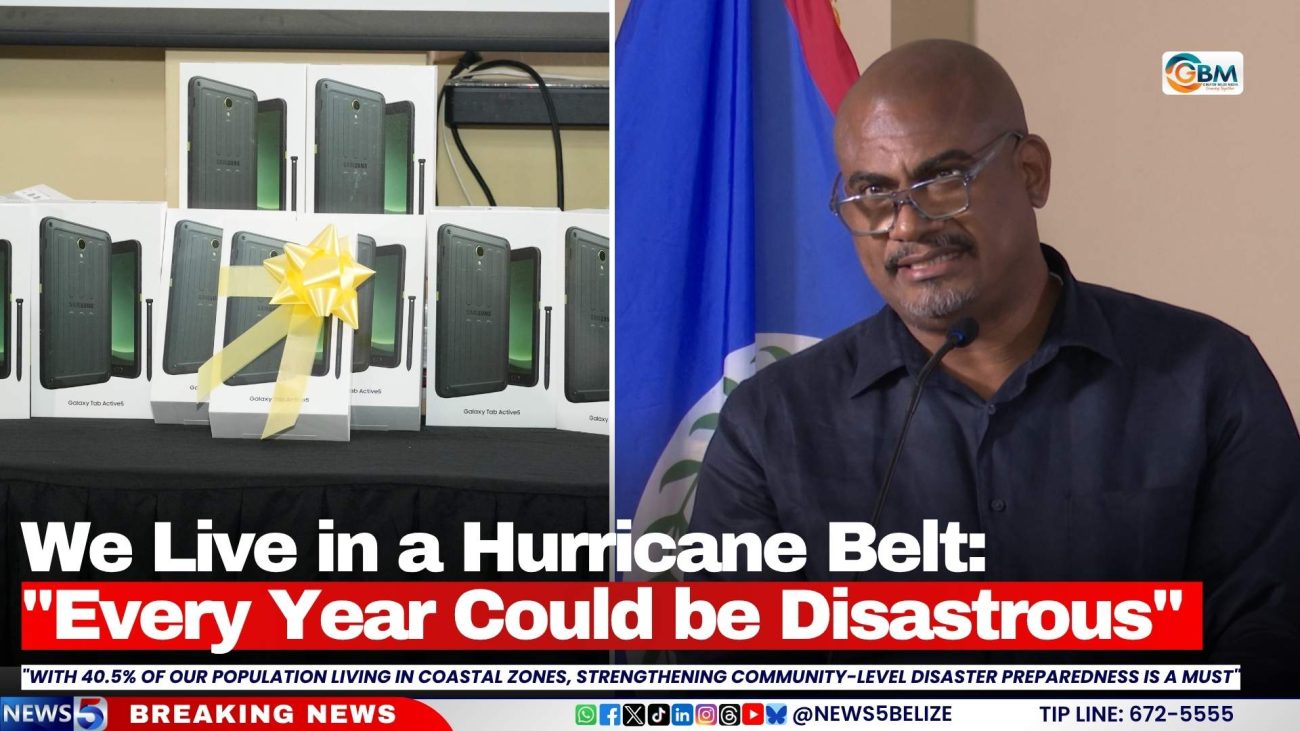
We Live in a Hurricane Belt: “Every Year Could be Disastrous”
Belize’s disaster response got a digital boost today with the official handover of 30 Samsung tablets to frontline agencies.
Dr Colin Young, Executive Director of the Caribbean Community Climate Change Centre (CCCCC), said at the handing-over ceremony the devices would serve as field tools during active emergencies, enabling officials to collect real-time data on the ground.
“They’ll be capturing geo-referenced photos, building footprint observations, and rapid assessments during storms, floods, and other emergencies,” Young said. The project will also provide high-resolution satellite imagery, digital maps and vulnerability maps for at-risk communities across the country.
Young added that equipment alone would not be enough and confirmed the project includes training for at least 40 officials, with broader benefits expected to reach hundreds directly and thousands indirectly.
Deputy Prime Minister and Minister of Natural Resources, Cordel Hyde, used the occasion to paint a picture of the climate reality Belize faces. “We live in a hurricane belt. Every year could be disastrous, literally every year or multiple times per year,” Hyde said.
Hyde pointed to droughts threatening water supplies, wildfires, flooding, landslides and eroding shorelines as compounding threats the country confronts with growing frequency. He cited International Monetary Fund (IMF) data showing that roughly two thirds of the 511 disasters that struck small countries since 1950 hit the Caribbean, claiming more than 250,000 lives.
“With 40.5% of our population living in coastal zones, strengthening community-level disaster preparedness is a must,” he said.
The tablets were handed over under the project “Strengthening Data Management Foundation for Disaster Risk Preparedness in Belize”, a collaboration between the Caribbean Community Climate Change Centre (CCCCC) and the Coalition for Disaster Resilient Infrastructure (CDRI). The primary beneficiaries are the National Climate Change Office (NCCO), the Lands and Survey Department and the National Emergency Management Organisation (NEMO).