


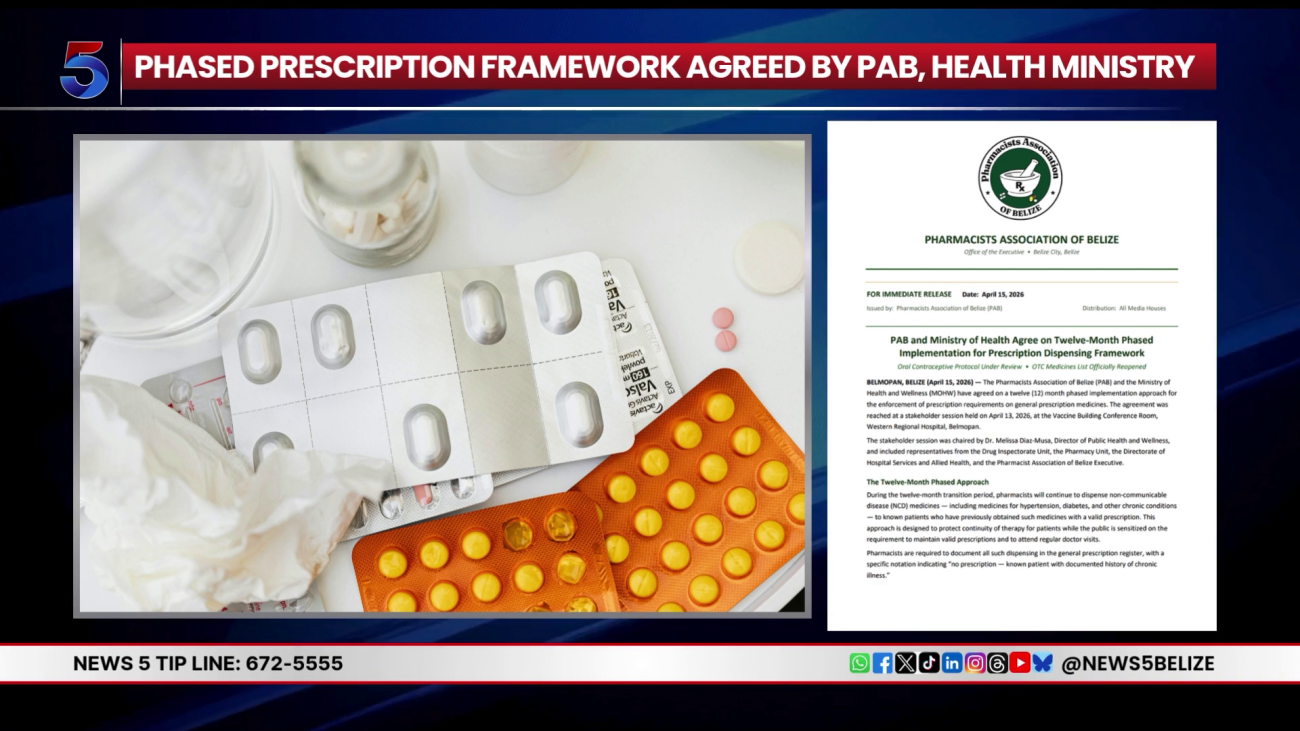
Pharmacists, Ministry of Health Agree on Prescription Rollout
As concerns grow over tighter prescription requirements, pharmacists want the public to know, this isn’t about cutting off access. The Pharmacists Association of Belize says it’s working closely with the Ministry of Health on a practical way forward, settling on a twelve month phased rollout designed to protect patients, especially those managing chronic illnesses, while strengthening existing prescription laws. The association insists the focus is safety, accountability, and proper medical oversight, not restriction. We spoke with Beverly Coleman, Public Relations Officer of the Pharmacists Association of Belize, who explains what this transition period means for doctors, pharmacists, and patients alike.
Beverly Coleman
Beverly Coleman, PR Officer, Pharmacy Association of Belize
“The laws have been on the books, like I said, for many years, and I think we come from a culture where we don’t appreciate the importance of doing follow up visits with our physicians, with our doctors, with our healthcare professionals. We are not accustomed to doing routine lab work. So this twelve month transition phase is giving us a chance to climatize ourself to that. It is not a period of a free for all. As stated in the press release it gives us a chance as pharmacists to tell our patients that I can give you, I can sell you, I can dispense to you a month’s worth of medication but just know that after this you will need a doctor’s prescription because our patients need to know that we are taking in foreign substances into our bodies, whatever we take. It could be a Tylenol, it could be a herbal medication. We need to know what effects those are having on our bodies.”
 New Regulations Will Require More from Pharmacists
As Belize prepares to change how people access prescription drugs, concerns are growing about whether the healthcare system can keep up. More patients are expected to flood clinics for prescriptions, raising questions about whether pharmacists could help fill the gaps, especially in rural and underserved areas. But according to the Pharmacists Association of Belize, it’s not that simple, with any expanded role requiring talks with health officials and possible changes to the law.
Beverly Coleman
Beverly Coleman, PR Officer, Pharmacist Association of Belize
“Medicine is something that is not static. It is dynamic and it changes every single day. So we have to keep updated so that we can keep on educating and counseling our patients.”
Shane Williams
“In order to limit the traffic on an already stressed system ’cause this will definitely increase traffic towards our health facilities. Will we be seeing pharmacists starting to prescribe medications in simpler cases or chronic disease cases?”
Beverly Coleman
“Pharmacists do not prescribe. Pharmacists we dispense. We fill prescriptions and we dispense. And if we see a prescription that has an issue on it, maybe it’s an overdose, maybe there is an interaction, we are the trained professional who in turn we have to alert the doctor who wrote the prescription and identify whatever is the issue on that prescription. We do not prescribe and that is another conversation that we will be having with Ministry of Health and Wellness because we have to take into consideration the rural areas where maybe a doctor is not readily available. We as pharmacists, we are governed by laws and we have to follow the law. So we do not prescribe but in a context like this, it’s a conversation that we have to have because our roles will now be expanding because of our reality of where we live and our geographic the vast geographic outline that we have. It is something that is definitely up for, that definitely has to come up in, in conversation with the Ministry of Health and Wellness.”
Attention readers: This online newscast is a direct transcript of our evening television broadcast. When speakers use Kriol, we have carefully rendered their words using a standard spelling system.
Watch the full newscast here: