


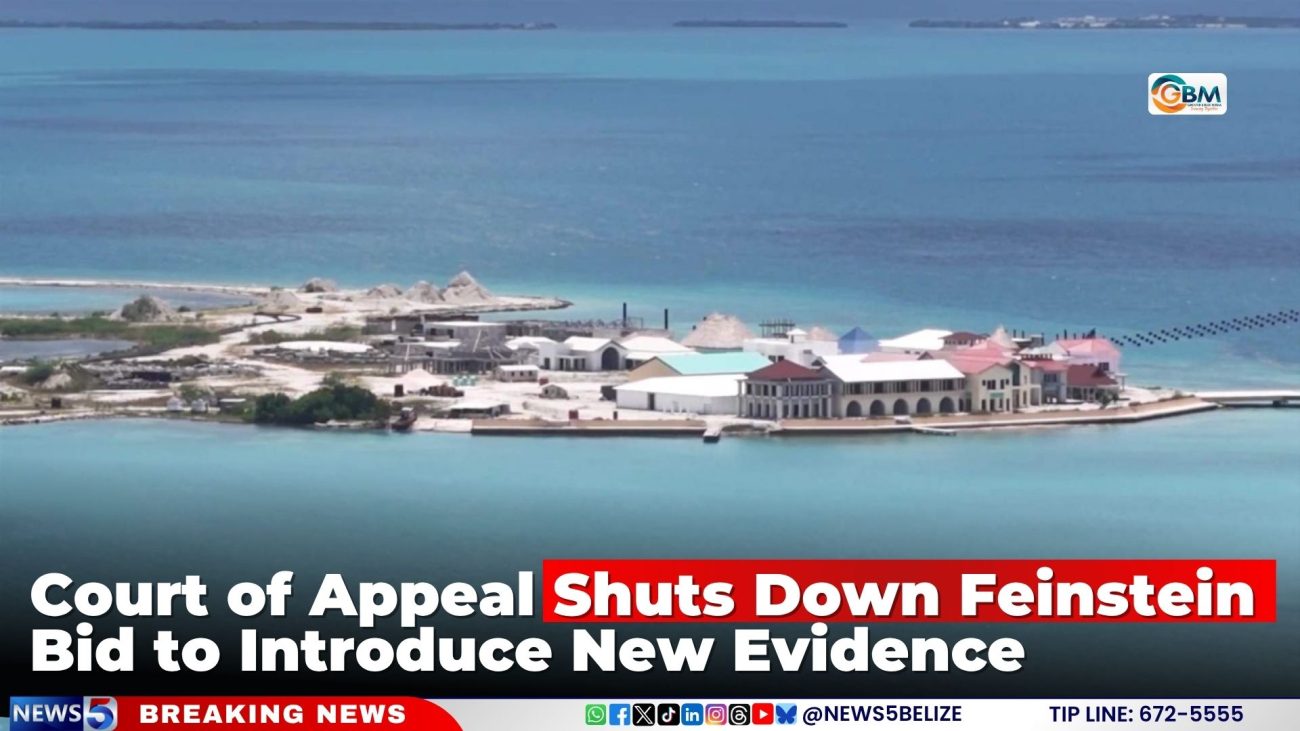
Court of Appeal Shuts Down Feinstein Bid to Introduce New Evidence
Michael Feinstein’s legal battle to stop the government from forcibly taking his land near Stake Bank Island hit a significant wall this week, after the Court of Appeal rejected his attempt to introduce a newly discovered government report into his ongoing appeal, and refused to compel the government to hand over further documents.
The three-judge panel unanimously dismissed both applications, finding that Feinstein had the means to seek the disputed evidence during the original trial and simply chose not to.
The ruling does not end the fight. The substantive appeal, which will determine whether the government’s compulsory acquisition of Feinstein’s 23.4 acres of land adjacent to Stake Bank Island was constitutional, is yet to be heard.
At the centre of the ruling is a report commissioned by the Ministry of Tourism in June 2024, just two months before the government published its declaration to acquire Feinstein’s land for the Stake Bank cruise port project. The report, prepared by consultants Osric Forrest and Orlando Hewitt, compared two other potential cruise port sites, the Port of Magical Belize and the Port of Belize, and described the Stake Bank project itself as “defunct.”
Feinstein, represented by London-based King’s Counsel Richard Salter, argued the report was explosive. If the government’s own consultants were recommending alternative cruise port sites and calling Stake Bank defunct in June 2024, he contended, then the Minister’s declaration two months later that acquiring his land was genuinely in the public interest was built on a false foundation. The argument was that the acquisition was not about advancing a public project at all, but about resolving a messy ownership dispute in favour of private investors.
Feinstein also applied for the Court to order the government to disclose six categories of documents, including Cabinet records and communications between the Ministry of Tourism and the Ministry of Natural Resources in the months leading up to the acquisition.
Chief Justice Blenman applied the long-established Ladd v Marshall test, which requires anyone seeking to introduce new evidence on appeal to satisfy three conditions: that the evidence could not have been obtained before trial with reasonable diligence; that it would probably have had an important influence on the result; and that it is credible.
On the first condition, the Chief Justice was unambiguous. Feinstein knew at trial that the government had been considering alternative cruise port sites, including Port of Magical. His own affidavit said so. His own witnesses raised it. Prime Minister John Briceño had made public statements about the competing port proposals. With all of that knowledge available, the Court found that Feinstein could have demanded disclosure of related government documents during the original proceedings and did not.
“It was a clear litigation choice by Mr. Feinstein to frame his case in the way he did,” Chief Justice Blenman wrote, adding that the Ladd v Marshall test is not an opportunity for a losing litigant to get “a second bite at the proverbial cherry.”
On the second condition, whether the report would have changed the outcome, the Court was equally unconvinced. Even substituting Port of Magical for Port of Belize in the trial judge’s analysis, the fundamental finding would have remained: Stake Bank was the only cruise port project with regulatory approvals in place, construction equipment already on site, and financing ready. Port of Magical, despite having an environmental assessment and a Royal Caribbean agreement, was still at a conceptual stage. The consultants’ use of the word “defunct” could not be attributed to the government as its official position.
Having failed two of the three conditions, the fresh evidence application was dismissed in its entirety.