


From Wage Bands to Percentages: What It Means for Your Paycheck
Your Social Security deduction might be on the chopping block, but don’t expect changes just yet. After weeks of nationwide consultations, the Social Security Board is now weighing a major shift in how contributions are calculated. The proposal would move away from fixed wage bands to a percentage-based system, while also raising the minimum contribution. Officials say the talks, held with government, unions, employers, and workers, are part of a broader effort to modernize the system. But for now, it’s still under review. Zenida Lanza has more from today’s media briefing.
 Zenida Lanza Reporting,
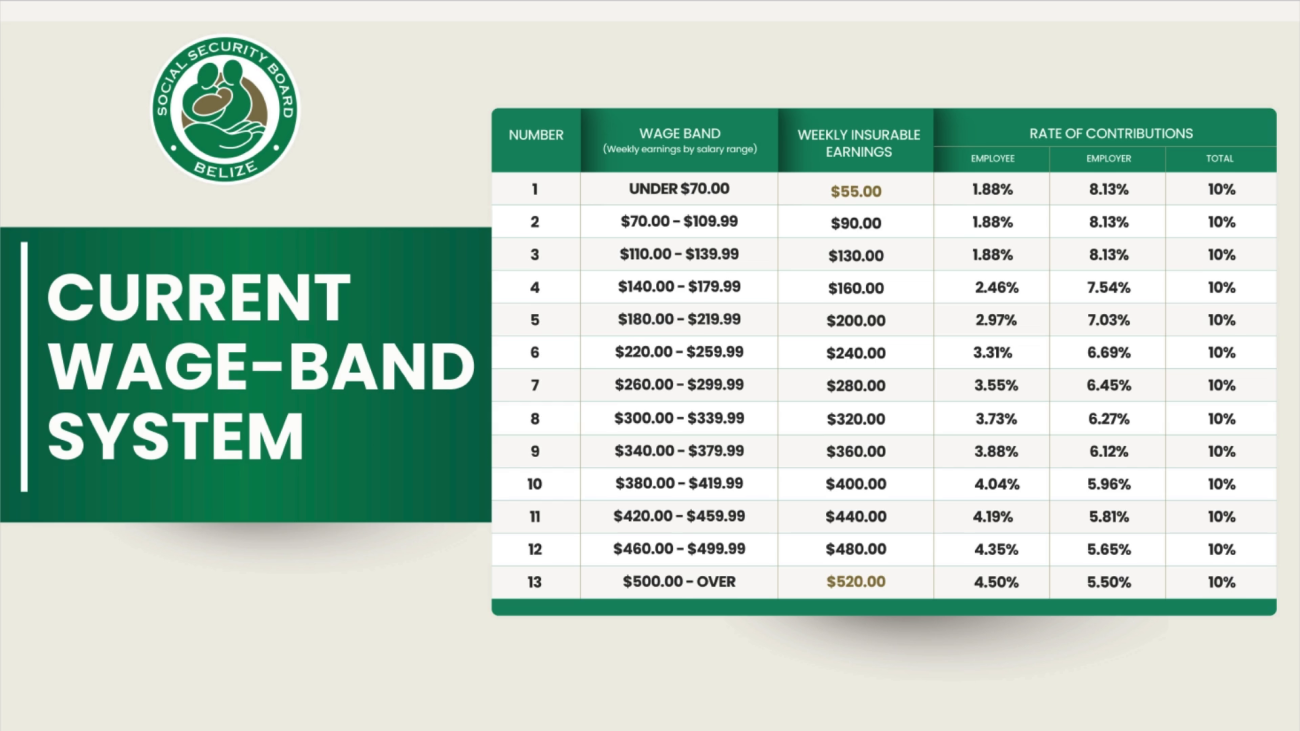
Right now, Belize uses a wage-band system, meaning workers fall into one of thirteen different contribution categories depending on how much they earn. But SSB says it wants to simplify that system by moving to a percentage-based model instead. The proposal would also raise the contribution floor, that’s the minimum amount used to calculate payments, from fifty-five dollars to one hundred and thirty dollars. That minimum has not changed since 2001. And finally, the split between what employees and employers pay would be adjusted. The reason? Efficiency.

Jerome Palma
Jerome Palma, CEO, Social Security Board
“The feedback is showing us that as much as ideally administratively having one band, one floor, ceiling, and one rate administratively is the most efficient. We also recognize that the $130 is not going to then be for full time employees, because there’s nobody who’s going to be working for a 40 hour work week at a minimum wage of $5 that’s going to be earning $130. So we do recognize by legislation that those persons who are part time working a number of hours can participate. Based on the numbers that we have on the band system, we recognize 130 as perhaps a more ideal point to be on. It was not rigid in that sense, but we recognize where 130 was a bit of the sweet spot, if I could call it that.”
 SSB says the current wage-band system creates extra paperwork and calculations for both businesses and the board itself. In fact, Belize is one of only four countries in the world still using this system. However, the initial proposal suggested one flat percentage base across all incomes. The suggested percentage splits as shown, with the initial lean towards CARICOM’s standard of 5.41% by employers and 4.59% by employees. But many workers pointed out that this could mean lower-income earners would pay more than they currently do. For example, someone making one hundred and sixty dollars weekly, currently contributes around two-point-four-six percent. Under the proposed flat rate, that deduction would increase. After hearing from more than one thousand people during the consultations, SSB says one message came through clearly.
 Jerome Palma
“The feedback is guiding us that there is still a hope that we have at least three tiers for the lower income, where the employer is contributing at a higher rate than at the higher income, and then somewhere in between. So that’s a lot of the feedback. That’s why we’ve gone through the consultation process. That is what the results is showing us, that there’s still an expectation that at least three tiers, a low income, a high income, and then somewhere in between. So that we will now factor in, in terms of determining what our final proposal will start to look like.”
SSB says about sixty percent of those who attended the consultations supported the proposed changes, with some minor adjustments. The Board will now review the feedback, revise the proposal, and return later this year for another round of public consultations. So, while changes to Social Security contributions may be coming, officials say Belizeans will not see those deductions change this year. Reporting for News Five, I am Zenida Lanza.
Attention readers: This online newscast is a direct transcript of our evening television broadcast. When speakers use Kriol, we have carefully rendered their words using a standard spelling system.
Watch the full newscast here: