


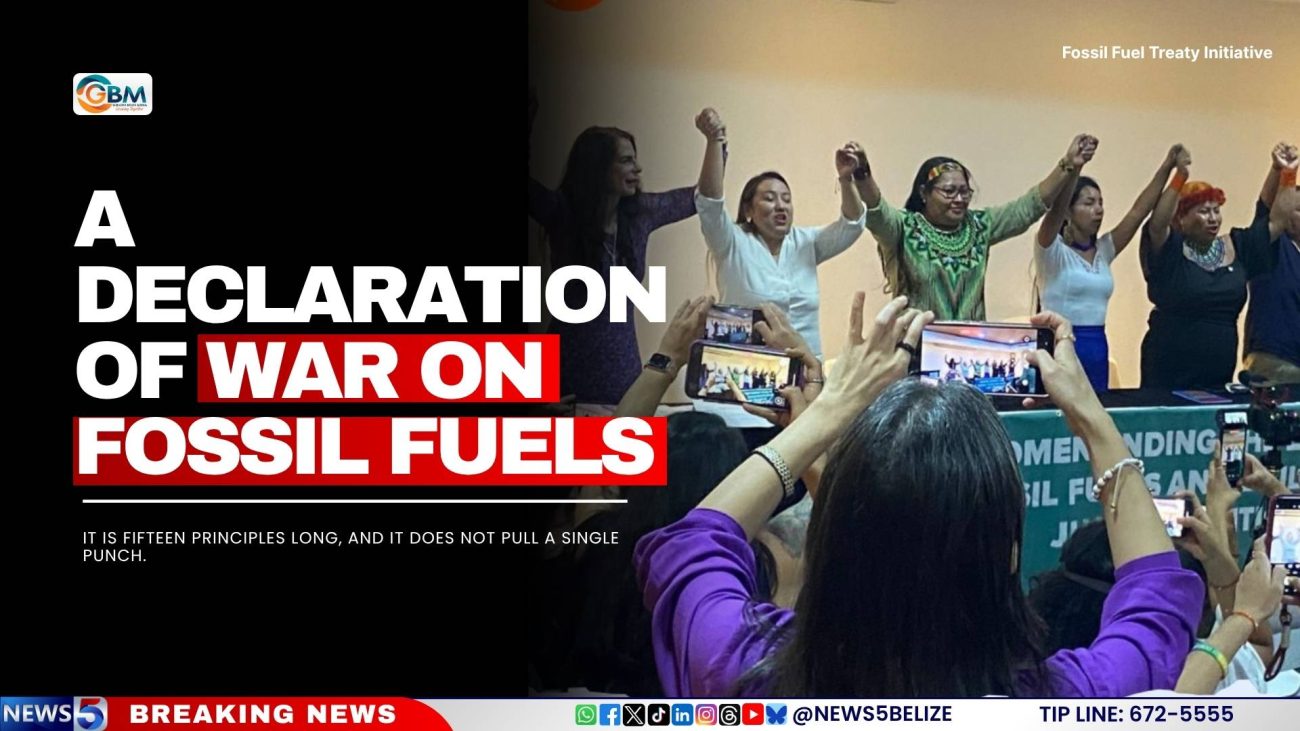
A Declaration of War on Fossil Fuels
Picture this: a coal-export port on the Caribbean coast of Colombia. Ships loaded with fossil fuels waiting in the harbour. And on the docks, a coalition of activists, Indigenous leaders, Afro-descendant communities, workers, and youth from across the globe, gathered in the very shadow of the industry they want dead, launching what they are calling a blueprint for the end of the fossil fuel era.
That was Santa Marta on Sunday.
As more than fifty countries gathered for the First International Conference on Transitioning Away from Fossil Fuels, co-hosted by Colombia and the Netherlands, a sweeping global coalition of civil society groups did not wait for the diplomats to speak first. They released the People’s Declaration for a Rapid, Equitable, and Just Transition for a Fossil-Free Future, and the message was blunt: the time for negotiating is over. Now comes implementation.
The document itself is remarkable
It is fifteen principles long, and it does not pull a single punch.
It frames the climate crisis not as an accident of industrial progress, but as a direct consequence of capitalism, colonialism, and militarism. It names the fossil fuel industry as structurally intertwined with global warfare. It demands that the Global North pay what it calls a “climate debt” to the Global South, not as aid, not as loans, but as reparations. It explicitly rejects what it calls “false solutions” (carbon capture, carbon markets, nuclear energy, hydrogen co-firing), calling them corporate delaying tactics dressed up as climate action.
And it calls, plainly, for system change. Not a greener version of what we have. A different system entirely.
“The era of negotiation has passed,” the declaration states. “The era of implementation must begin.”
Why Santa Marta, and why now
The location was not chosen by accident. Santa Marta is one of Colombia’s main coal-exporting ports. Launching a fossil fuel phaseout declaration from a working coal terminal carries a message that no press release could.
The timing is equally deliberate. With over fifty governments converging this week for a conference that organisers are billing as historic, civil society wanted its position on the table before any government made a move.
Lidy Nacpil of the Asian Peoples’ Movement on Debt and Development said it plainly: “We are here to remind governments that a just transition is a matter of survival for our communities.”
Tasneem Essop, Executive Director of Climate Action Network International, went further: “The Global South unequivocally rejects voluntary promises that serve only to deepen our neocolonial dependence.”
What they are actually demanding
Strip away the diplomatic language and the demands come down to four things.
First, stop now. No new coal, oil, or gas projects. No public or private financing for fossil fuel expansion. The Global North should complete its coal phaseout by 2030 and end oil and gas extraction by the early 2030s. The Global South gets slightly more time: coal out by 2035 and oil by 2050, but the direction is the same.
Second, pay up. The declaration insists that climate finance from rich countries to poorer ones is not charity. The document says that this is a legal and moral obligation rooted in centuries of extraction and emissions. It calls for trillions, not billions, and demands the money come without debt conditions attached.
Third, no shortcuts. The coalition is explicit that carbon capture technology, carbon offsets, and gas as a so-called “transition fuel” are not acceptable. They want a direct line from fossil fuels to renewables, community-owned, publicly managed, and decentralised wherever possible.
Fourth, connect the dots. The declaration links fossil fuel dependence to war, militarism, and geopolitical aggression in terms that are unusually direct for this kind of document. It notes that global military spending hit 2.7 trillion dollars in 2024, money it argues should be redirected to renewable energy and climate adaptation instead.
The harder argument underneath it all
What makes this declaration different from the hundreds of climate statements released every year is its willingness to name the structural problem directly.
Most climate policy conversations treat fossil fuels as an energy question. This document treats them as a power question. Who controls resources. Who profits from instability. Who absorbs the cost when things go wrong.
The communities represented in Santa Marta, frontline villages in the Global South, Indigenous territories, Afro-descendant communities, low-income urban populations, are not the ones who burned the coal and oil that heated the planet. But they are the ones watching their coastlines disappear, their harvests fail, and their energy bills rise whenever a pipeline gets caught in a geopolitical dispute.
That asymmetry is the engine driving the declaration’s anger, and it is an anger backed by increasingly solid legal ground. The coalition points to the International Court of Justice’s Advisory Opinion, issued last year, which affirmed that states have binding legal obligations to act on climate change. Not moral obligations. Legal ones.
What happens next
The formal conference begins this week. Negotiators will talk. Communiqués will be drafted. Commitments will be made, some binding, some not.
The coalition behind the People’s Declaration plans to keep the pressure on through a global campaign they are calling Fossil Free Rising which includes days of action in communities around the world, running parallel to whatever happens inside the conference halls.
The full declaration can be viewed here: PEOPLE’S DECLARATION FOR A RAPID, EQUITABLE, AND JUST TRANSITION for a FOSSIL-FREE FUTURE