




AI Enters the Courtroom as Belize Acts to Protect Justice
Artificial intelligence is already changing how Belize lives, learns, and governs. But what happens when that same technology steps into the courtroom, where facts, fairness, and human judgment can’t afford to fail? As AI tools become more powerful and more accessible, courts around the world are racing to keep up, weighing innovation against the risks of misinformation, ethical breaches, and data security. Belize is now part of that global conversation. Tonight, in our Five Point Breakdown, News Five’s Paul Lopez takes us inside the judiciary’s response, showing how new safeguards aim to protect justice in an age where technology is moving faster than the law itself.
 Paul Lopez, Reporting
Artificial Intelligence, or AI is now a buzzword, used across multiple sectors in Belize. In the National Assembly, policing, education, and the list goes on.
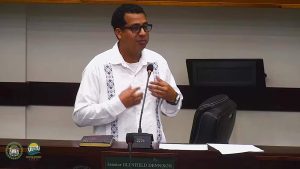
Glenfield Dennison
Glenfield Dennison, Union Senator

“Based on my estimates, nuh me sorry, not me, the AI had to do it. Straight, the AI do it, mek wih know, I nuh fraid fuh tell unu.”

Richard Rosado
Dr. Richard Rosado, Commissioner of Police
“In modernization, in embracing advanced technology.”

Dale McDougall
Dale McDougall, Adjunct Lecturer, Galen University (File: July 10th, 2025)
“How is it that we can have students use A.I. as a tool rather than a replacement.”
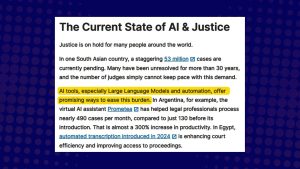 The fact is that artificial intelligence is here to stay, and Belize must learn how to adapt. Courts want speed, but not at the expense of truth. Around the world, judges are turning to artificial intelligence to clear backlogs and move cases faster. UNESCO says countries like Argentina have boosted court productivity by up to three hundred percent using AI tools. But the risks are real. UNESCO warns that AI can hallucinate, and that danger is no longer theoretical. In the UK, lawyers have already been caught submitting AI‑generated legal arguments that cited cases that never existed. Those missteps are forcing countries like Belize to rethink their approach to AI in the justice system. They’re grappling with one critical question: how do you use powerful technology without letting it undermine justice? It’s a fine line; one the courts can’t afford to cross.

Hector Guerra
Hector Guerra, Attorney-at-law
“Generally speaking, attorneys need to ensure that the information being used is verified, and that is largely because these large language models is a form of artificial intelligence that uses large data sets, yes, it is trained on large data models, which is able to produce information quickly. So, these artificial intelligence tools often hallucinate and they hallucinate a lot.”
Attorney Hector Guerra is a managing partner at Marine Parade Chambers and has been following the integration of artificial intelligence in judicial practices.
 Hector Guerra
“We have seen in other jurisdictions attorneys being sanctioned because they fail to verify the material being generated by the AI tools and in certain cases, fabricate cases that do not exist.”
In response, Belize’s Senior Courts have rolled out a new practice direction outlining how generative AI can be used ethically in legal proceedings. The four-page document places strict limits on AI use in evidence and anyone using AI must disclose that fact in court submissions.

Louise Blenman
Chief Justice Louise Blenman, High Court
“This practice direction establishes clear ethical boundaries, governing the use of AI in litigation, safeguarding the principles of accuracy, confidentiality and verification and transparency, while acknowledging the legitimate use of AI as a support tool.”
In doing so, Belize’s judiciary joins the first wave of regional jurisdictions establishing formal standards for the use of AI. Beyond accuracy and verification, Guerra warned that confidentiality remains a key risk when AI is used in court proceedings.
 Hector Guerra
“We now have to be careful when utilizing artificial intelligence, because the minute you upload any data unto these models, it may mean it is no longer confidential, so you have to be careful. There is a difference between what is called open ended AI which is open for anyone to see and closed ended AI that keeps information private.”
[Embracing AI Into the Future]
Around the world, industries are racing to harness AI while trying to keep ethics front and center. As the technology grows more powerful, that balancing act will only get harder, but it’s clear that Belize’s judiciary isn’t backing away from the digital future.
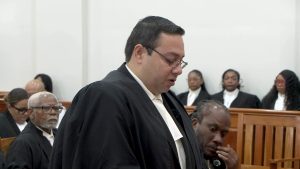
William Lindo
William Lindo, Former President, Bar Association
“We have entered an era where technology is no longer optional, it is foundational. We cannot sit idly by as luddites. Courts and legal systems globally have embraced digital transformation in an effort to complement and enhance the deliver of justice, but not meant to replace the human element.”
Going forward, Belize’s judiciary will need to modernize carefully, protecting human judgment while adopting new tools. Reporting for News Five, I am Paul Lopez.
Attention readers: This online newscast is a direct transcript of our evening television broadcast. When speakers use Kriol, we have carefully rendered their words using a standard spelling system.
Watch the full newscast here:
Facebook Comments