



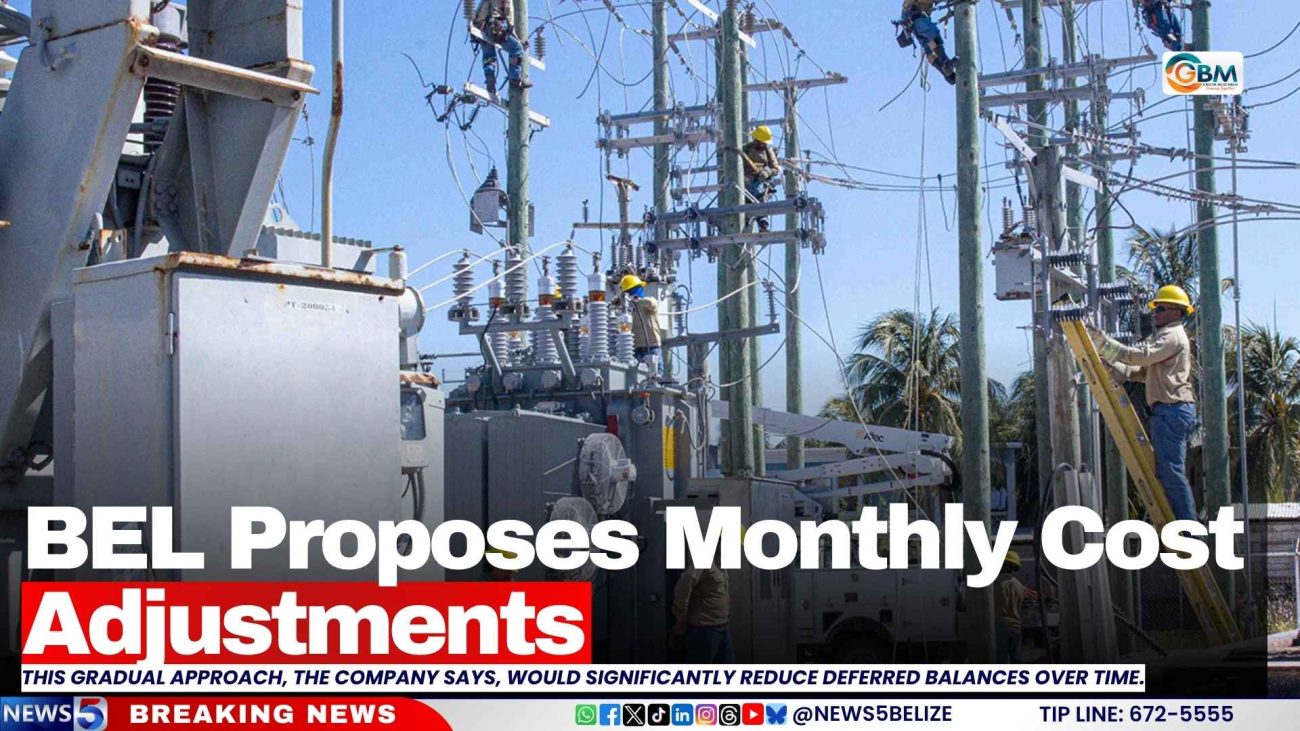
BEL Proposes Monthly Cost Adjustments
Belize Electricity Limited (BEL) is seeking regulatory approval to introduce monthly electricity bill adjustments as it grapples with rising and volatile power costs that are outpacing current tariffs.
In its submission for the 2025–2026 Annual Review Proceeding (ARP), filed on April 1, BEL is asking the Public Utilities Commission (PUC) to keep the existing Mean Electricity Rate (MER) at $0.4428 per kilowatt-hour and the Reference Cost of Power (RCOP) at $0.3033 per kilowatt-hour. This would mean no immediate increase in base electricity rates for consumers.
However, the company’s proposal hinges on the introduction of an automatic Cost of Power (COP) adjustment mechanism, which would allow electricity costs to be updated monthly to reflect real-time conditions in the energy market.
BEL says the move is necessary as it continues to face significant fluctuations in power costs driven by structural factors within Belize’s energy system. While the country benefits from a diverse energy mix, including hydro, biomass, imports and thermal generation, this diversity does not eliminate volatility.

 According to the submission, the cost of power has ranged from as low as $0.16 per kilowatt-hour to as high as $0.46 in extreme cases. These fluctuations, combined with delays in lower-cost energy projects, have placed increasing pressure on BEL’s finances.
Under the proposed system, adjustments to electricity bills would be made monthly but capped at plus or minus five percent of the RCOP. These changes would be calculated using a six-month rolling average of actual power costs, helping to smooth out short-term spikes while ensuring that adjustments are based on verified data.
Any differences between actual costs and the approved RCOP would be reflected as either a recovery or rebate on customers’ bills, shown as a separate line item. Deferred balances, whether under-recovery or over-recovery, would be tracked and gradually settled over time.
BEL argues that this approach would replace the current system of infrequent but larger tariff adjustments with smaller, more predictable changes, reducing the risk of sudden bill increases while improving transparency.
For the 2024–2025 period, BEL recorded an under-recovery of approximately $6.7 million. That figure is projected to climb to $22.8 million in 2025–2026. BEL forecasts under-recovery reaching $40.35 million in 2026–2027 and $25.78 million in 2027–2028. Overall regulatory balances could rise to more than $110 million by 2027, posing serious cash flow risks.
BEL estimates that, under the proposed mechanism, monthly recoveries would range between $1.3 million and $1.6 million. This gradual approach, the company says, would significantly reduce deferred balances over time.
Facebook Comments