


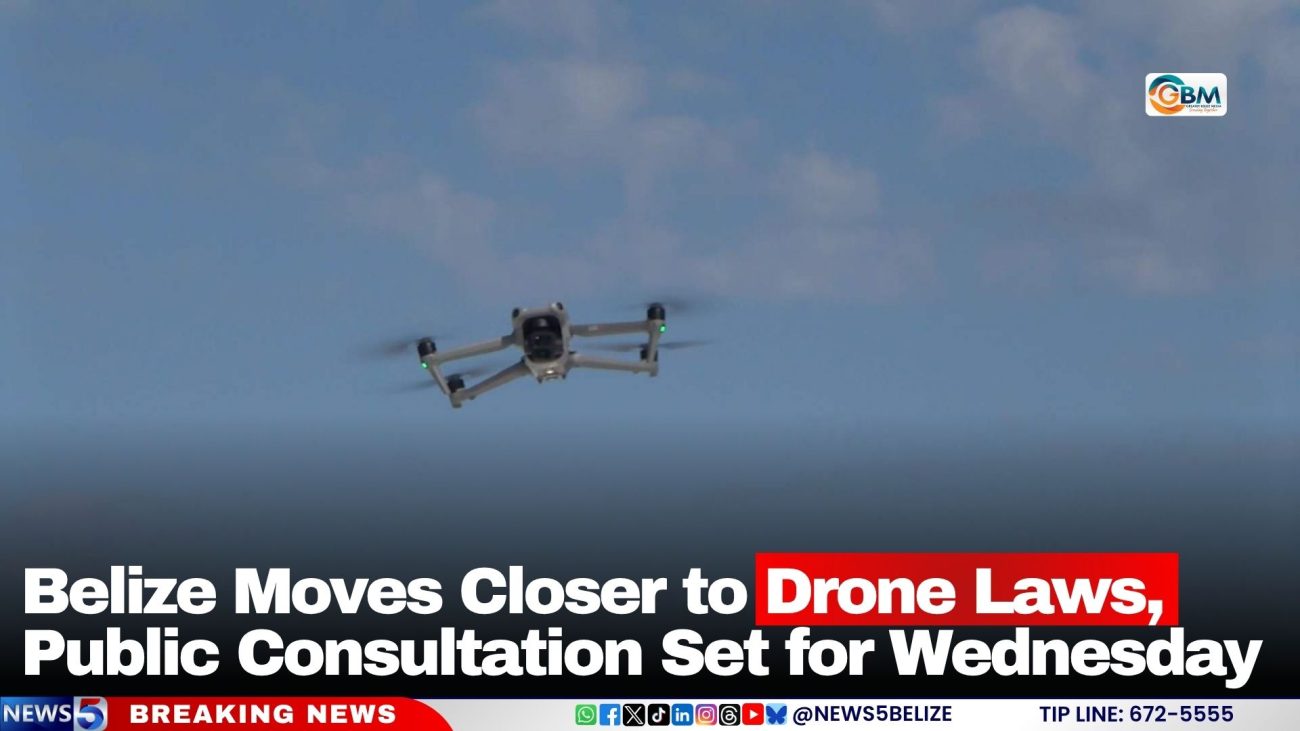
Belize Moves Closer to Drone Laws, Public Consultation Set for Wednesday
Belize is taking another step toward regulating its increasingly crowded skies, as the Department of Civil Aviation prepares to host a national consultation on draft drone regulations this Wednesday.
According to the department, the consultation is intended to strike a balance between innovation and safety, as drone use expands rapidly across industries and everyday life in Belize. Stakeholders ranging from commercial operators and hobbyists to environmental groups and legal experts are being invited to weigh in.
“This consultation represents an open and transparent effort to ensure that Belize’s drone regulations are practical, safe, and responsive to the needs of all airspace users. We strongly encourage anyone with a stake in drone operations to attend and make their voices be heard,” the department said.
The latest move builds on months of growing debate over how drones should be managed in Belize’s uniquely low-altitude airspace. Back in January, aviation officials warned that the surge in drone activity, from real estate and agriculture to media production, was increasing the risk of conflicts with manned aircraft.
Director of Civil Aviation Nigel Carter had said that planes in Belize often operate at much lower altitudes than in larger countries, sometimes as low as 500 feet while en route. That overlap, he said, makes unregulated drone activity a potential hazard.
At the time, the department introduced an Aeronautical Information Circular to begin gathering public feedback. Those proposed measures include standardised licensing, operational limits, and enforcement mechanisms that could carry legal penalties for non-compliance.
While some stakeholders have welcomed the effort as necessary for safety, others have raised concerns about possible impacts on businesses that rely on drone technology. Carter has previously stressed that while economic concerns are valid, safety remains the priority, particularly given Belize’s dependence on aviation for tourism and connectivity.
Beyond commercial use, drones are already playing a growing role in national security and law enforcement. Police have integrated aerial surveillance into crime-fighting strategies, using drones to monitor hotspots, track suspects, and coordinate patrols. In April, authorities also used drone reconnaissance in the Toledo District to locate and destroy dozens of cannabis plants in remote terrain.
The department announced that the session will be held on May 6 from 9:00 a.m. to 12:00 p.m. at the St. Catherine Academy Mercy Centre in Belize City, with a virtual option also available. The meeting is part of an ongoing effort to formalise rules governing unmanned aerial systems.