


Belize’s Celebrates 50 Years of Dollar Stability!
For fifty years, Belizeans have counted on one simple equation: two Belize dollars equal one U.S. dollar. It shapes everything from grocery prices and credit card payments to international travel and overseas purchases. But behind that familiar rate lies decades of financial discipline, difficult policy choices and steady economic management. As Belize marks fifty years of currency stability, Central Bank Chief Economist Emory Ford explains what it takes to protect the peg, while Senator Christopher Coye and Financial Secretary Joseph Waight examine why it matters to every Belizean and what must be done to keep it secure.
 Emory Ford, Chief Economist, Central Bank of Belize
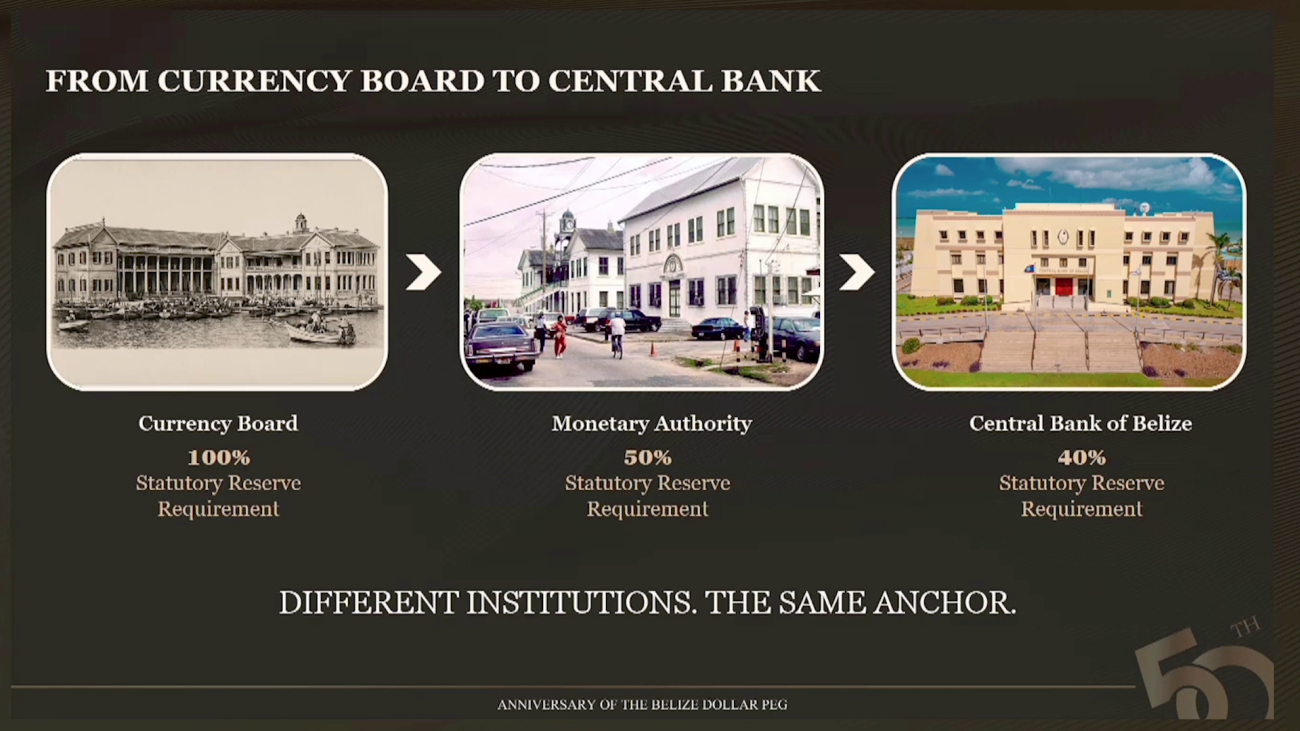
“The peg’s durability depended largely on the evolution of institutions capable of preserving credibility. The institutional evolution is most clearly reflected on the changing requirements for external assets. Under the currency board, reserved assets were required to provide approximately one hundred percent backing for currency in circulation. The statutory minimum fell to fifty percent under the 1976 Monetary Authority Ordinance and forty percent when the Central Bank commenced operation in 1982. Because the later ratio covered broader liability bases, the percentages are not strictly comparable but they clearly marked a transition to a broader framework of monetary management.”

Christopher Coye
Christopher Coye, Government Senator
“What are the implications of not having that peg that we might not appreciate now, fifty years having gone by with this macroeconomic stability in the peg but our predecessors didn’t have that stability. And what were their concerns back then, 1894, 1949. What were they thinking about? Certainly, they didn’t have that certainty. They didn’t have income certainty. They didn’t have savings certainty. They didn’t have wage certainty and what are the implications of all of that?”
Joseph Waight, Financial Secretary
“We used to listen to the CARICOM News and we saw what was going on in Jamaica. I think they went through over fifteen years or so, fifteen funding programs? More or less. Guyana was also in trouble and we realized that guess what; we don’t want to go there. We have to learn from the experiences of others. And I would want to say that no government would want to have the ignominious departure of having changed the exchange rate. Remember it’s in our DNA. The political movement in Belize was born out of, the nationalism was born out of 1949 of an exchange rate crisis at the time. It’s almost sacred and sacrosanct.”
Belize officially adopted its fixed currency rate policy on May 11, 1976. Successive administrations have since worked to sustain the strength of the Belize dollar.
Attention readers: This online newscast is a direct transcript of our evening television broadcast. When speakers use Kriol, we have carefully rendered their words using a standard spelling system.
Watch the full newscast here: