



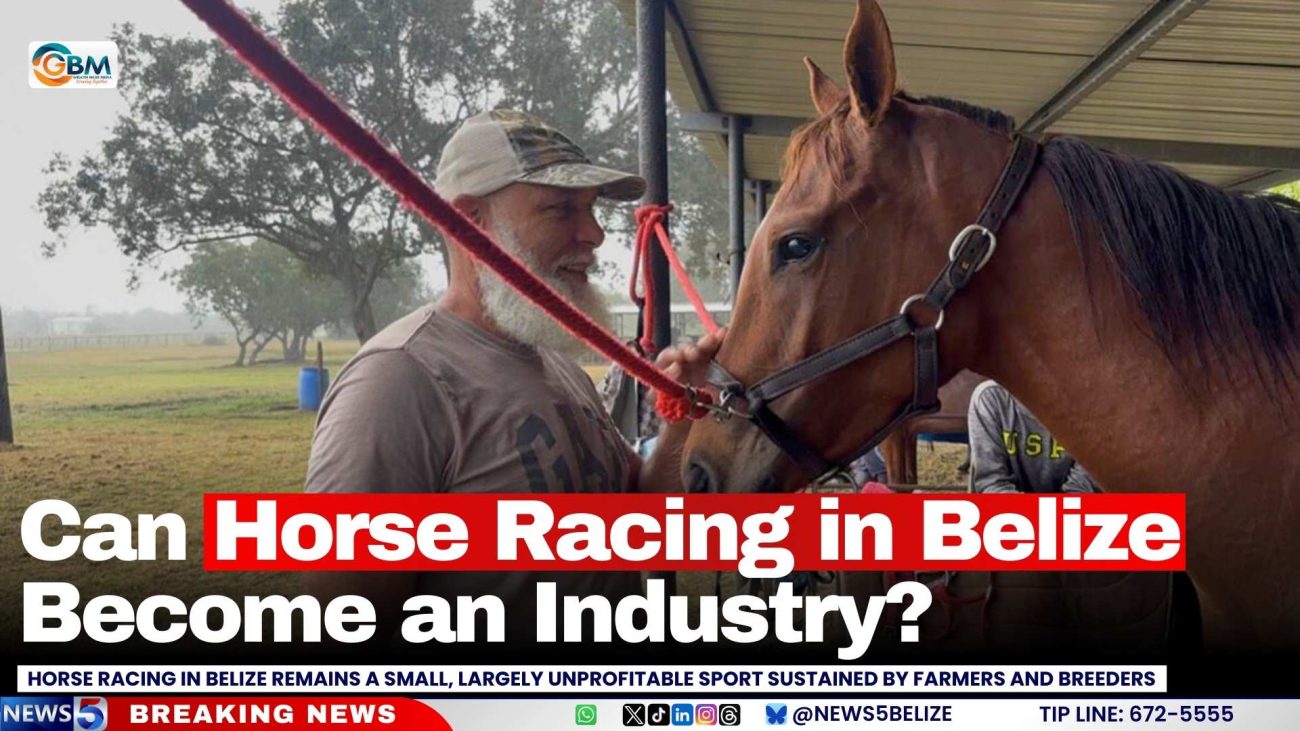
Can Horse Racing in Belize Become an Industry?
Horse racing in Belize remains a small, largely unprofitable sport sustained by farmers and breeders who say passion, not prize money, keeps it alive. With only a handful of races held each year, those involved hope for government support to help transform the activity into a viable industry.
Veteran owner Harold Burns says most participants lose money simply by taking part in race days. “We spend more than we make, way more than we make,” he said, noting that transportation, feed, medical care, and equipment often exceed the race purse itself.
Burns owns 15 horses, five of which currently race. Among them is Amira, a filly who survived a near-career-ending injury early in her life. Burns recalled that she crushed her front leg in a stable accident and “almost amputated her left front leg.” After surgery and recovery, Amira went on to win five first-place trophies, beginning at just two years old.

Despite Belize’s horse racing history dating back to the 1800s, the sport has remained limited in scale. Burns said owners often do not even take home winnings, as prize money is shared immediately among crew members. “We don’t really make money,” he said.
Burns believes the sport could grow into a real industry with government support. He argues that investment through sports and tourism could create jobs, from feed mills and tack shops to trainers and jockeys. “It could become an industry that employs quite a bit of people directly and a lot more indirectly,” he said.
Local breeder Gilbert Canton agrees, noting that internationally horse racing is sustained by betting. He says Belize must develop its capacity to tap into that model if the sport is to survive.
Canton breeds his horses locally, carefully matching pedigrees and performance traits. “We try to see if we can breed a winner,” he said, explaining that most horses begin racing at age two.
Trainers and stable workers, many of whom work part-time, play a critical role in preparing horses for competitions. Trainer Arthur Veyes said managing a racehorse requires careful conditioning to avoid injury. “This is not my job,” he said. “This is just my passion and love.”
For now, those involved say horse racing in Belize continues to exist because of a deep love for the horse, while holding on to the hope that with proper investment, the sport could become more than a hobby.
Facebook Comments