


Coastlines Overwhelmed, Tourism at Risk, But Solutions Are Emerging
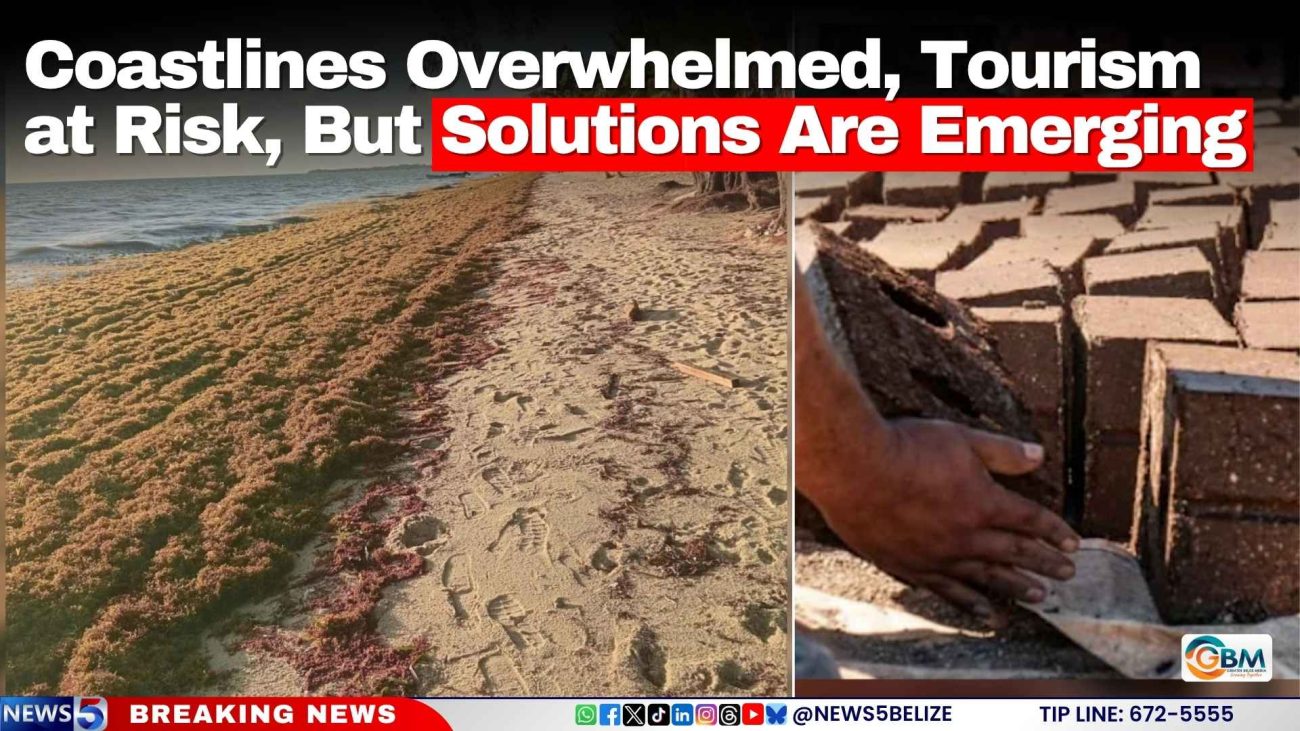
Sargassum is back, and this time it’s hitting Belize’s coastline harder than ever. From Placencia to San Pedro and Hopkins to Caye Caulker, the seasonal seaweed invasion is smothering beaches, choking tourism, and testing the limits of coastal communities. It’s also sparking a wave of creative solutions that could change the way Belize deals with its most persistent environmental headache.
The National Meteorological Service sounded the alarm as early as April, warning of a major influx of sargassum along the southern coast, with Hopkins and Placencia facing a high probability of major impact, while San Pedro and Caye Caulker were forecast to experience a high probability of moderate impact. Those forecasts proved accurate, and then some.
In Placencia, the scale of the problem has been staggering. Fifteen dump truck loads of sargassum were cleared from the beach in mid-April, yet the shoreline remained overwhelmed as more continued to wash ashore. “Sargassum continues to come in quite heavily, and we will continue with efforts to remove as much as possible,” the Placencia Village Council said. Residents have been vocal about their frustration. One local resident posted online, saying the smell had been horrendous and expressing hope that something could be done to prevent it in the future. Even visitors haven’t been spared; one tourist said they were only able to go into the sea twice during their stay, though they still managed to enjoy their trip overall. Residents say they are fighting a losing battle with daily cleanups, lacking the tools, staff, and equipment to keep pace with the volume coming in.
The crisis is not limited to the south. Ambergris Caye, Caye Caulker, and Hopkins Village have all reported significant sargassum landings, and the government has committed BZD$250,000 in emergency cleanup grants and launched a BZD$50 million sargassum-to-fuel conversion project, with record-high levels forecasted by summer.
Tourism leaders are not waiting for the situation to resolve itself. Belize Tourism Industry Association President Efren Perez says he has been in active communication with the Ministry of Tourism, the Ministry of Blue Economy, and the Ministry of Environment to coordinate efforts and assess what is being done on the ground. Perez acknowledges the damage extends beyond the physical mess. He noted there is concern not only from the beaches themselves but from the impact on hotels, with cancellations rising and visitors hesitating to book because of the perception that sargassum is everywhere. He described the challenge as a regional one, with countries across the Caribbean still trying to manage and mitigate its effects.
But where some see only a crisis, others see opportunity. In San Pedro, the Town Council has taken an innovative approach, rolling out a science-driven beach restoration program backed by World Bank financing and university partnerships, using the sargassum itself to rebuild eroded shorelines by extracting the sand trapped within it. Biodiversity Scientist Valentine Rosado revealed a striking finding from last year’s work: forty percent of every load of sargassum leaving the beach is actually sand, meaning significant quantities of valuable shoreline material can be recovered from the seaweed rather than lost with it.
And in the private sector, one Belizean company is thinking even bigger. Building Belize Better Manufacturing Co. is exploring how to convert sargassum into eco-friendly building blocks and livestock feed, eyeing what its co-founder Gregory Lavalley describes as a supply gap of two to seven million blocks in the northern corridor alone over the next five years. Lavalley says the project could bring jobs to rural fishing villages hit hard this year, reduce dependence on imported building materials, and position both the company and the government as partners in turning an environmental burden into a homegrown solution. Testing is set to begin later this month, and if approvals come through, production could be up and running within six to twelve months.