



Controversial History Book Cover Reopens Belize’s Colonial Wounds
Is displaying a racist image from Belize’s colonial past an act of education, or does it give that insult new life? That question has sparked a heated debate over the anniversary edition of A History of Belize in Thirteen Chapters. The National Kriol Council says the 1907 Coat of Arms on the cover degrades Black Belizeans and disrespects their ancestors. But author Assad Shoman says he chose the image precisely because it exposes the ugly realities of colonialism. Tonight, the controversy is forcing a much wider conversation about race, representation and how Belize tells its history. Shane Williams reports.
 Shane Williams, Reporting
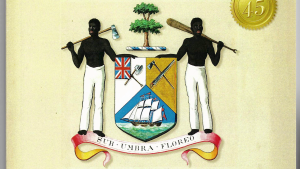
At first glance, it resembles Belize’s familiar Coat of Arms. But look closer, and the difference is impossible to ignore. Two Black men stand beneath a mahogany tree, holding a shield filled with symbols of Belize’s logwood industry. Their distorted, cartoon-like features reflect how colonial authorities portrayed Black laborers in the early 1900s. Now, that image appears on the sapphire anniversary edition of Assad Shoman’s A History of Belize in Thirteen Chapters, reopening painful questions about race, dignity and Belize’s colonial past.
Wilford Felix
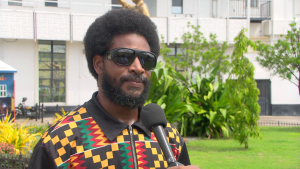
Wilford Felix, President, National Kriol Council
“It’s absurd and it is a slap in the face to every creole person in this country whose ancestors, fought, bled and died for our sovereignty.”
 The National Kriol Council describes the image as a degrading racial caricature. Its leaders argue that placing it prominently on a book about Belizean history does more than recall colonial prejudice. They say it gives that offensive portrayal a new platform. Council President Wilford Felix says the image fails to honor the role Kriol people played in laying the foundation for modern Belize. For him, the controversy is also a warning that Kriol Belizeans must speak more forcefully when their culture and history are misrepresented.
Wilford Felix
“Fi kriol people be the foundational people inna Belize, we should never the experience this type of disrespect but it comes because for many years, many decades, creole people have been somewhat passive inna this country in terms of representing our heritage and our culture. That day de done gone. It done.”
 But Shoman says the cover was not designed to celebrate the colonial image. It was chosen to confront it. Shoman says the image lays bare the racism and inequality of colonial Belize. He discovered it during a 2019 lecture by former ISCR Director Nigel Encalada. In other words, Shoman believes Belizeans should not hide the image simply because it is offensive. He says they should face it, question it and understand what it reveals about colonialism. But Felix says intention does not erase impact. Even if the goal was to provoke discussion, he argues that the image still disrespects the people it portrays.
Wilford Felix
“I want young Belizeans understand that disrespect noh always come a sa slap in your face. Sometimes it subtle. Sometimes it comes with a smile. Sometimes it comes with a pat on your back but we have to be true to ourselves, true to our heritage and true to our identity and not stand for disrespect.”
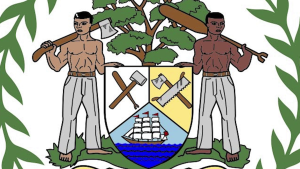
 The debate highlights the difficulty of confronting painful history. The 1907 image is a historical record, but it is also a reminder of how colonial authorities viewed and portrayed Black Belizeans. The Coat of Arms eventually changed, replacing the crude figures with more realistic representations of Belizean woodcutters. Historian Hector Silva says the updated design preserved the country’s logging history while giving the men a more recognizably Belizean appearance.
 On the Phone: Hector Silva, Historian
“He brought that image of that coat of arms to Mr. Price. Mr. Price said well this sounds good, wood cutters. The two wood cutters, a mahogany tree, the axe or instruments to cut down the tree and saw the tree. And inserted that coat of arms in there but more of a living personality and not as it was chartered in 1907 which sounded as though it was just a plastered picture that has no localized nobody.”
The book-cover dispute is not the only debate surrounding the Coat of Arms. Some Belizeans have also called for the current national symbol to reflect the country’s gender and ethnic diversity. But Silva draws a distinction between representation and history. He says the Coat of Arms was designed to document Belize’s economic roots, not represent every group in the country. For that reason, he believes it should remain unchanged.
 On the Phone: Hector Silva
“That flag will remain forever. It was already approved and I don’t think the movers and shapers would want to interfere with that flag because that was the flag that adopted at independence day and it is the flag that depicted the history of the nation.”
The controversy has turned one book cover into a national conversation. Can Belize confront racist images from its past without allowing those images to demean people in the present? And when history causes pain, should it be displayed, explained or left behind? Shoman intended the cover to provoke discussion about decolonization. It has certainly done that. But the debate also shows that how Belize remembers its history can be just as contentious as the history itself. Shane Williams for News Five.
Attention readers: This online newscast is a direct transcript of our evening television broadcast. When speakers use Kriol, we have carefully rendered their words using a standard spelling system.
Watch the full newscast here: