


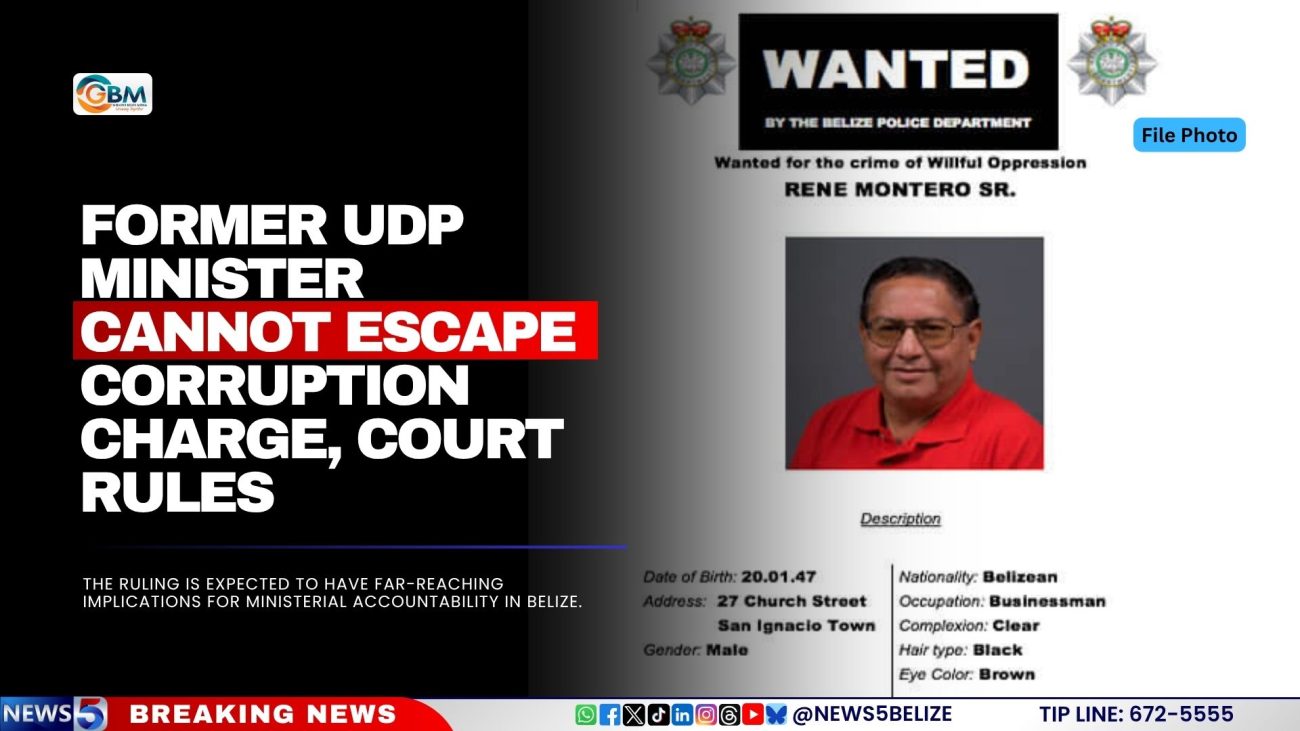
Former Minister Cannot Escape Corruption Charge, Court Rules
The High Court judge has handed down a landmark ruling confirming that a former Cabinet Minister can be prosecuted for wilful oppression under the Belize Criminal Code.
In a judgement delivered in late March, Justice Natalie Creary-Dixon refused an application by former UDP minister Rene Montero to have his indictment quashed, finding that ministers of government, including former ministers, qualify as “public officers” under the Criminal Code and can be held criminally accountable for abuses of their authority while in office.
The ruling is expected to have far-reaching implications for ministerial accountability in Belize.
Montero was jointly indicted in April 2024 alongside George Andrews, who served as Assistant District Technical Supervisor in the Ministry of Works. The pair face charges of wilful oppression under sections 284(1) and 309 of the Belize Criminal Code.
The indictment alleges that between April 2016 and November 2020, Montero, in his capacity as the Minister responsible for Works, and Andrews willfully abused their authority by directing and allowing the improper use of government resources to the injury of the public.
At the heart of Montero’s application was a constitutional argument: that Ministers of Government are expressly excluded from the definition of “public service” under section 131(4) of the Belize Constitution, and that this exclusion should flow through to the Criminal Code, placing Ministers outside the reach of section 284(1).
His legal team argued that the Constitution draws a firm structural line between the political executive, accountable through democratic politics, and the public service, accountable through administrative law. To collapse that distinction, they argued, would be constitutionally impermissible, particularly in a criminal statute where liability based on status must be established with precision.
The DPP countered forcefully that the constitutional exclusion was expressly confined to the internal workings of the Constitution itself, the provision opens with the words “In this Constitution”, and was never intended to govern how Parliament defines terms in ordinary legislation such as the Criminal Code.
Justice Creary-Dixon found that section 299 of the Criminal Code provides its own autonomous definition of “public officer,” crafted by Parliament for criminal law purposes and independent of the constitutional definitions.
Under that definition, a “public officer” is anyone holding a “civil office” where appointment or removal is vested in the Governor-General or another prescribed authority. Ministers are appointed by the Governor-General under section 40 of the Constitution. They hold non-military, civil offices of government. They are therefore, the Court found, “public officers” within the plain meaning of the Code.
Crucially, the Court held that the Constitution’s exclusion of Ministers from the “public service”, for the purposes of the Constitution, does not translate into an exclusion from criminal liability under the Code. The phrase “In this Constitution” in section 131(4) limits the reach of that exclusion to the constitutional document itself, the judgment explains.
“The Constitution does not confer immunity upon Ministers from the application of criminal law,” the judgment states. “On one view, interpreting section 299 so as to include Ministers arguably advances the constitutional value of the rule of law by ensuring that holders of significant executive authority remain subject to legal standards governing abuse of public power.”
The application to quash the indictment was refused. Montero’s trial will proceed.