

FPIC: Who Decides What Happens on Maya Land?
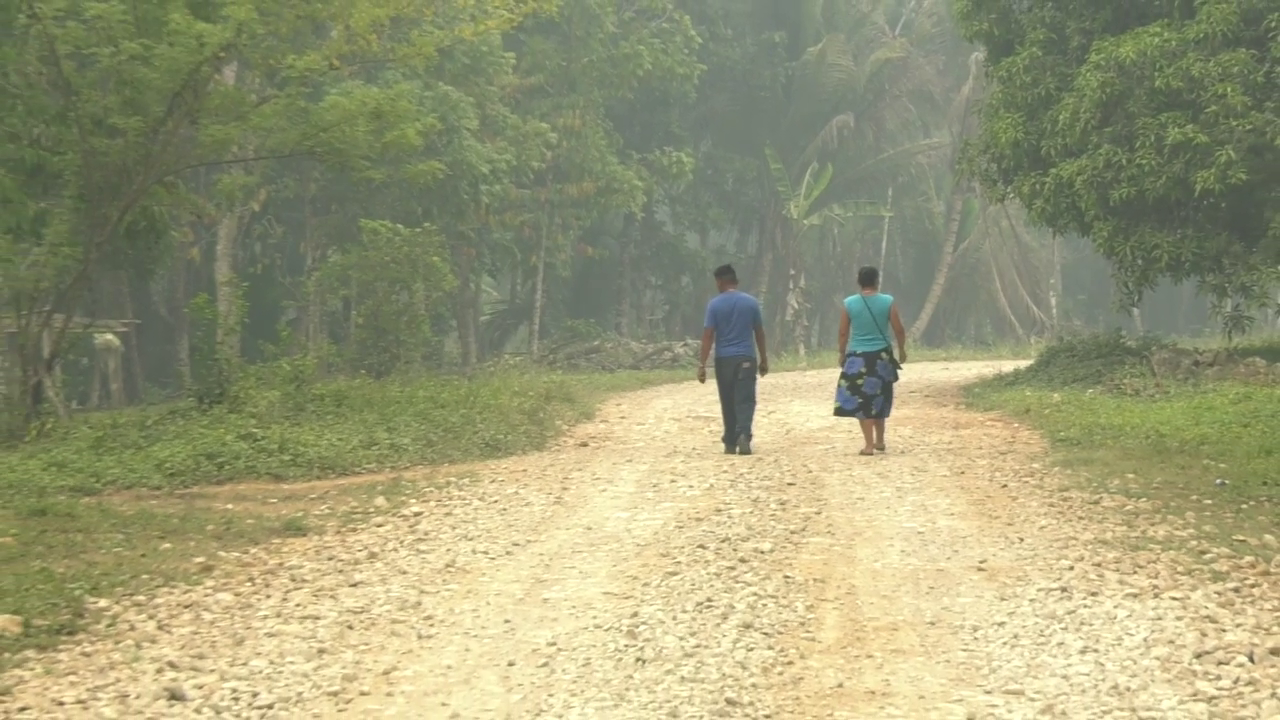
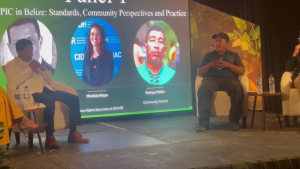
Free, Prior and Informed Consent may sound like complicated legal language, but for Maya communities, it comes down to a straightforward question: who gets to decide what happens on their land? That question brought Maya leaders, government officials, development partners and human rights advocates together in Golden Stream Village. The conference, hosted by the Sarstoon and Temash Institute for Indigenous Management, focused on moving FPIC beyond policy and putting it into practice. Isani Cayetano reports.
 Isani Cayetano, Reporting
Before government approves a project or a developer enters Maya territory, affected communities must have a meaningful voice in the decision. Consultation alone is not enough. Communities must receive the information they need, discuss it through their traditional systems and decide collectively whether to give or withhold consent. Maya Leaders Alliance founder Greg Ch’oc says that approach is not new. It reflects a system of collective decision-making that Maya communities have followed for generations.
Greg Ch’oc
Greg Ch’oc, Founder, Maya Leaders Alliance
“Consent in its literal meaning is you accept. You say yes. But it also has a meaning under ethnic where it is the collective decision of a village, of the villagers that may be impacted negatively from whatever the government may be proposing. So, consent is the action itself, the decision, which can either be consent of the village, or their decision to withhold that consent. In Maya governance, traditional decision-making cannot be divorced from the institution. The village meeting, which I’m going to go into, is an institution, so is the alcalde system. The protocol recognizes the village meeting as the authoritative body. The only entity that can take decisions on behalf of the village.”
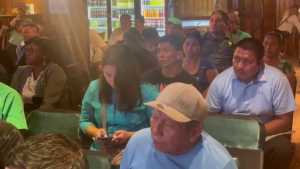 The legal foundation for that process was strengthened in 2015, when the Caribbean Court of Justice affirmed the existence of Maya customary land tenure in the Toledo District and ordered the government to protect those rights. The FPIC Protocol gives Maya communities a voice in development, from receiving information to making the final call. Toledo West Area Representative Oscar Requena says communities in San Vicente, Jalacte and San Benito Poite approved electrification projects before work began.
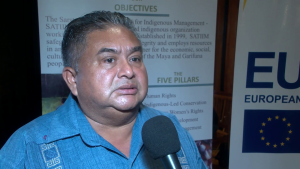
Oscar Requena
Oscar Requena, Area Representative, Toledo West
“Right now, we have three projects that are about to be completed in my constituency, and they are electrification projects in rural communities. We have San Vicente, Jalacte, and San Benito Poite. Those projects are funded and supported by the European Union, uh, BEL, and the government of Belize. And for us to have even started those projects require that we go in, and when I say we, I mean the Office of Indigenous Peoples Affairs that represents the government, to meet with the communities and to carry out the FPIC process. At the end of the process, these communities gave their consent and said, ‘Yes, we want the projects to go ahead,’ and that is why those projects have been implemented.”
 The European Union is supporting electricity and water expansion in southern Belize, along with initiatives intended to create more opportunities for women and farmers in Maya communities. But EU Representative Elizabeth Lanzi-Mazzocchini says funding development is only part of the responsibility. She says government agencies, development partners and community leaders must also understand how FPIC works and what communities need to exercise their rights.
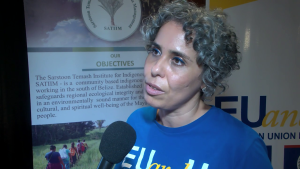
Elizabeth Lanzi-Mazzocchini
Elizabeth Lanzi-Mazzocchini, Head of Office, European Union Belize
“We have seen on EU side, under initiatives that we have supported, such as, for example, a project for rural electrification that soon will bring light to Jalacte, San Benito Poite, and San Vicente, how important it is for the entities entering in an FPIC process with communities to be properly trained to have those specialized knowledge and skills, and also for the community members and indigenous leaders to fully understand FPIC and know how to exercise their rights. So as an international partner to both the government and civil society of Belize, we thought it was very important to fund this initiative.”
 The conference, therefore, was not simply about explaining another acronym. It tackled a much larger challenge: how can Belize pursue development while respecting Maya land rights, traditional leadership and the authority of village meetings? For Ch’oc, the answer must begin with protecting the rights that the courts have already recognized.
Gregory Ch’oc
“It is my hope that the government will not dilute the FPIC as it is. It is my hope that the state will not compromise the judicial recognition of Maya customary land tenure.”
Legislation intended to give greater effect to Maya land rights remains under development. In the meantime, Maya communities say the real test will be whether FPIC becomes a consistent and meaningful process, one that gives them more than a seat at the table and respects their authority to say yes or no. Isani Cayetano for News Five.
Attention readers: This online newscast is a direct transcript of our evening television broadcast. When speakers use Kriol, we have carefully rendered their words using a standard spelling system.
Watch the full newscast here: