


Gun Board Lifts Restrictions While Tightening Requirements
If you own a firearm, or are thinking about applying for a license, you may want to pay close attention. Belize’s Firearms and Ammunition Control Board is overhauling the country’s gun licensing system, easing restrictions in some areas while tightening the screws in others. The changes spell out who can apply, what documentation is now required, and which firearm accessories are permitted. Officials say the goal is simple, better public awareness and stronger oversight. News Five’s Shane Williams breaks down what’s changing and what it means for you.

Shane Williams, Reporting
The Firearms and Ammunition Control Board says owning a gun in Belize is a privilege, not a right, and it’s tightening public understanding of that message. The board has lifted the moratorium on .223 caliber rifle applications and eased rules on some accessories, but officials say education is the real focus. According to Ministry of Defense and Border Security CEO Francis Usher, the priority is making sure the public clearly understands how the licensing system works.

Francis Usher
Francis Usher, CEO, Ministry of National Defense and Border Security
“The new board that was established in December of last year. We went through extensive consultations across the board with the general public, with dealers, with current firearm owners. And one of the common themes was that information wasn’t readily accessible. So we wanted to get that information out there. We felt it prudent to put a public notice that outlines it because when this cloud of doubt exists, that’s when agents thrive and we wanted to have people understand that you don’t need to go through an agent to get a firearm. All the information is there. You can apply, you deliver it to the firearms control board office and your application will be deliberated by the board.”
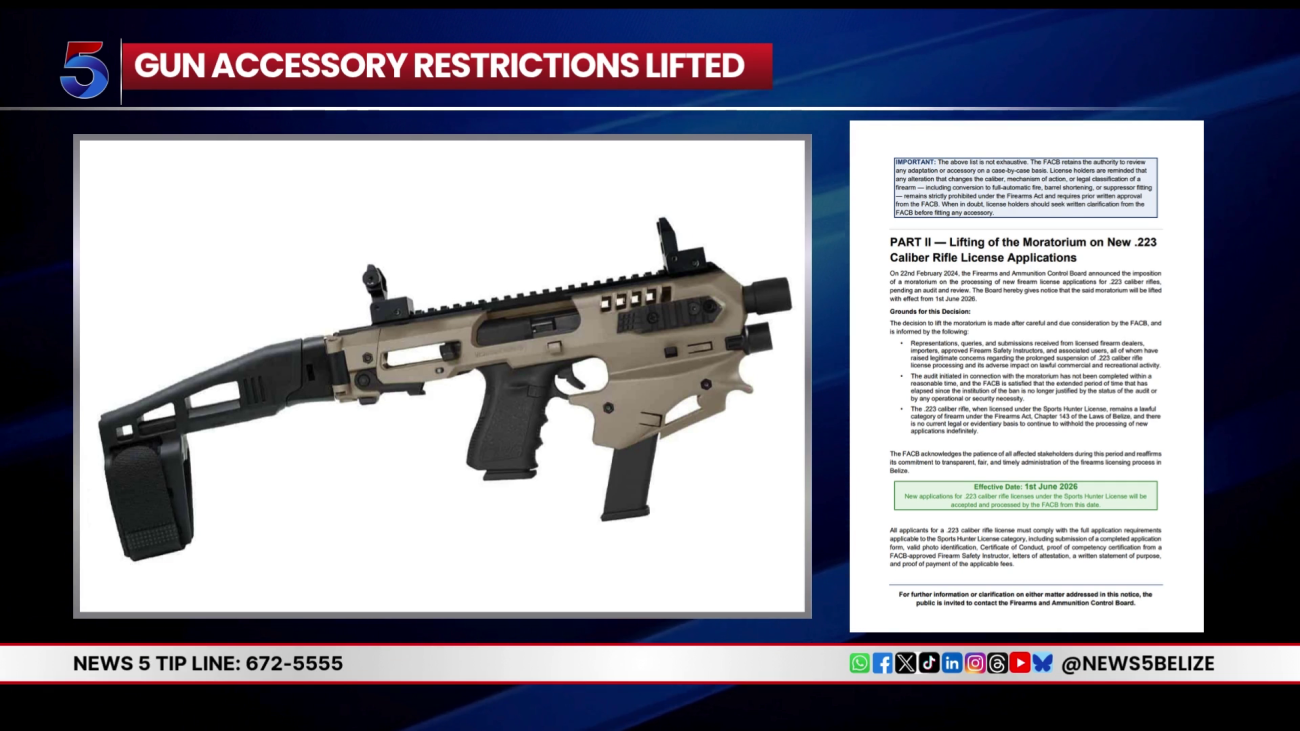
 The board also clears the way for certain firearm adaptations without additional approval, saying accessories like scopes, weapon lights and even micro‑conversion kits don’t change a firearm’s classification or lethality. That might be legal on paper, but does it match how people actually use these adaptations? And who draws the line between an “accessory” and something more dangerous?
Francis Usher
“What we found was that the main distinction that should be made is does it affect the the velocity or the manner in which the round comes out of the chamber. That’s where we draw the line. And a red dot or a green dot sight, a flashlight, these lasers they don’t typically affect how the round comes out of the chamber. What it does is it makes the firearm more accurate, and if you are a licensed firearm holder, we have already vetted you. We have already determined that we trust you to safely and legally operate a firearm. Then why not have you safely and legally operate it more accurately with these accessories?”
 At the same time, the FACB plans to lift the moratorium on new .223 rifle licenses beginning June 1, 2026. The ban, put in place in February 2024, was supposed to give time for an audit and review. Now the board admits that audit still isn’t finished, so why end the moratorium now?
Francis Usher
“It was for an audit to be done on two, two, three based on public outcry. I think the public outcry was based on an incident following a funeral where a rifle was pulled out. We are not easing off on the criteria for getting a two-two-three rifle. Those are still very strict body of criteria that’s very strict. But for current two-two-three holders we wanted to lift moratorium so that they could now get access to ammunition within reason of course. And also probably the main catalyst into making the decision to lift it now was that we went through several consultations with the cattle industry in Belize. Now coyotes are ravaging cattle in the north and along the border with Guatemala as well. Coyotes have a keen sense of smell, so you can’t get close enough to them to shoot them with a shotgun. And the twenty-two rifles weren’t doing anything to keep them away from the cattle. And certain farmers are losing as many as two, three cattle a night. That’s thousands of dollars.”
 Even as the moratorium ends and rules loosen, accountability is shifting, especially to gun dealers. Under the new framework, licensed dealers take on a bigger role in enforcement. Applicants must now complete training and pass a competency test at a certified firearm school before their applications move forward. Stakeholders say they welcome the added responsibility.
 On the Phone: Babil Abner, Owner, Locked and Loaded Guns and Ammo
“There has never been an issue with licensed firearm holders in the country of Belize. You have very minimal incidents when it comes to licensed firearm holder. Nothing on God’s green Earth is perfect and the percentage of incidents that come from firearm holders, licensed firearm holders is way below one percent. So there has never been an issue, and we have an excellent compliance rate. And these, the board acknowledges that and they are acting based on the information, based on the facts, right? So once again, I commend them. They’re very knowledgeable and all these decisions I believe are in the benefit of public safety and public interest.”
The goals for the Firearms Control Board are easier access in some areas, stricter vetting in others and a nationwide push to ensure that every gun owner understands the law before they ever pull the trigger. Shane Williams for News Five.
Attention readers: This online newscast is a direct transcript of our evening television broadcast. When speakers use Kriol, we have carefully rendered their words using a standard spelling system.
Watch the full newscast here: