



Infrastructure, Education Lead PM Briceno’s New Spending Plan
The Briceño administration is laying out its roadmap for the year ahead, and the draft national budget points to an economy that’s still growing, along with a bigger push on the country’s major priorities. For Fiscal Year 2026/27, government is planning a larger public‑sector investment program and steering most of its spending toward infrastructure, education, health, and climate resilience. According to the draft estimates, Belize’s economy is projected to reach seven-point-four billion dollars in 2026, fueled by expected gains in foreign investment and a steady climb in tourism. The overall budget ceiling comes in at 1.9 billion dollars. So, where will government be spending the most and where will it be tightening up? And just as important, where is the money coming from? News Five’s Paul Lopez takes a closer look.
 Paul Lopez, Reporting
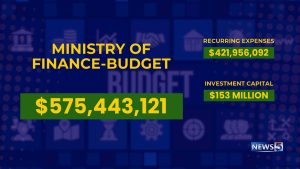
The Briceño administration proposes a budget ceiling of one point nine billion dollars for 2026/2027. It anticipates spending one point three billion in recurrent expenditure and six hundred and six million in investments. Which government ministries will spend the most in the new financial year? Well, the Ministry of Finance takes the lead with a budget estimate of five hundred and seventy-five million dollars. Most of that sum, four hundred and twenty-one million, will be used for recurring expenses, in areas like salaries and public debt service, while one hundred and fifty-three million dollars have been earmarked for capital investment, primarily going towards NHI’s expansion.
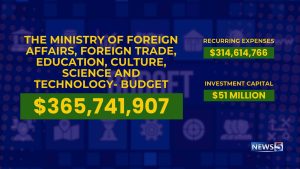 With a three-hundred-and-sixty-five‑million‑dollar budget, the Ministry of Foreign Affairs, Foreign Trade, and Education takes the number‑two spot on the spending list. With such an extensive portfolio under one ministry, three hundred and fourteen million dollars have been allocated for recurrent expenditure, primarily for wages, but also for grants and operational costs. The ministry’s investment capital stands at fifty-one million dollars. The Ministry of Health and Wellness ranks third in spending for the new fiscal year, with a budget of one hundred and ninety-nine million dollars. One hundred and one million dollars in recurrent expenditure. And an investment capital of ninety-seven million dollars, second only to Ministry of Infrastructure and Housing’s ninety-nine-million-dollar capital expenditure.
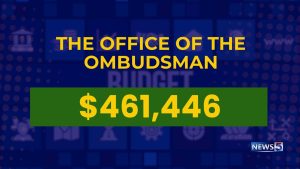
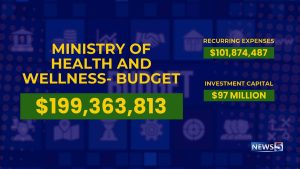 These allocations emphasize the government’s push to modernize Belize’s physical and social infrastructure, tackle debt, improve education and health services for Belizeans. But the opposite end of the Briceño administration’s proposed budgetary allocation paints a different picture. Where is the government spending the least? According to the draft estimates, the country’s oversight and governance watchdogs are among that list. For the Auditor General’s Office, the government has allocated three million dollars. The Integrity Commission is looking at a three-hundred-and-twenty-five-thousand-dollar budget. The Office of the Ombudsman will receive four hundred and sixty-one thousand dollars while four hundred and four thousand dollars have been allocated to the Office of the Contractor General’s. These offices, while essential for transparency and accountability, continue to receive comparatively low budget allocations.
 So, the big question tonight is: where is government getting the money to fund this massive budget? According to Prime Minister Briceño, most of it will come from tax revenue, an estimated one-point-five-eight billion dollars. Here’s how that breaks down. Government expects to collect eight hundred and forty-three million dollars from taxes on goods and services. Another four hundred and sixty-six million should come from income and business taxes. And just over two hundred sixty million dollars is projected from international trade taxes. Altogether, it forms the backbone of the revenue plan for the new fiscal year. As the National Assembly debates the estimates, Belizeans will watch closely to see how the Briceno administration priorities translate into real improvements in services, opportunities, and economic stability in the year ahead. Reporting for News Five, I am Paul Lopez.
Attention readers: This online newscast is a direct transcript of our evening television broadcast. When speakers use Kriol, we have carefully rendered their words using a standard spelling system.
Watch the full newscast here:
Facebook Comments