


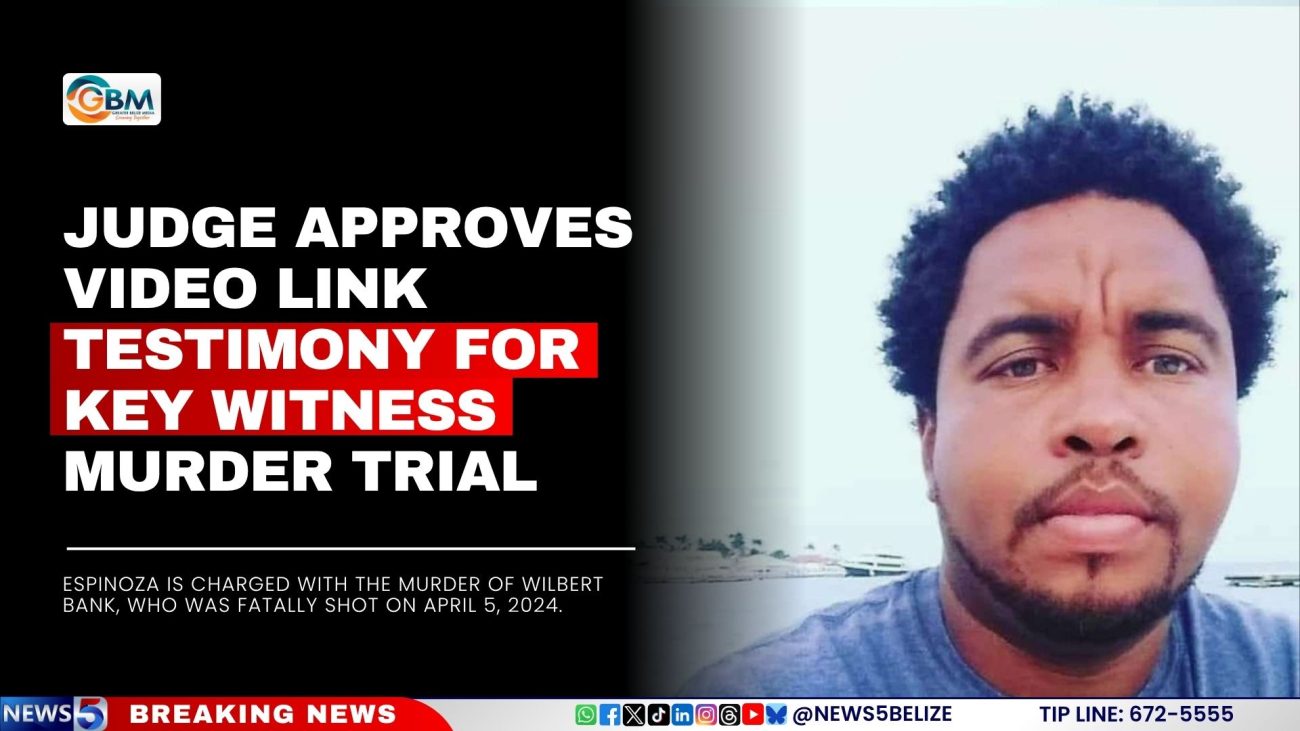
Judge Approves Video Link Testimony for Key Witness in Krismar Espinoza Murder Trial
A High Court judge has ruled that a critical Crown witness in the murder trial of Krismar Espinoza can testify by video link from the United States. The judge rejected arguments that the arrangement would be unfair to the accused.
Espinoza is charged with the murder of Wilbert Bank, who was fatally shot on April 5, 2024. The Crown had asked the court to allow Jenella Armstrong, described in the ruling as the primary witness grounding the case, to give her evidence remotely, since she now lives in the U.S. and has an active asylum application there.
According to her affidavit, Armstrong says she fears for her safety because of the case and alleges Espinoza threatened both her life and her son’s. She also argued that returning to Belize to testify in person could jeopardise her pending asylum claim in the U.S.
Espinoza’s lawyers argued that a witness testifying from outside the country has little real incentive to tell the truth, since she wouldn’t face meaningful risk of a perjury charge. They also suggested Armstrong’s stated fear wasn’t genuine at all. They argued that she really wanted to avoid the public assuming, from her appearing in court, that she had some hand in the murder herself.
Justice Pilgrim’s ruling leaned on Section 64(1)(c) of the Evidence Act, which lets courts accept evidence by video link, and Section 186 of the Senior Courts Act, which gives the High Court broad authority to hold hearings virtually. Neither provision draws a line between civil and criminal cases, and neither spells out strict conditions for when the discretion should be used.
The judge also drew on precedent from well beyond Belize, including a House of Lords ruling and a 2020 Privy Council decision, to make the point that a fair trial doesn’t require a witness to be in the same room as the accused. What it does require, he wrote, is that the defendant get a real chance to see, hear, and cross-examine the witness. Video link, he found, can deliver all of that.
Justice Pilgrim was careful to note he isn’t deciding, at this stage, whether Espinoza actually threatened her. That’s a matter for trial. He also rejected the defence’s perjury concern, noting that Armstrong would still be committing an offence under Belize’s Criminal Code if she lied to the court, regardless of which country she’s speaking from.
Armstrong will appear via Microsoft Teams, under oath, visible to the judge, the defendant, defence counsel, and the public, and she’ll be cross-examined just as she would in person.