



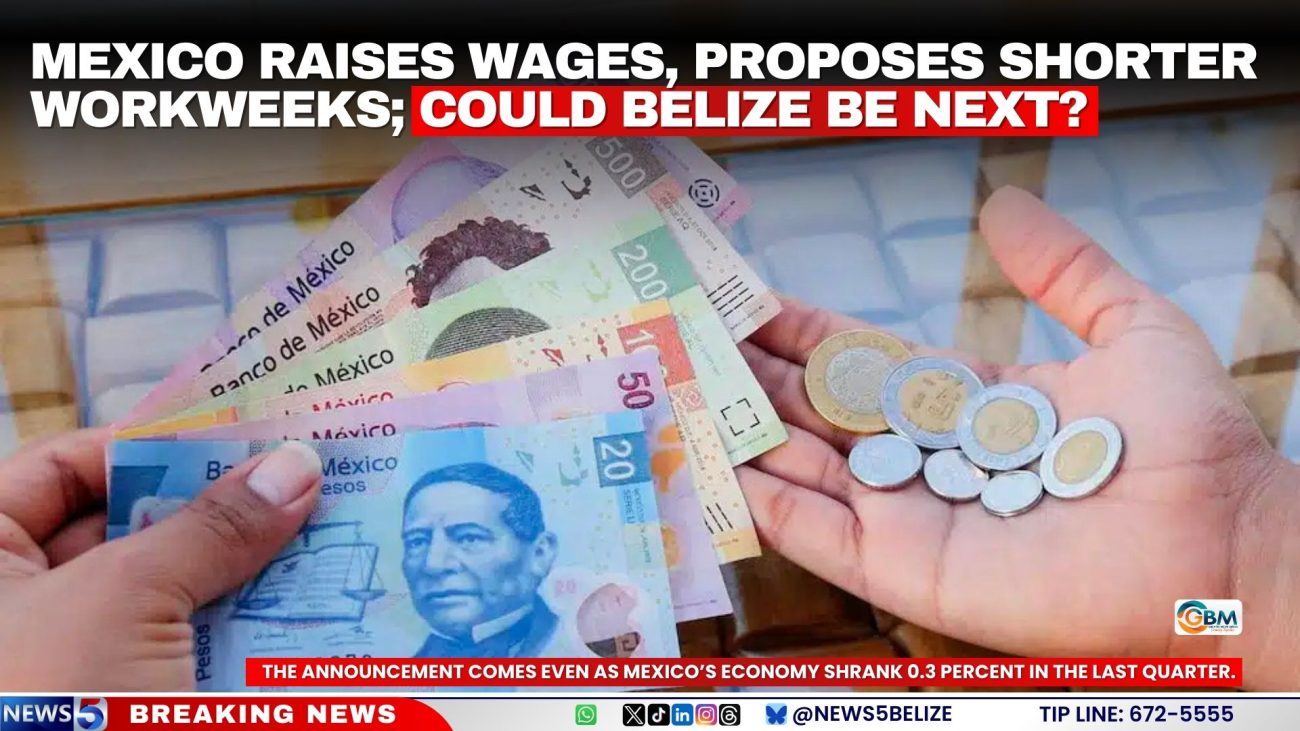
Mexico Raises Wages, Proposes Shorter Workweeks; Could Belize be Next?
Mexico is raising its minimum wage again and is now pushing to shorten the workweek. The announcement represents a major shift in the country’s workforce, and it raises questions about whether the region could be moving towards a similar direction.
Starting in January 2026, Mexico’s minimum wage will increase 13% to 315.04 pesos per day, which is equivalent to $17.27 USD per day. In the northern border zone it will rise to 440.87 pesos per day or $24.27 USD.
Assuming an eight-hour workday, the new daily rate in Mexico works out to roughly $2.15 USD per hour.
President Claudia Sheinbaum said wages have now grown 154% since 2018. She insisted the increases have not scared away investors. “For years it was said that the minimum wage could not go up, that it would cause inflation, that there would no longer be investment in the country, foreign investment. And we are at a record level of foreign investment,” Sheinbaum said during her Wednesday morning press conference.

The announcement comes even as Mexico’s economy shrank 0.3 percent in the last quarter.
The Mexican government is also proposing a gradual cut to the workweek from 48 hours to 40 hours by 2030.
Meanwhile, Belize is also proposing an increase in minimum wage in the coming year. In September, Prime Minister John Briceño announced that “hourly wage earners can soon expect another raise to $6 for the minimum wage,” which is equivalent to $3 USD per hour.
Facebook Comments