


No Robot Judges, But AI Is Now Assisting Belize’s Courts
Belize’s courts are getting a digital assist. Today, judges, magistrates, attorneys and other legal professionals are learning how artificial intelligence can help them research faster, work more efficiently and deliver better service to the public. The Judicial Education Institute of the Senior Courts is hosting a one-day workshop focused on the responsible use of AI in the legal profession. The training includes hands-on sessions with Lexis AI, a tool designed to support, not replace, the people who administer justice. Shane Williams has more.
 Shane Williams, Reporting
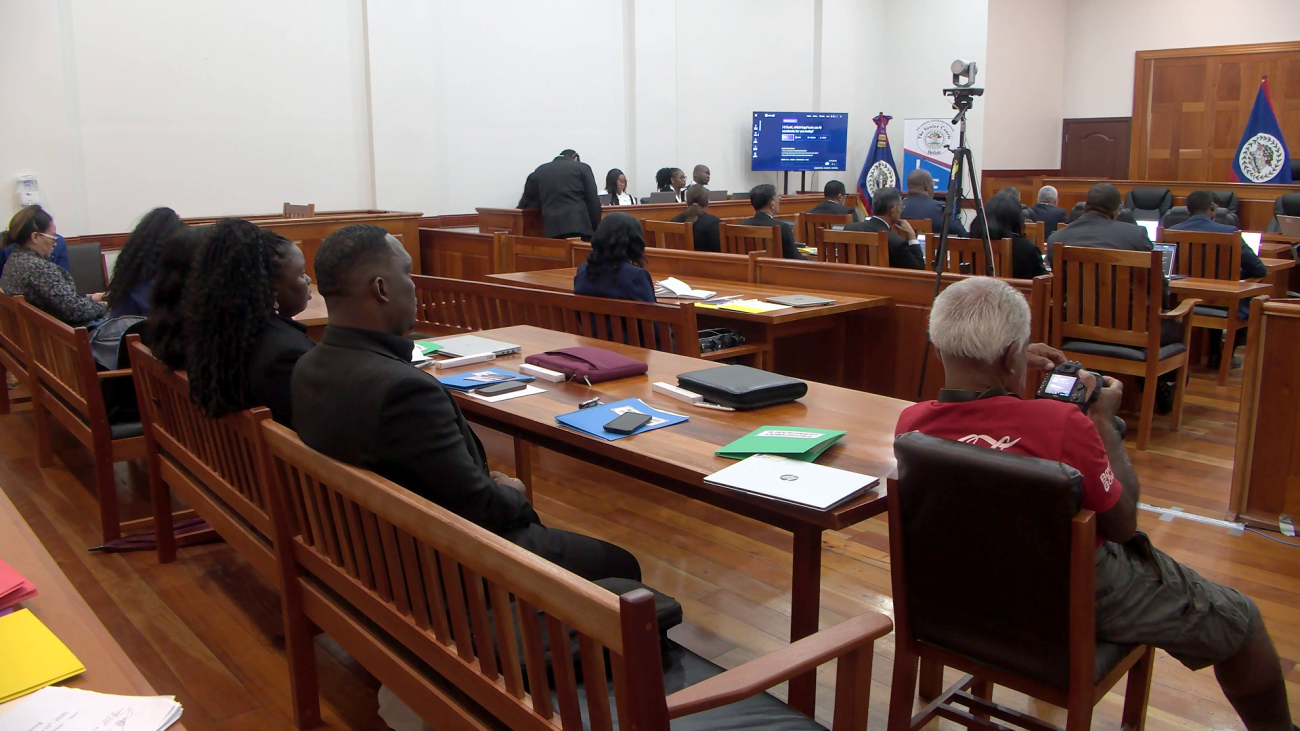
High Court justices, magistrates, attorneys and other legal professionals gathered in the Chief Justice’s chamber today for a second workshop on the responsible use of artificial intelligence in Belize’s Judiciary. Justice Derick Sylvestre says the judiciary is moving beyond simply talking about technology and is now putting it to work. He describes today’s workshop as another important step in the courts’ push to fully embrace digital tools in the administration of justice.

Derek Sylvestre
Derek Sylvestre, High Court Judge
“I must say that we’ve had the support of the powers that be in relation to having those trainings, because this is the second training. We’ve had one training already that dealt actually with the theoretical aspect of AI. Now we’re dealing with the practical aspect of AI. So today we’re actually doing hands-on training.”
UK-based AI consultant Scott Wiles facilitated today’s training on Lexis AI. He stresses that AI is just another tool in the courtroom designed to save time, not replace legal minds.

Scott Wiles
Scott Wiles, Director, Lexis Nexis
“The different judges that I’ve spoken to from different jurisdictions. They’ve got a lot of work on and any way that we can help streamline that process and reduce bottlenecks has been a really big impact for them. So even if it’s summarizing cases, whether it is actually helping them with workflows and starting to draft judgments, that’s some of the ways that they’ve been using it so far.”
 In today’s training, High Court judges say artificial intelligence has proven extremely useful for legal research, summarization of evidence and analysis of their work. Justice Sylvestre says technology and training embraced by the Judicial Education Institute of the Senior Courts has helped to markedly reduce workloads and backlogs.
Derek Sylvestre
“Now you go, you enter into the computer, you state exactly what you want, and you create all your research, create all your material. So one, it legally it would assist the court. Secondly, it would tremendously reduce backlog, because the issue with the court is time. For the last three years, you would no doubt recognize that the quantity of matters we’ve had in the court has decreased drastically. From a twelve-year backlog, now we’re onto a year or two.”
 Wiles says AI has proven valuable in reducing the time spent on repetitive legal tasks. But he stresses that every response generated by AI must still be carefully reviewed by the legal professional using it.
 Scott Wiles
“People for some reason will treat AI slightly differently, so they won’t give it all the information they would do a human. Or worse still, some people trust it blindly, whereas they wouldn’t do if someone else in the office provided them with the research they’d asked for. They’d look into that. They’d verify it. And I think that if you can try and frame it in that way, that it’s like a junior in the office, it probably adjusts your thinking and the way that you work to make it more effective.”
While artificial intelligence is becoming an increasingly powerful legal tool, today’s message inside the courtroom was clear. Technology can support the justice system, but it cannot replace the experience, ethics and independent judgment of the men and women entrusted to uphold the law. Shane Williams for News Five.
Attention readers: This online newscast is a direct transcript of our evening television broadcast. When speakers use Kriol, we have carefully rendered their words using a standard spelling system.
Watch the full newscast here: