



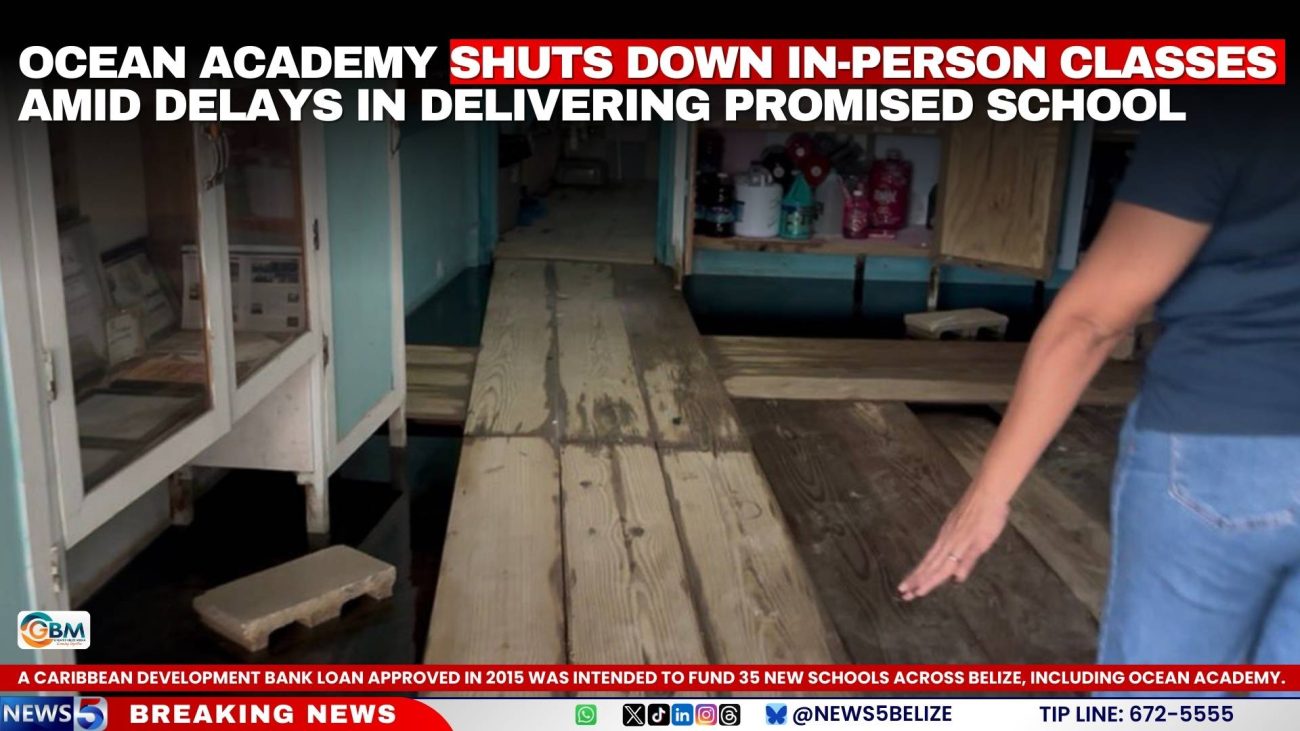
Ocean Academy Shuts Down In-Person Classes Amid Delays in Delivering Promised School
Ocean Academy High School in Caye Caulker has shut down in-person classes after health inspectors flagged severe flooding, widespread mould, and mosquito infestations that pose serious risks to students and staff. Despite repeated efforts to raise floors and pump out water, conditions have not improved, forcing the school into a hybrid system with classes scattered above bars, shops, and village council spaces.
The disruption comes as the school continues to wait for a promised new campus. A $70-million-dollar Caribbean Development Bank loan approved in 2015 was intended to fund 35 new schools across Belize, including Ocean Academy. A groundbreaking ceremony was even held in 2019, but construction never followed, and the site remains an empty lot. Five years later, officials cite administrative delays and the COVID-19 pandemic, while parents and local leaders are calling for urgent action.

Flooding and Mould Shuts Down Ocean Academy High School
Ocean Academy High School was forced to abandon in-person classes after health inspectors determined that severe flooding, widespread mould infestation, and mosquito breeding posed serious risks to students and staff.
The findings are contained in an urgent report (Report on Urgent Infrastructural and Health Hazards at Ocean Academy High School, Caye Caulker) submitted by the Environmental Health Unit of the Central Health Region following a site inspection conducted on November 18, 2025.
The school is housed in a three-story structure built on low-lying ground, a condition that has worsened over time as surrounding development occurred on higher elevations. Health officials say this has created a basin effect, making the campus increasingly prone to flooding. Even on a day without rain, water was found settled beneath raised wooden floors in the school’s main hallway, with cinder blocks laid out as makeshift pathways.
Principal Noemi Zaiden said the situation has been deteriorating for years. She says the school has repeatedly raised its floors, pumped out thousands of litres of water, including 4,500 litres in a single day during the most recent flooding, and hired an engineer to assess the building every three months. Despite those efforts, the flooding persists.
According to the report, Ocean Academy requested an urgent assessment on November 17 after flooding conditions became unmanageable. A team of public health inspectors, along with the school’s principal and counsellor, documented extensive water accumulation on the compound, particularly on the ground floor, where flooding has rendered classrooms, offices, and restroom facilities unusable.
Prolonged dampness has led to visible mould growth on walls, ceilings, and surfaces throughout the building, accompanied by a strong and persistent odour indicating deep moisture retention. Inspectors also observed warped wooden flooring, deteriorating walls, and signs of compromised structural integrity, particularly on the lower level.
The stagnant water has created ideal breeding conditions for mosquitoes, raising additional public health concerns. Health officials warn that the infestation increases the risk of vector-borne illnesses such as dengue, compounding the dangers posed by poor air quality and mould exposure.
The report highlights that several students at Ocean Academy suffer from asthma and severe allergies, placing them at heightened risk of respiratory complications due to mould exposure. Inspectors concluded that the conditions violate basic public health standards and the right to education in a safe environment.

Health Report Detailing the Conditions of Ocean Academy, Nov 18, 2025
As a result, the school has transitioned to online learning. However, the report notes that this solution presents significant challenges, particularly for students living in areas without reliable electricity or internet access.
Health officials recommended immediate relocation support to identify temporary spaces for in-person instruction, with priority given to students most affected by digital access barriers. They also advised restricting access to the ground floor entirely, closely monitoring upper floors for signs of structural compromise, and notifying parents and guardians of the health risks involved.
Former Village Council chairperson Wayne Miller urged residents to respond with urgency. He said they “should get the same kind of energy we got some weeks ago with this referendum. Because this situation is tragic, and it is more important than a weed referendum.”
Makeshift Classrooms Leave Ocean Academy Students Struggling to Learn
After health officials recommended the school’s closure, Ocean Academy was left scrambling for space. Administrators were advised to relocate students immediately.
With no permanent alternative, the school shifted to a hybrid system, rotating students between online learning and in-person classes held wherever space could be found.
The village council offered two rooms and office space, where classes were squeezed around a single long table. Teachers had no chalkboards or whiteboards, and some sessions had barely a dozen students, showing decreased attendance.
Local businesses also opened unused spaces above shops and bars. At The Magic Grill, the first floor featured an open bar with music playing, while the second floor hosted just under 20 students in an empty event space. In this makeshift classroom, students sat without desks, balancing notebooks on their laps, with a stack of unused chairs pushed to the back.
Even physical education has been improvised, with no gym or schoolyard, students play football in an empty lot near the island’s airport landing strip.
“It’s really hard for me because I learn more face-to-face,” said Nathaneal Rodriguez, a fourth-form student. “Not having that connection with my teachers and friends makes it hard to complete assignments. I don’t want to spend my last year online.”
He added, “Whenever I need help with work, learning it through a voice call or voice message, or also on text, is really hard. I think a lot of students in Ocean Academy struggle with that issue. And they need that hands-on experience.”
Parents say the disruption has taken a toll at home as well. With students learning online, many families struggle to create quiet, focused environments for schoolwork.
“When are they going to build the new high school here on the island?” asked parent Alfonso Magaña. “Because the kids have been moving around and around…When is the government going to step in and start the new high school?”
A $70 Million Loan, a Promise, and an Empty Lot
What makes the situation more troubling, parents say, is that Ocean Academy was promised a new campus years ago.
In October 2015, the Government of Belize signed a loan agreement with the Caribbean Development Bank titled the Belize Education Sector Programme II. The $70 million loan focuses on constructing and equipping 35 schools at the pre-primary, primary, and secondary levels. The stated goal was to “increase access to quality basic education and assist the Government in increasing the number of children benefiting.”
When the project was launched in January 2016, the then Minister of Education, Patrick Faber, said, “These schools will be across the country. These schools are being put there as a result of a school mapping exercise that we did in the preparatory stages with the support of the Caribbean Development Bank. We looked at projected population growth. We looked at where students were not being served. That is how we determined where these 35 new schools will be.”
Following the launch, the ministry held a series of groundbreaking ceremonies across the country, signalling that construction was imminent.
That same year, then Caye Caulker Village Council Chairperson Wayne Miller wrote to the former United Democratic Party Area Representative, Manuel Heredia, to secure land large enough to accommodate Ocean Academy’s expansion. Miller said his push was driven by a belief that “education is what gets you through life…It’s one of my obsessions. And we bent over backwards.” The council eventually secured 5.17 acres of land, which required mangrove clearing and land filling before construction could begin.

Land Papers Showing the Acquired 5.17 Acres
On December 19, 2019, Ocean Academy held its own groundbreaking ceremony on the newly acquired site. Ministry of Education officials assured the community that construction would begin in early 2020.
Photographs and video from the ceremony show cameras rolling as the school’s principal, village council representatives, the area representative, and Faber delivered speeches and posed with shovels beside a ceremonial pile of sand. Promises were made, applause followed, and the community was told construction would soon begin. Faber said, “As I said, we are building thirty-five new schools across the country. Twenty-two of them are pre-schools. I just saw the drawing of what these preschools will look like. This is not a small-type preschool. This is a state-of-the-art facility, and you are going to have one of those facilities right here on Caye Caulker.”
According to the CDB, “The new schools will include 178 classrooms and laboratories, as well as relevant sanitary and administrative spaces. The project will also fund the outfitting of each school with furniture, equipment, and technology to enhance the students’ learning environment.”
The CDB’s Loan and Programme Summary states that the implementing agency is the Ministry of Education, but does not provide project‑level disbursement details, leaving communities uncertain about how funds were allocated for all 35 schools.
Five years later, the land remains empty, as construction for a new school in Caye Caulker has yet to begin.
Miller says, “Everything was approved, the ribbon was cut, money was allotted, and the contract was signed with the person that was going to build. Everything was set to go, and unfortunately, something happened.” Or did not happen.
What Happens to a Loan So Big When an Administration Changes?
The Caribbean Development Bank lists the Ministry of Education’s Project Execution Unit as responsible for implementing the programme. However, the ministry’s own website lists the unit as “under construction,” with no publicly available data on project spending, timelines, or completion.

Ministry of Education’s Webpage Showing an ‘Under Construction’ Project Execution Unit
When asked what happened to Ocean Academy during his tenure, former Education Minister Patrick Faber said the loan funded multiple schools nationwide. “I think it was about 10 or so high schools across the country under the loan programme from the Caribbean Development Bank,” Faber said. “Of course, we built a number of these schools, but time ran out on the administration.”
The People’s United Party assumed office on November 12, 2020, following national elections. Faber attributed the failure to complete Ocean Academy to the change in government.
“When the transition happened, the project somehow got lost, and I think that is a tremendous shame,” he said. “While I don’t want to be quick to say the PUP threw out the baby with the bathwater, they certainly have not made any great effort to ensure Caye Caulker has a permanent place for secondary education. That is a travesty for the people of Caye Caulker.”
Faber also cited the COVID-19 pandemic as a possible factor.
Belize had reported its first case of COVID-19 on March 23, 2020. And as the cases grew, many businesses and schools eventually saw closures during the period 2020-2021.
However, questions remain about what portions of the loan were already approved, contracted, or allocated before those closures.
News Five also sought comment from the current Area Representative for Belize Rural South, Andre Perez, who described the 2019 ceremony as a “groundbreaking for show,” while stating that construction is now expected to begin in 2026. “The process has been slow,” Perez said, “but there is a plan that still exists, and I assure you that plan will be executed. By next year, if we do nothing, those funds will be renegated back to where it came from.”
“I can confirm that the funds are not lost. We have the plans in place to build these schools,” he said.
Perez’s administration has already served one full term from 2020 to 2024 and is now in its second consecutive term.
Addressing community speculation that some of the designated land had been sold, Perez denied the claim, saying the land was cleared in 2021 through collaboration with sand extractors who deposited fill material on the site. “Whatever was inherited from the last administration is still intact,” he said.
Paul Thompson, Chief Executive Officer in the Ministry of Natural Resources, confirmed that the land remains registered under the Government of Belize. He said the formal transfer process is ongoing and largely procedural, as the land is government-owned.
Perez reiterated his commitment to the project, saying he intends to hold what he described as the “real” or “authentic groundbreaking” in the coming year. For many in Caye Caulker, similar assurances have been made before.
Perez, however, maintains that construction is imminent.
“The bids are going out already,” he said. “Everything should be starting no later than May, and they do not expect it to go beyond one year construction time period.”
A Future in Doubt
Meanwhile, parents have collected more than 2,000 cinder blocks, and others have offered two prefabricated houses in an effort to provide students with a stable learning space. School administrators say those efforts have faced resistance from representatives of Area Representative Andre Perez on the island.
Perez denied that claim. “No one has approached me during that process,” he said. “I have not heard about it, but if there is a group who would like to do some work right now, I am willing to work along with them. If there is anybody who wants to donate, I am here to work. There has been no pushback from our side. Not at all.”
For Principal Noemi Zaiden, the strain is already evident. The hybrid system, she said, is taking a toll on the resilience of both teachers and students.
“As we move into the holidays, it’s weighing on our minds,” she said. “What do we come back to?”
The loss goes beyond physical space.“The sound of students moving from classroom to classroom matters,” Zaiden said. “Being able to socialise, to be with their peers, to just be teenagers on their campus. They deserve that. This community deserves that.”
Facebook Comments