



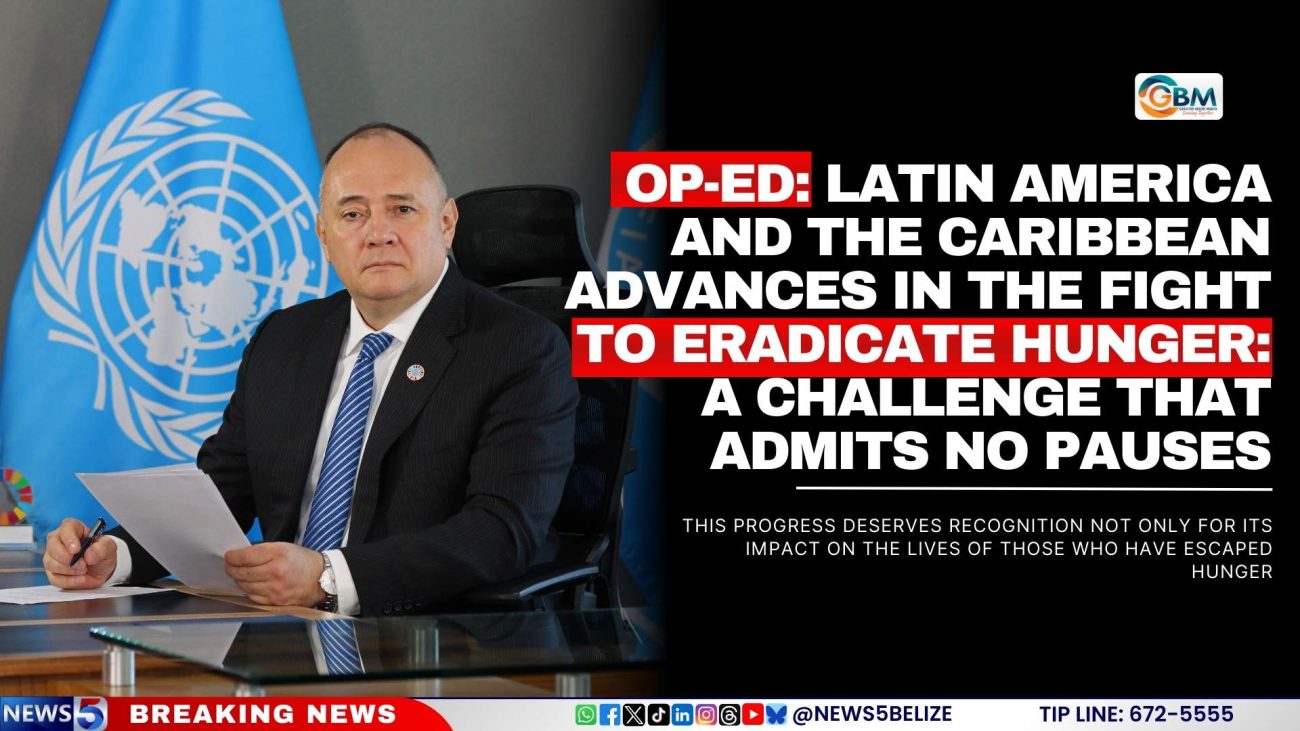
Op-ed: Latin America and the Caribbean advances in the fight to eradicate hunger: a challenge that admits no pauses
By René Orellana Halkyer, Assistant Director-General and FAO Regional Representative for Latin America and the Caribbean
Eradicating hunger is an ethical imperative and an essential condition for the development of countries. Every step forward in reducing hunger is therefore not only an encouraging statistic; it is a clear sign that, with strong political commitment and sound public policies, it is possible to transform realities and improve lives.
The most recent data from the 2025 Regional Overview of Food Security and Nutrition, published by FAO together with other United Nations agencies, confirm that undernourishment declined for the fourth consecutive year. In 2024, it affected 5.1 percent of the population, down from 6.1 percent in 2020. In concrete terms, 6.2 million people no longer suffer from hunger.
This progress deserves recognition not only for its impact on the lives of those who have escaped hunger, but also because it demonstrates that public policy decisions adopted by countries can generate real transformation. When national authorities show strong political commitment and promote economic recovery measures, social protection, support to family farming, productive innovation and the promotion of agrifood trade, among other actions, results follow.

However, we must continue to join efforts and work together, as more than 33 million people in the region still suffer from hunger. Some 167 million face food insecurity, 181 million cannot afford a healthy diet, and 141 million adults are living with obesity.
These figures reflect a persistent paradox of the double burden of malnutrition across all our countries: hunger coexists with overweight and obesity, nutritional deficiencies with unhealthy diets. Access to a healthy diet also remains limited due to its high cost, which stands at 5.16 PPP dollars per person per day — the highest in the world.
The high cost of a healthy diet is one of the main drivers of food insecurity and malnutrition. It is compounded by economic challenges, limited access to fresh and nutritious foods, and the consequences of extreme climate events that affect agrifood systems and call for policies that strengthen their sustainability and resilience.
Hunger both reflects and deepens poverty and inequality. Access to food and healthy diets should not be a privilege for a few.
The upcoming 39th FAO Regional Conference for Latin America and the Caribbean (LARC39) represents an important opportunity for dialogue and decision-making.
This entails strengthening family farming and sustainable production systems to eradicate hunger and poverty and reduce inequalities; expanding and improving school feeding programmes by incorporating public procurement from family farmers and national dietary guidelines; implementing subsidies to enable the most vulnerable populations to access nutritious but costly foods; and promoting food environments in cities that facilitate access to and consumption of healthy diets.

Sponsored by RF&G
It also means strengthening and modernizing food supply systems, fostering agrifood trade to increase the availability and access to a wider variety of foods, expanding robust social protection systems with synergies with productive inclusion programmes and a focus on reducing hunger and poverty, investing in innovation and digitalization for production, productivity and climate resilience, and mobilizing financing for large-scale investments through the Hand-in-Hand Initiative.
The region has shown that progress is possible. The challenge now is to sustain that momentum and make it inclusive, so that everyone can access sufficient, safe and nutritious food and healthy diets.
Since 1945, FAO has supported its Members through the generation of data and scientific evidence, technical cooperation for the implementation of policies and actions, and the mobilization of investments. Today, FAO is implementing its Strategic Framework 2022–2031 across the region through four Regional Priorities aligned with the Four Betters — Better Production, Better Nutrition, a Better Environment and a Better Life — strengthening sustainable production, food security and nutrition, climate action and social inclusion.
Together, we can work to develop the policies and programmes needed to drive change and build more efficient, inclusive, resilient and sustainable agrifood systems for food security and nutrition.
Facebook Comments