
Plan Belize Promises Prosperity, But Where’s the Money?
The government has laid out an ambitious vision for Belize by 2030: poverty below ten percent, annual economic growth above seven percent and public debt below sixty percent of GDP. But reaching those targets will require more than another national plan. Plan Belize 2.0 acknowledges that government spending still does not fully reflect its priorities, while climate shocks threaten to erase hard-won gains. Tonight, News Five’s Paul Lopez examines the gap between the promises, the money and the results Belizeans are being told to expect.
 Paul Lopez, Reporting
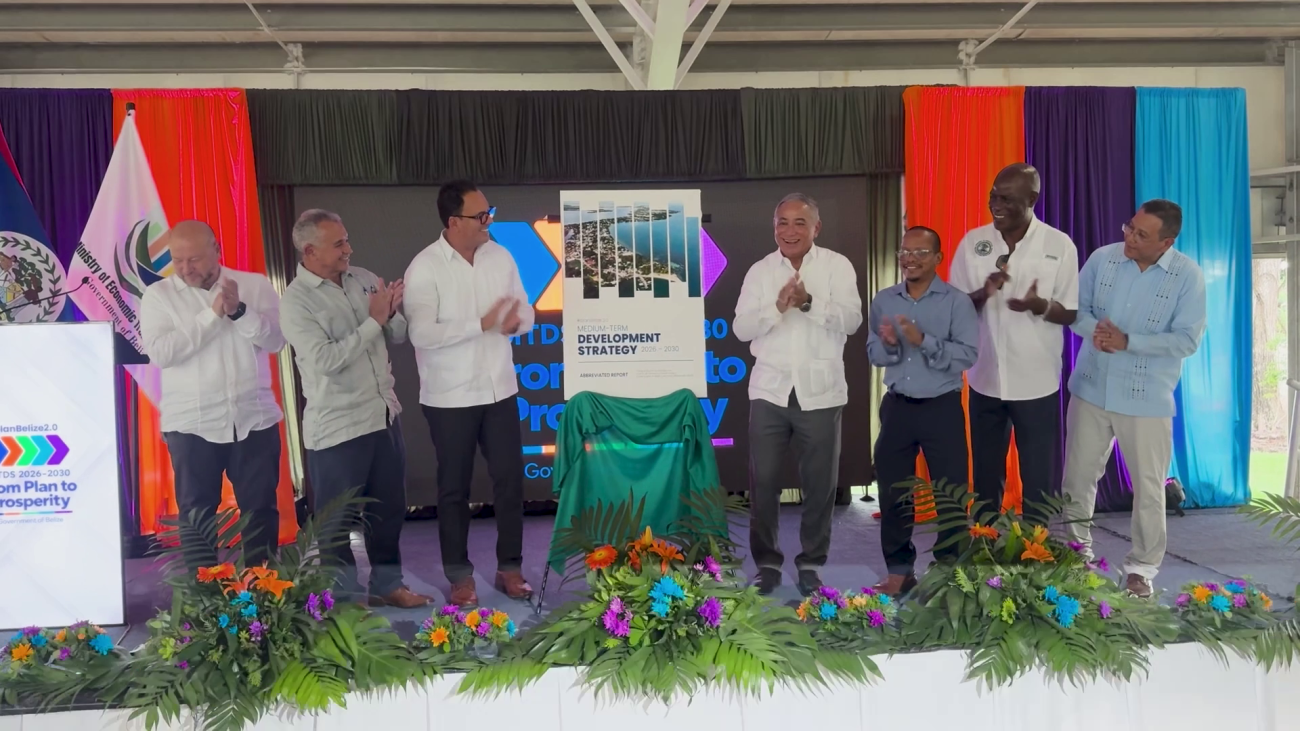
Plan Belize 2.0 promises prosperity by 2030, but the government’s own strategy identifies a major obstacle: it is not yet spending enough on several of the areas expected to drive that progress. The government launched its Midterm Development Strategy this week at Muffles College Auditorium in Orange Walk. The five-year framework sets fourteen objectives across five pillars under the theme, “From Plan to Prosperity.” Prime Minister John Briceño says the planning phase is over. The challenge now is disciplined execution.
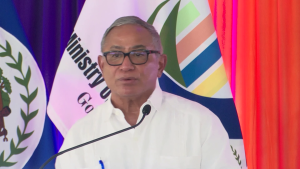
Prime Minister John Briceño
Prime Minister John Briceño
“We have to be more deliberate about our choices, more coordinated in our efforts and much more disciplined about following through. We must become more deliberate, more strategic, more connected in our thinking, more determined in our execution. That is what Plan Belize 2.0 is designed to help us do.”
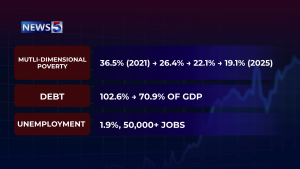 The government says multidimensional poverty has nearly halved since 2021, with roughly thirteen thousand fewer Belizeans facing deprivation. It credits the minimum-wage increase, school-feeding programs and expanded health insurance. Belize created more than fifty thousand jobs, with over forty percent in outsourcing, while public debt fell from nearly one hundred and three percent of GDP to about seventy percent. The new strategy now sets a common yardstick for measuring each ministry’s performance.
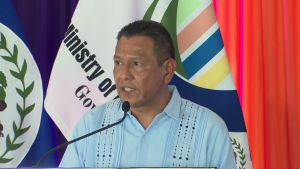
Carlos Pol
Carlos Pol, CEO, Ministry of Economic Transformation
“In my view, we cannot have a national strategy if the institutions responsible for delivering it cannot see themselves in it, and that is one of the things I am particularly pleased about this strategy. The MTDS gives us a framework, but it does not attempt to prescribe every action that every institution must take. Instead, it gives us a basis for coordinating the implementation, and it gives us a way to measure the progress we are making, because this strategy will only succeed when the individual contributions add up to something greater than the sum of their parts.”
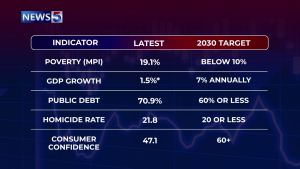 The government’s 2030 targets are ambitious: poverty below ten percent, debt under sixty percent of GDP, fewer homicides and annual growth above seven percent. Belize reached that growth rate during the post-pandemic rebound, but averaged only one-point-two percent in the decade before COVID-19. The strategy describes its targets as ambitious but achievable. The Prime Minister concedes, however, that governments have unveiled plans before without delivering the promised results.
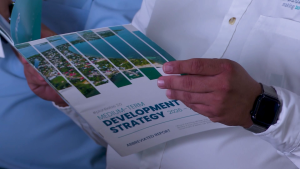 Prime Minister John Briceño
“Of course, setting out a direction is only the beginning. The real test is whether we can carry it through. We have all seen plans with good intentions that never quite make it beyond the planning stage. We have seen priorities delayed, priorities lose momentum and opportunities pass us by. And too often, we are left looking back at what could have been. I don’t want this strategy to become a next document that we look back with regret.”
The government has set ambitious targets, but the money has not caught up. Economic transformation, agriculture and climate programs all receive less than the strategy recommends. Capital spending will rise in the 2026–27 budget, but with 2030 approaching, the government must quickly turn its priorities into funded programs and measurable results.
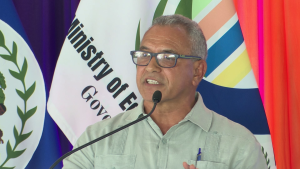
Orlando Habet
Orlando Habet, Minister of Sustainable Development
“This is a moment for both continuity and for ambition, to build on what has worked, confront what still needs to be changed and apply the lessons learned. Our task is clear: to turn national priorities into lasting progress for our people.”
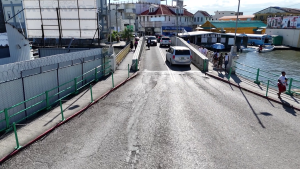 The strategy promises Belizeans a way to judge that progress. Ministries will have targets, deadlines and indicators showing whether living conditions are actually improving.
Orlando Habet
“We must demonstrate what changed as a result, whether poverty declined, access to essential services improved, better employment opportunities were created, communities became more resilient and environmental pressures were reduced. Most importantly, we must show whether the lives of Belizeans improved.”
Plan Belize 2.0 has now set the benchmarks. By 2030, the numbers should reveal whether the government matched its spending and execution to its ambitions, or simply produced another plan that promised more than it delivered. Paul Lopez for News Five.
Attention readers: This online newscast is a direct transcript of our evening television broadcast. When speakers use Kriol, we have carefully rendered their words using a standard spelling system.
Watch the full newscast here: