


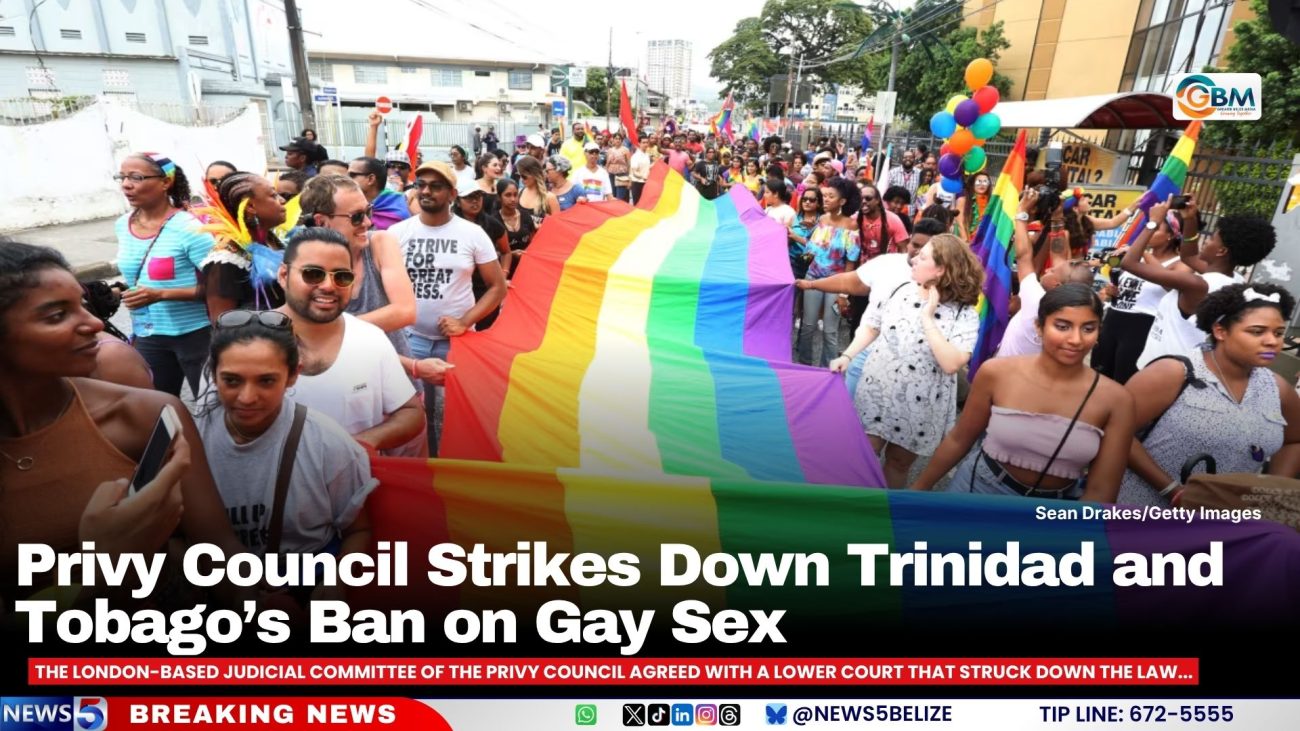
Privy Council Strikes Down Trinidad and Tobago’s Ban on Gay Sex
The Privy Council, the highest court of appeal for several former British colonies, has struck down a law in Trinidad and Tobago that criminalized gay sex, ending a colonial-era ban that dates back over a century, CNN reports.
The London-based Judicial Committee of the Privy Council agreed with a lower court that struck down the law. It had criminalized “buggery” and “gross indecency” between gay partners and carried prison terms of up to five years for the first and two years for the second.
The case was brought by Jason Jones, an LGBTQ+ rights activist born in Trinidad who lives in the United Kingdom. He won in the High Court of Trinidad and Tobago in 2018, but the Court of Appeal overturned that ruling in 2025. He then took the case to the Privy Council.
Jones said he filed the case to start a movement toward equality. “My case is not just about decriminalizing (gay sexual acts in) countries in the Commonwealth that carry these British colonial-era laws. It’s about making people aware (of) how homophobia is being weaponized to take away our democratic rights.”
The law traces back to England’s “Buggery Act” of the 1500s, and Britain applied a version of it in Trinidad and Tobago through a 1925 act. The country kept the ban after independence under a “savings law” clause that shields pre-independence laws from challenge. In 1986 it repealed the 1925 provisions and brought in tougher measures. Jones’ lawyers argued those 1986 measures were not protected by the clause.
Belize has already been through this. In August 2016, the Supreme Court ruled in a case brought by activist Caleb Orozco that Section 53 of the Criminal Code, which carried a 10-year prison term for “carnal intercourse against the order of nature,” was unconstitutional and violated his rights to dignity and privacy. The court added a line that the section “shall not apply to consensual sexual acts between adults in private.” The Court of Appeal upheld the ruling in December 2019 and dismissed the Government’s limited appeal.
The judgment applies only to Trinidad and Tobago, but activists say it could open the way to similar challenges in other former colonies that still use the Privy Council. Ria Mohammed, an attorney and director of the Caribbean Centre for Human Rights, said it would be hard for another case within the Privy Council’s jurisdiction to be decided differently.
Belize is one of five countries, along with Guyana, Barbados, Saint Lucia and Dominica, that have replaced the Privy Council with the Caribbean Court of Justice as their final court of appeal.