



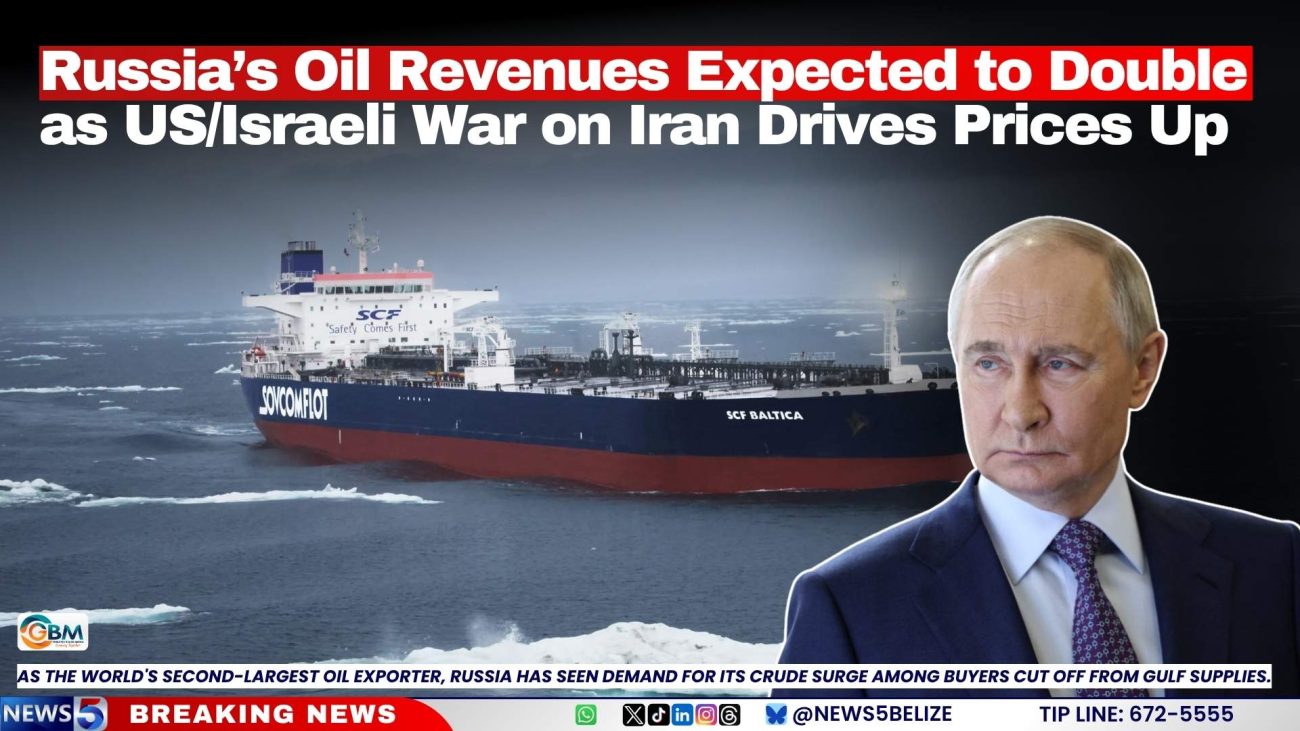
Russia’s Oil Revenues Expected to Double as US/Israeli War on Iran Drives Prices Up
Russia is expected to collect about USD $9 billion in oil taxes this month after Iran shut the Strait of Hormuz following strikes by the U.S. and Israel. This has sent global energy prices soaring, Reuters reports.
Global oil prices have jumped nearly 50% since the strikes on February 28.
The Strait of Hormuz, a narrow passage at the mouth of the Persian Gulf, has been almost completely closed since Iran retaliated. On Wednesday, only six ships passed through in 24 hours, compared to the usual 140.
Iran’s Revolutionary Guard has directed ships to use a route near Larak Island, warning of naval mines in the main lanes. Still, more than 180 tankers remain stranded in the Gulf.
A two‑week ceasefire is now in place, but shipping companies say they need stronger safety guarantees before resuming normal operations. Japanese firm Mitsui O.S.K. Lines said Thursday it managed to move three tankers during the ceasefire but is still waiting for government guidance.

As the world’s second-largest oil exporter, Russia has seen demand for its crude surge among buyers cut off from Gulf supplies. Reuters calculations show Russia’s main oil extraction tax revenue will double to around USD$9 billion in April alone, up from USD$4.7 billion in March. The average price of Russia’s Urals crude jumped to $77 per barrel in March, its highest level since October 2023 and well above the $59 per barrel the Russian government had budgeted for this year.
At the same time, the conflict is also affecting the global financial system, as Iran and China push to reduce reliance on the US dollar.
Most oil deals worldwide are paid in US dollars. Iran, by controlling Hormuz, has started charging some ships in Chinese yuan instead. China’s Ministry of Commerce confirmed reports of payments in yuan, and Iran’s embassy in Zimbabwe said it was time to add the “petroyuan” to the global oil market.
“At one level, Iran is aiming to poke its thumb in the United States’s eye, adding insult to injury,” Harvard economist Kenneth Rogoff told Al Jazeera. “At another level, Iran is dead serious about preferring yuan to avoid US sanctions and to cultivate its ally, China,” he added.
Facebook Comments