



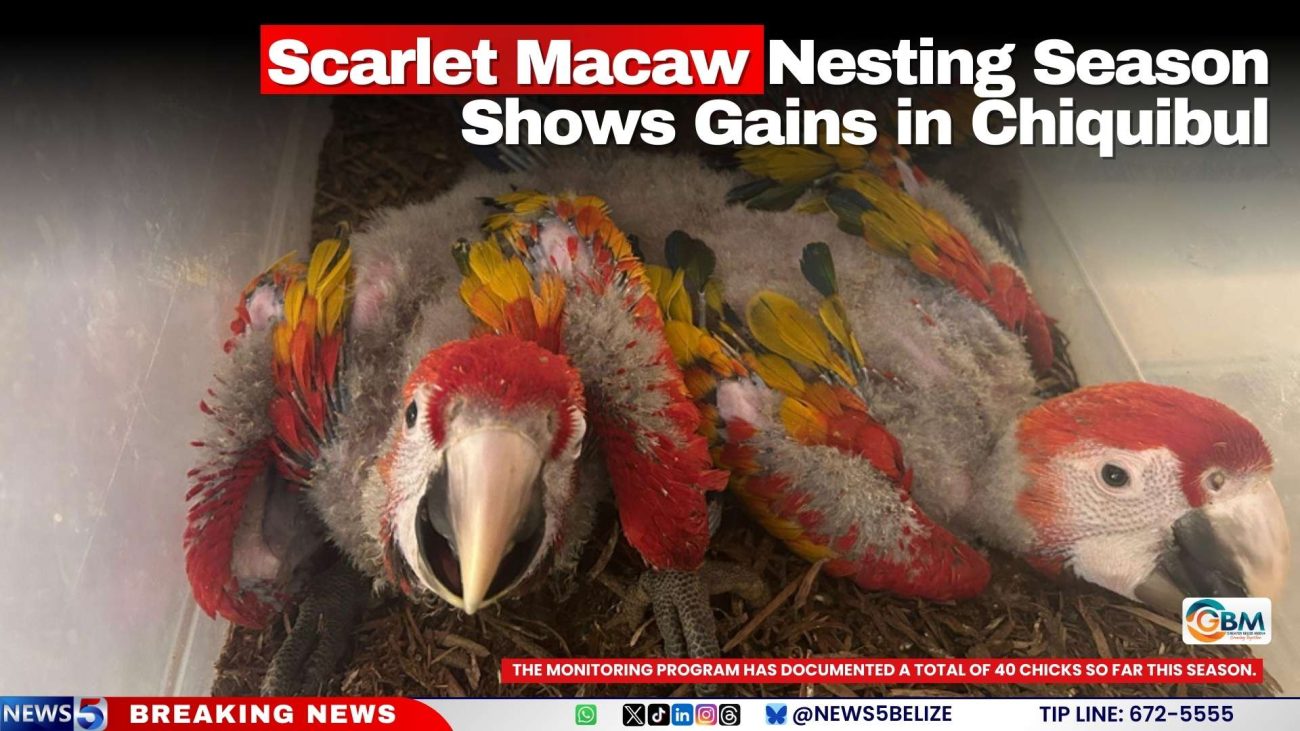
Scarlet Macaw Nesting Season Shows Gains in Chiquibul
Belize’s endangered Scarlet Macaw population is showing encouraging signs this nesting season, according to a mid season 2025 update on conservation efforts in the Chiquibul ecosystem.
The Neotropical Scarlet Macaw, one of the most recognizable bird species in the region, is native to the humid evergreen forests of Central and South America. While the species is listed globally as “Least Concern” by the International Union for Conservation of Nature, the subspecies found in Belize, Ara macao cyanoptera, remains endangered due to habitat loss and pressures linked to human settlement and development.
In Belize, the Scarlet Macaw’s range is largely confined to the Chiquibul and Maya Mountain Massif. Sightings are most common along riparian corridors such as the Upper Macal River and its tributaries, including the Raspaculo, Monkey Tail, and Chiquibul Rivers, where food sources are plentiful during the dry season. Conservationists estimate the national population at just 300 to 350 birds, underscoring the importance of sustained protection and monitoring.

Friends for Conservation and Development has been leading Scarlet Macaw monitoring and nest protection efforts in the Chiquibul since 2011. In 2025, the organization continues to track breeding activity while guarding against poaching, particularly the illegal extraction of chicks from nests.
As of June 15, 2025, FCD identified 23 active Scarlet Macaw nests across the forest. Two nests failed after eggs were eaten by an unidentified predator. Data collected so far show that 70 eggs were laid during the season. Of these, 42 hatched successfully, 16 failed to hatch due to infertility or embryo failure, six were lost to predation, and six remain under incubation.
Based on current figures, hatching success for 2025 stands at 60 percent, a result conservationists consider promising. Egg failure accounts for 22.86 percent, while predation represents 8.57 percent of losses. Another 8.57 percent of eggs are still incubating, leaving room for further improvement in final outcomes.
The monitoring program has documented a total of 40 chicks so far this season. Twenty six remain in the wild within natural nests, while 14 are being cared for at in situ facilities at Las Cuevas.
FCD recommends continued monitoring of the remaining incubating eggs, along with targeted strategies to reduce nest predation. The organization also plans to explore whether nesting success is influenced by factors such as nest location, environmental conditions, or parental behavior.
Facebook Comments