


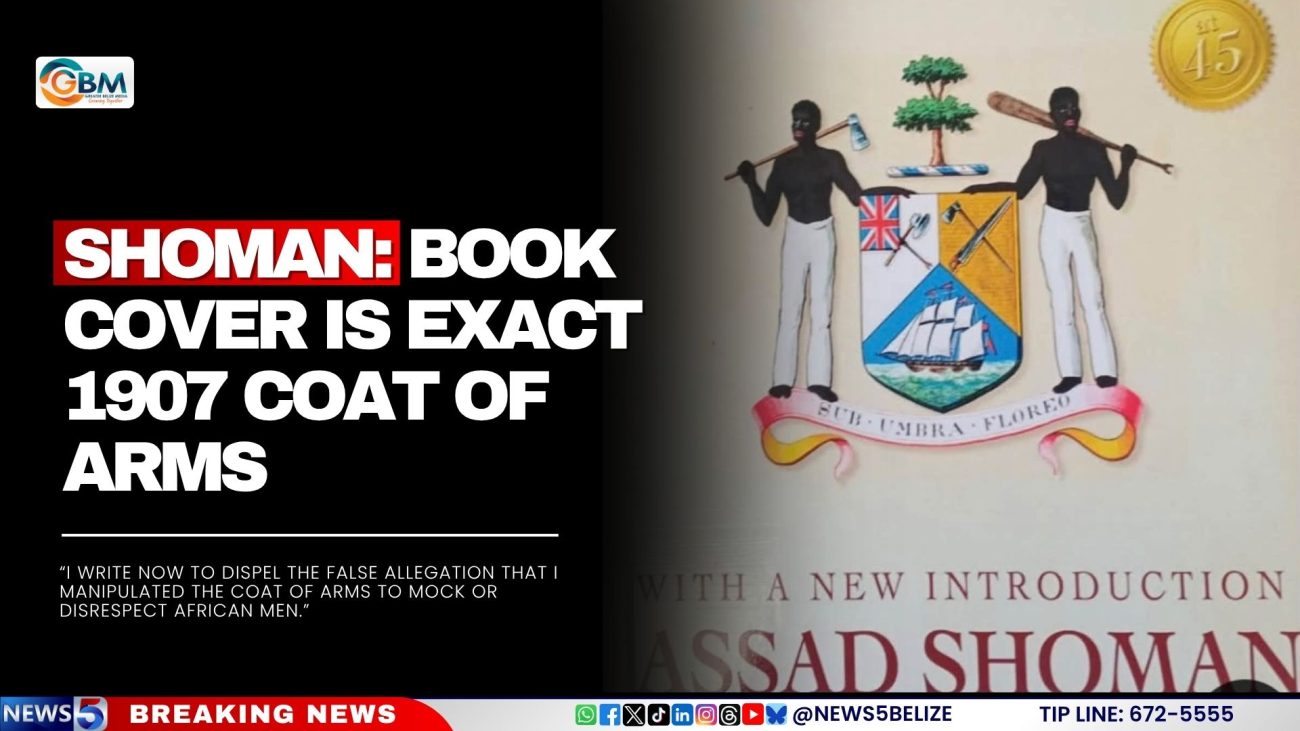
Shoman: Book Cover Is Exact 1907 Coat of Arms
Author Assad Shoman has responded to the National Kriol Council (NKC). He says the cover of the Sapphire edition of A History of Belize in Thirteen Chapters exactly reproduces the 1907 British Honduras Coat of Arms and was not altered to mock African men.
The council objected to what it called “exaggerated racial imagery” on the cover. It said the depiction of exaggerated Black figures “evokes degrading racial caricatures historically used to ridicule, dehumanise, and undermine the dignity of people of African descent.” It called on the author and publisher to explain the choice of image.
Shoman answered in an open letter to the council, copied to the media, “I write now to dispel the false allegation that I manipulated the Coat of Arms to mock or disrespect African men.”
Shoman said he first saw the image in a 2019 lecture, “Belize’s Coat of Arms and National Flag”, by Nigel Encalada, then Director of the Institute of Social and Cultural Research at the National Institute of Culture and History (NICH). He said Encalada presented it as the official coat of arms issued in England by royal warrant in 1907. Shoman said no one in that audience complained of “the exaggerated racial imagery” in the coat of arms.
He said he chose it because it shows the colonial depiction of African men as “hewers of wood”, which he says illustrates the book’s thesis that colonialism is inherently racist and exploitative.
Shoman said his work honours the resistance of Belizean ancestors. “What I have always sought to emphasise, as I do now, is that our ancestors always resisted colonialism, from slave revolts and escapes to peoples’ uprisings and working-class movements. My work honours that resistance.”
Shoman said he showed the image to about 50 Belizean Studies teachers a few weeks ago. According to him, they agreed it would stimulate necessary conversations about decolonisation, and none objected.
He then applied to the College of Arms in London, obtained an officially photographed copy and secured a licence to use it. Shoman said the book explains the process in a note titled “The front cover of the book” on pages 14 and 15. He said the College of Arms allowed him to share its email correspondence confirming the image’s authenticity, and he attached it to his letter. He urged the council to contact the College of Arms itself.
“My purpose in using the image was to invite readers to confront colonial imagery directly—to see how Afro‑Belizean labourers were depicted by the colonial state and to reflect on how such depictions echo in our present national symbols.”
The council’s statement said, “Our ancestors were not caricatures. They were people whose labour, resilience, resistance, knowledge, and cultural contributions helped shape Belize.”