



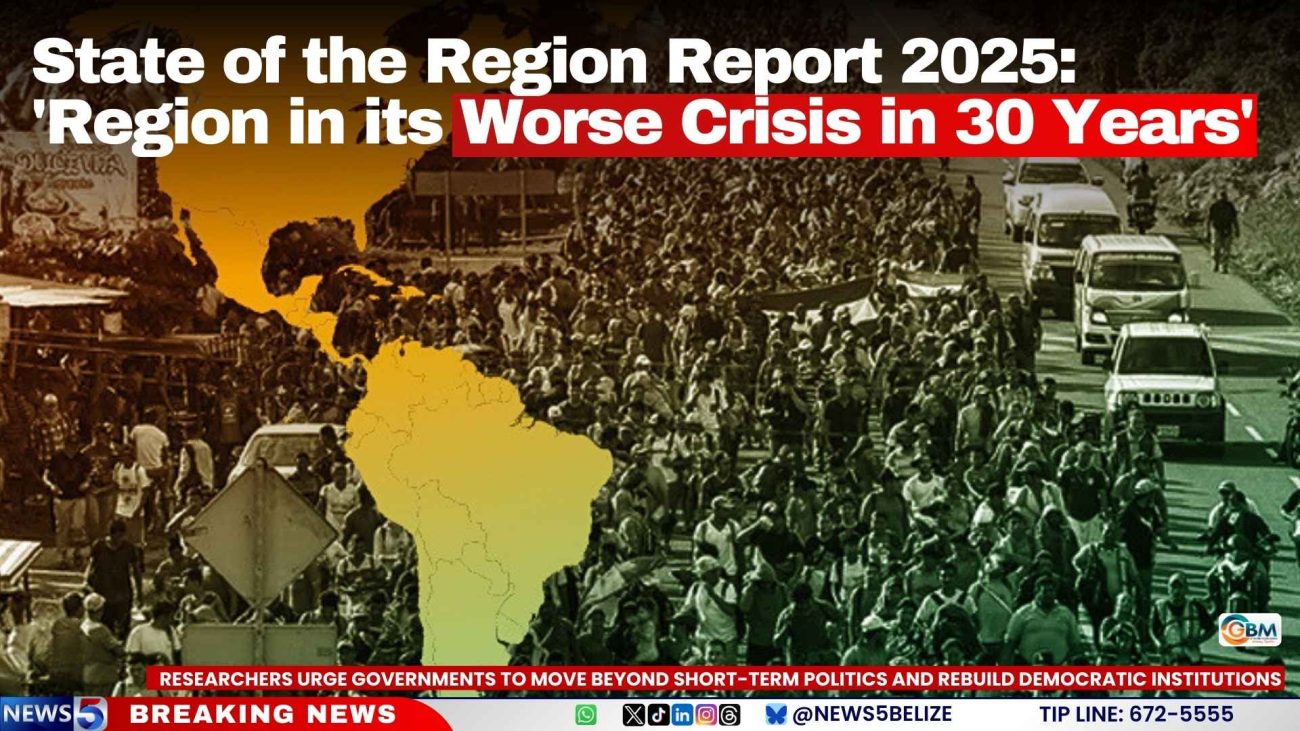
State of the Region Report 2025: ‘Region in its Worse Crisis in 30 Years’
Central America and the Dominican Republic are facing their most dangerous political and social moment in decades, according to the Seventh State of the Region Report 2025, launched today by the University of Belize Research Office and regional partners.
“As the first quarter of the 21st century draws to a close, the region is experiencing its worst crisis in three decades,” the authors said.
Compiled by Costa Rica’s National Council of Rectors, the report analyses developments between 2018 and 2023 and paints a picture of widening inequality, democratic retreat and weakening regional cooperation.
It finds that development gaps across the region have deepened over the past 30 years, despite sustained economic growth. According to the report, “democratic backsliding occurs against a backdrop not of economic stagnation, but of moderate growth.” That growth, however, remains “socially exclusionary” and “environmentally unsustainable,” failing to deliver broad wellbeing.
The report identifies five interconnected challenges.
- Economic and social inequalities between countries have widened, especially between Costa Rica, Panama and the Dominican Republic and the rest of the region. Growth has not closed historic gaps.
- After a brief rebound, countries cut social investment despite persistent poverty and inequality, returning to pre-pandemic patterns of exclusionary growth.
- Politically, the region is “facing its worst and most dangerous political period since the era of military conflicts,” with growing autocratisation fuelled by public frustration over unmet social expectations.
- Fragmentation limits the region’s ability to respond to pressure from global powers, reduced foreign aid and external economic shocks.
- Weak cooperation, ageing populations, rising organised crime and poor coordination on climate adaptation are undermining collective action.
Essentially, the report says post-pandemic governance has weakened the region’s capacity to promote sustainable human development. Poverty, inequality and fragile institutions persist, while social investment has declined since Covid-19.
It also warns that escalating global geopolitical conflicts and an “internal diaspora” of fragmented politics will have reduced the region’s ability to respond collectively to organised crime, climate change and external pressures.
Researchers urge governments to move beyond short-term politics and rebuild democratic institutions and regional cooperation before today’s pressures harden into long-term losses.
Facebook Comments