



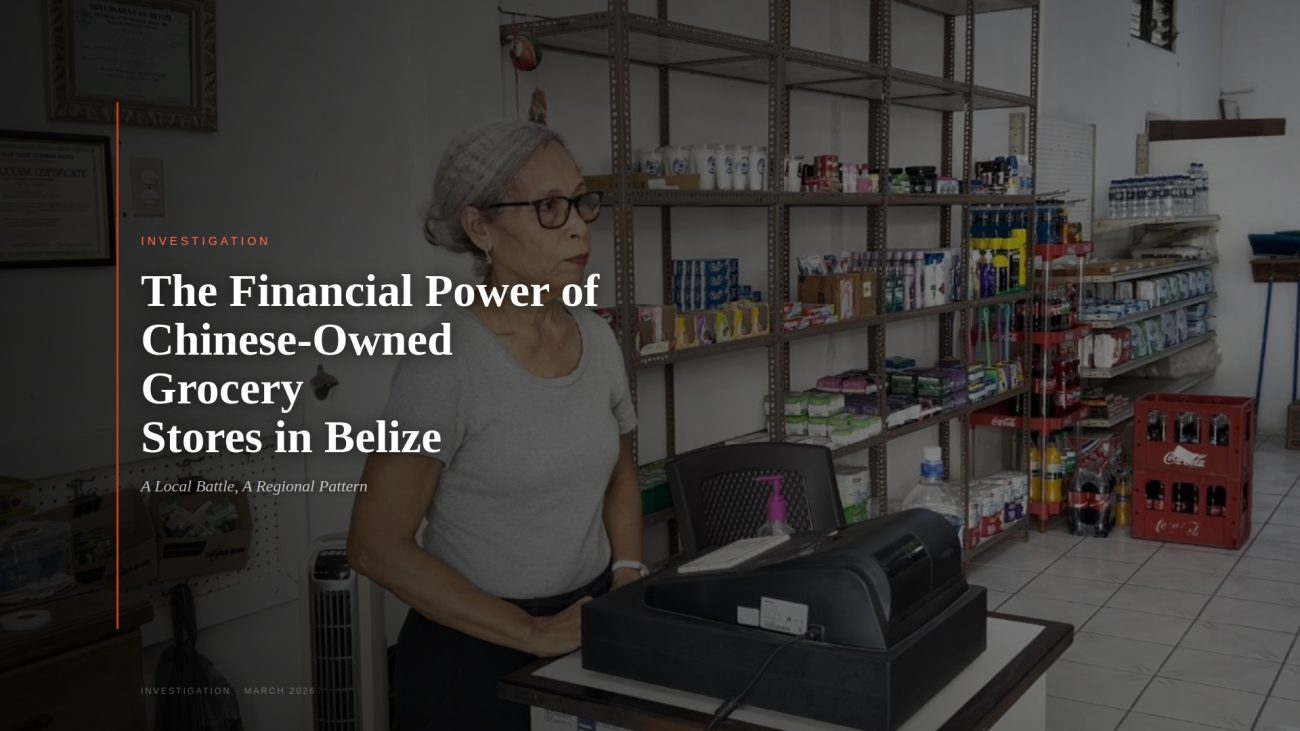
The Financial Power of Chinese-Owned Grocery Stores in Belize
“More Than a Shop”
For more than a quarter century, a small neighborhood grocery has opened its doors each morning not just to sell bread, rice, or a single sachet of seasoning, but to offer something increasingly rare in Belize’s retail landscape: trust.
At sixty-seven years old, Consuelo Catzim still stands behind the counter of Jansyl Mart, the modest shop she opened on Savannah Street in Orange Walk Town in late 1999. “I started this because I had to survive,” she recalls. After retiring from her job, she invested her payout into a grocery store to continue supporting her children, who were still in high school. A grocery, she reasoned, was a necessity. People would always need food.
The early days were slow. For months, customers hesitated, unsure whether the small store would last. But gradually, the shelves emptied more often, the foot traffic grew, and a relationship built on familiarity, patience, and compassion formed between shopkeepers and community.

Unlike large supermarkets, Catzim’s store operates on something far more fragile than bulk buying power: personal knowledge. She knows which customers she can trust, who is struggling, and who will return to settle a balance of a few cents. “If they’re short today, I let them take it. I know they’ll come back. And if they don’t, next time I don’t give credit.” It is a system that works only because of proximity and trust because customers are neighbors, not strangers.
Over the years, the store has changed. When Chinese-owned supermarkets across town, her sales dropped sharply as customers chased lower prices and the excitement of something new. That loss cut deep.
“These were the same people I helped when they had nothing. Sometimes they’d owe me for weeks. But when they got money, they’d pay me, and go buy somewhere else.”
She does not hide her understanding. People, she says, buy where their money stretches furthest. A difference of just a few cents can decide where a customer shops. The deeper problem, she believes, lies further up the supply chain. Wholesalers often give significantly lower prices to those who buy in bulk, usually the Chinese-owned stores with access to financing. Small shops buying a single case pay more, and that difference is passed directly to customers.
“That five cents is what kills us.”
Despite everything, she never closed. “People worry when I don’t open,” she says softly. “They come and ask if I’m okay.”
Her story is not unusual. In Orange Walk Town, municipal trade license records spanning 2020 to 2025 show that of the 92 grocery and supermarket businesses active in 2020, 25 have since closed, a closure rate of more than 27 percent in five years. The survivors are disproportionately larger, better-stocked operations. The smaller neighborhood shops, the stores that extend credit, which know their customers by name, are quietly disappearing.
Standing Strong on a Street of Giants
Meanwhile, in the bustling stretch of Mahogany Street in Belize City where large Chinese-owned supermarkets dominate, Wallace Usher has carved out a place for himself.
Usher, a seasoned businessman with years of experience in smaller stores, opened his latest supermarket in 2025. The response was immediate. Social media buzzed. Belizeans expressed support because Mahogany Street Supermarket represented something more: a chance to support someone from their own community in a market largely controlled by others.
“People felt they finally had the opportunity to support someone of their own kind. That response was both humbling and motivating.”
Operating on a street with three large Chinese-owned supermarkets was no small challenge. Yet Usher approached it with strategy. While larger stores have the advantage of bulk buying and lower wholesale prices, Usher focuses on customer service, store cleanliness, and maintaining personal connections with shoppers. “Customer service plays a huge role. It’s about maintaining good relationships, understanding expectations, and offering quality products.”
He sees his role as a community contributor. His advice to others entering the market is simple: commit fully, understand your clientele, and never underestimate the power of relationships. “What’s most rewarding is that a lot of people look up to you. Especially the youths. They see what’s possible and feel inspired.”
The numbers behind Chinese MSME success in Belize are not a matter of speculation. In 2015, Dong Hoon Choe, who was a management student at the University of Belize, conducted a formal quantitative study of Chinese MSMEs in Belize’s economy. He surveyed 60 Chinese business owners across Belize City.
The study’s portrait of Chinese business operations in Belize reveals a model built on discipline, frugality, and community:
- Operating hours: 56.7% of Chinese business owners operated 12 or more hours per day
- Working days: 53.3% worked all seven days per week; 88.3% worked six or seven days
- Business structure: 47% operated as sole proprietorships; 38% as partnerships
- Primary sector: 60% were engaged in retail grocery; 38% in food service
- Monthly expenses: 58.3% kept monthly expenses below BZD $9,999, despite 30% reporting monthly sales of $50,000 or more
- Startup financing: 45% relied on family and friends as their primary source of startup capital; only 5% used bank loans
- Operating financing: 93.3% used personal savings to fund operations; 71.6% also drew on family and friends
The gap between revenue and expenses is striking. A business generating over $50,000 in monthly sales while keeping expenses below $10,000 is effectively living off its margins and reinvesting the difference in growth, debt repayment, or the next store. This is the financial engine that Belizean competitors describe as opaque or unfair. Choe’s data suggests it is neither: it is simply a model built on radical cost suppression, long hours, and deferred personal comfort.
The study also documented employment patterns. Across the 60 businesses surveyed, an estimated 420 employees were hired, but 54 of the 60 respondents employed Chinese workers, while 31 employed Hispanics and only 20 employed Creoles. This hiring pattern reflects the practical logic of language and trust, but it also means that the economic multiplier effect of Chinese MSME growth flows disproportionately back through co-ethnic networks rather than into Belizean households.
When asked to rank their best practices in order of importance, Chinese business owners placed access to capital first (76.7% rated it “very important”), followed by lower operating costs (75%), good customer service (66.7%), hard work (61.7%), and support from family and friends (56.7%).
“These principles still hold up today,” Choe said. “You can’t replace hard work. You have to put in the hours. You have to control costs, treat customers professionally, and offer something different.” His broader message to Belizean entrepreneurs was pointed: the model is not a secret. Anyone can replicate it. The question is willingness.
The expansion of Chinese commercial activity in Belize is visible not just in storefronts, but in trade data. According to import statistics compiled from Belize’s trade records, Chinese imports into Belize grew from BZD $226 million in 2020 to nearly BZD $495 million in 2024, a 118.5 percent increase in five years, totaling more than BZD $2 billion across the period. The number of distinct product lines imported from China also grew, from 1,726 in 2020 to 2,285 in 2024. This shows a broadening of the commercial relationship well beyond any single sector.
Food and grocery-related imports from China followed the same trajectory. In 2020, food product imports from China totaled approximately BZD $16 million. By 2024, that figure had grown to over BZD $41 million, a 158 percent increase. The top food import by value was garlic, which alone accounted for over BZD $3 million across the five-year period.
Mayor Bernard Wagner of Belize City noted that the proliferation of Chinese-owned stores has been more pronounced in rural areas than in the city. “In the city, we have seen a lot of local barber shops, hairdressers, mechanic shops. But if you go into the rural areas, you will see them blowing up.”
News 5 requested specific trade license data from the Belize City Council and while Mayor Wagner and his team agreed to share, we have yet to receive the data.
In Orange Walk Town, municipal trade license data offers a ground-level view of what this competition looks like over time. Between 2020 and 2025, the total number of active retail grocery and supermarket licenses grew modestly from 92 to 123 — but the closure rate accelerated sharply. In 2021, only 4 businesses closed. By 2023, 24 had closed that year alone. By 2025, 41 businesses appear on the closed list. Of the 92 businesses active in 2020, only 66 remain active in 2025, a five-year survival rate of 72 percent.
The Wholesale Gap: Where the Real Competition Is Lost
The competitive pricing that defines Chinese-owned stores in Belize, the same pricing that small shopkeepers say they cannot match, is itself subject to government regulation. And a cumulative enforcement record produced by Supplies Control Unit (SCU) of the Ministry of Agriculture, Food Security and Enterprise in January 2025 revealed that regulations were broken, repeatedly, across every district in the country.
The SCU conducted compliance inspections of grocery establishments under Belize’s Supplies Control (Prices) Regulations, laws that set maximum retail prices for essential goods including bread, rice, and cooking oil, and require those prices to be visibly displayed in-store. The SCU documented 136 unique establishments that were issued tickets across all six districts of Belize, as well as Caye Caulker and San Pedro.
A district-by-district analysis of the violation list reveals a pattern that closely mirrors the broader market structure this investigation has documented.
The list of entities that were found in violation reflects the structure of the retail business sector in the particular location and in majority of the locations, stores found in violation are Chinese-owned.
The violations fall into two categories. The first, failure to display prices for controlled goods, prevents consumers from knowing whether they are paying the legal maximum price. The second, selling above the control price, means consumers were, in documented cases, overcharged for essential goods.
This has direct structural implications. Much of the price advantage that Chinese-owned stores hold over local competitors has been attributed, legitimately, to vertical integration, bulk purchasing, informal capital networks, and disciplined cost control. But the enforcement record adds a further dimension: in the districts where that competitive pressure is most intense, Chinese-owned stores appear disproportionately among establishments selling essential goods above their legally mandated ceilings, while small competitors like Catzim’s Jansyl Mart were simultaneously paying the higher per-case wholesale rate and complying with the same price control rules.
“That five cents is what kills us.” — Consuelo Catzim. If that five cents included, in some cases, an illegal markup above the control price — the competitive gap Catzim describes was not purely structural. Part of it was non-compliance.
The SCU identified four concrete expansion measures, one of which is particularly significant for this investigation: the expansion of surveillance activities to the wholesale segment of the distribution chain.
If Chinese-owned wholesalers are found to be pricing below the regulated margins for controlled goods or applying discriminatory pricing to bulk buyers in ways that compound the retail disadvantage of small shopkeepers, enforcement at the wholesale tier could begin to address the structural root rather than only its retail symptoms.
The regulatory framework governing these margins is set out in Statutory Instrument (SI) No. 88 of 2023, issued under the Supplies Control Act. This SI establishes fixed maximum markups on a wide range of controlled goods, generally 25 percent at the wholesale level and 15 percent at the retail level for essential food items, with slightly higher retail margins (20 percent) permitted for certain personal care and household products.
In effect, wholesalers are legally restricted in how much they may add to landed cost before reselling to retailers, and retailers are similarly capped in how much they may add to the wholesale price. This creates a regulated pricing chain from importation to final sale, making the wholesale tier a critical enforcement point in determining whether statutory margins are being observed.
According to Catzim, a structural chokepoint is created when bulk buyers receive dramatically lower per-unit prices than small retailers. “If I buy one case, let’s say the case is thirty dollars, they will sell it to the Chinese for twenty-seven. To every small business that buys one case for thirty dollars we are actually paying that three-dollar difference.”
When a Chinese business owner controls both the import/wholesale tier and the retail tier, they do not simply have lower costs…they have a different business model entirely.
Catzim recently switched her own wholesale supplier from a Belizean vendor to a Chinese-owned one, precisely because the Chinese supplier offered more competitive prices. “I could sell almost like them or like the other stores. So I started to switch. And then my sales picked up.”
The Belizean shopkeeper buying from that same wholesaler is, in effect, subsidizing the competitive advantage of their own competitor.
Over the past year, the unit’s staff has more than doubled, expanding from a single permanent office in Belmopan to four locations: Belize City, Belmopan, Orange Walk and Independence Village. With new personnel, vehicles and regional coverage now in place, officers are being trained and deployed to collect data as the unit moves into surveillance of importers and wholesalers.
The Informal Finance Powering Chinese-Owned Supermarkets
For more than a decade, Chinese-owned supermarkets and grocery stores have reshaped Belize’s retail landscape. Their rapid expansion, long operating hours, and ability to undercut competitors have fueled a persistent public question: where does the money come from?
A closer look at academic research and interviews with leading scholars suggests the answer lies not in shadowy syndicates or foreign state schemes, but in dense, informal financial networks operating largely outside Belize’s formal banking system.
According to a multi-year ethnographic study by Josephine Smart and Alan Smart of the University of Calgary, conducted in Belize in 2013 and expanded to Panama in 2015, Chinese small and medium-sized enterprises in Belize are primarily financed through family capital, rotating credit systems, overseas remittances, and transnational property income, rather than local bank loans or government-backed financing. Their findings align closely with what Choe’s quantitative data showed: bank loans are rare, family networks are central, and the informal sector does what formal institutions cannot.
Most recent Chinese migrants cannot access commercial bank loans when they first arrive. As non-citizens with limited credit histories and no collateral, they are effectively excluded from formal financial institutions. Alan Smart explained it directly: “Access to money is not about cheap credit. It’s about accessibility and speed. These entrepreneurs often pay higher interest than a local business would, but they can get the capital immediately.”
Instead of banks, many rely on informal financing: loans from relatives in China or North America, pooled family savings, and rotating credit associations (RCAs) where members contribute fixed sums and take turns receiving large payouts. At peak payout moments, these systems can generate lump sums large enough to open a supermarket, purchase inventory, or buy commercial property outright.
The Smarts also documented a practice they call lateral expansion: an established owner helps a relative or trusted worker finance a new store, often supplying inventory and short-term credit. The new operator remains independently responsible for repaying loans and running the business.
“It looks coordinated from the outside, but legally and operationally, these are separate enterprises.” — Josephine Smart
This is the source of the confusion Belizeans often voice: multiple stores in the same area, appearing to operate as a network, perceived as a coordinated effort to dominate a corridor. The Smarts found no evidence of centralized ownership or cartel-style financing. They found that what exists is a kinship and trust network that functions as a substitute for the institutional infrastructure.
Their research also challenges the assumption that Chinese supermarkets succeed because of unlimited capital. The model depends on high-volume sales at thin margins, an approach historically known in the Caribbean as the “penny trade.” By reducing labor costs through family work, living on-site, and vertically integrating supply chains, Chinese storeowners minimize expenses that Belizean competitors often cannot. “Each item earns less, but selling more items still meets daily profit targets,” said Josephine Smart.
While China encourages overseas investment, the Smarts found no indication that small Chinese retailers in Belize are vehicles for geopolitical influence. “These shopkeepers are not agents of a global plan,” Alan Smart said. “They’re trying to educate their children, buy homes, and eventually leave retail altogether.” Most expressed hopes that their children would become professionals, doctors, engineers, accountants, rather than inherit the family store.
A Government’s Take: Competition as Lesson, Not Threat
According to Dr. Osmond Martinez, Minister of State in Economic Transformation, the growth of Chinese-owned grocery stores reflects not only hard work but also innovative business strategies. He says local entrepreneurs can learn from these models rather than view them purely as competition. “Because when it comes to competition with two entrepreneurs, it does hurt. But when it comes to the benefits of the consumer, that’s a different type of language. The reason why they have survived is because they have managed to capitalize on the finance that they have, the finance mechanism, and the network that they do have.”
“My assumption is that working together makes a big difference. The Asian community is not the first model that we have of working in a collective way that can bring financial prosperity to a community of people. We also have the Mennonites, for example, who came back in the 1950s, and by working together as a community, they have been able to be where they are today,” Minister Martinez added.
The SCU’s enforcement record sharpens the policy question Dr. Martinez frames as competitive adaptation. Competition, as he correctly notes, is not inherently bad. But competition that involves selling essential goods above legally mandated control prices, in districts where local businesses have the least capacity to absorb even small cost disadvantages, is not simply market competition. The SCU data suggests the playing field in Orange Walk and Cayo has not been level, and that the gap Belizean shopkeepers have long described was, in part, sustained by non-compliance.
And as for the clustering of Chinese-owned grocery stores on the same street, Martinez said, “There is no policy for that. When you live in an open economy, if they want to put a business next to another, that’s part of it as well. Competition by itself is not bad. Competition helps to reduce the cost.”
“We must learn. Why can’t we, the Belizean people, work as a community so that we can import directly from the factory wherever it is? We just need to use the reverse business psychology on what’s happening now and learn and make it better. Don’t be afraid to take risks, but at the same time, don’t be afraid to be innovative.”
It’s A Regional Pattern. Will Belize Become More Dependent?
What is unfolding in Belize’s grocery sector is not isolated. Across the Caribbean and Central America, the same story is playing out, and in some countries, the consequences have been sharper and more cautionary.
In Nicaragua, following the implementation of a Free Trade Agreement with China in January 2024, an estimated 400 Chinese-owned retail businesses opened across the country within a year. Local merchants reported sales declines of up to 70 percent in some areas. Nicaraguan entrepreneurs said they lacked the capacity to compete with stores offering retail goods at prices below what locals could access at wholesale. The pattern mirrored what Catzim described on Savannah Street in Orange Walk…just at a far larger scale and accelerated by a trade agreement that granted Chinese businesses preferential tariff rates.
In Guyana, Chinese-owned supermarkets have similarly reshaped the retail landscape in recent years, with local vendors raising concerns about supply chain access, pricing power, and their inability to compete with stores that appear to absorb losses that no locally financed business could sustain.
This regional convergence matters for how Belize frames its own debate. In Nicaragua, the rapid expansion of Chinese retail was explicitly tied to a diplomatic realignment. Belize has maintained its relationship with Taiwan, which means the Belizean situation is driven primarily by entrepreneurial migration rather than state-directed commercial strategy. This distinction is important, and researchers like the Smarts caution against conflating the two.
“These shopkeepers are not agents of a global plan. They’re trying to educate their children, buy homes, and eventually leave retail altogether.” — Alan Smart, University of Calgary
And yet the broader framework of what analysts call “corrosive capital”, defined by organizations like the Center for International Private Enterprise and the Americas Society as investment or commercial influence that erodes democratic institutions, distorts competition, or exploits regulatory gaps, is worth keeping in view. The SCU enforcement record adds concrete texture to this framework: the regulatory gap is not theoretical. It has been documented in Belize’s own official records, across all six districts. Whether the government’s enforcement expansion closes that gap, or whether it remains episodic, will determine whether Belize’s situation continues to track the regional pattern.
In Nicaragua’s case, economists have warned that once local enterprises are displaced and consumer dependency on Chinese-owned stores deepens, price dynamics can shift. “They start off cheaper,” one Belizean business owner noted. “But what happens when there’s no one left to compete with?”
What Consuelo Catzim has done for twenty-six years, building trust, knowing her customers, extending credit when it makes sense, creating a place that people check on when it closes, is something no bulk-buying algorithm can replicate. It is, as she puts it, more than a business.
“People worry when I don’t open. They come and ask if I’m okay.”
The question for Belize is whether that kind of commerce can survive and what it would take to ensure that it does.
Data & Reporting Notes
Trade import figures are drawn from Belize's Statistical Institute of Belize (SIB) customs data for 2020–2024. Orange Walk municipal trade license data covers 2020–2025 and was provided by the Orange Walk Town Council. Municipal trade license data was requested from the Belize City Council. None was provided at the time of publication.

Supplies Control Unit enforcement data is drawn from the SCU's revised cumulative public notice issued by the Ministry of Agriculture, Food Security and Enterprise, documenting violations "since the launch of compliance activities" across all six districts of Belize plus Caye Caulker and San Pedro.

Quantitative research on Chinese MSMEs in Belize City is drawn from Dong Hoon Choe's 2015 University of Belize thesis. Ethnographic and qualitative research is drawn from Josephine Smart and Alan Smart (University of Calgary), fieldwork conducted in Belize (2013) and Panama (2015). Original interviews were conducted with Consuelo Catzim (Jansyl Mart, Orange Walk Town), Wallace Usher (Mahogany Street Supermarket, Belize City), Dr. Osmond Martinez (Minister of State, Economic Transformation), Mayor Bernard Wagner (Belize City), Dong Hoon Choe and Josephine Smart and Alan Smart. President of the Belize Chinese Association denied request for interview. Regional context draws on reporting by Diálogo Américas on Nicaragua, Kaieteur News and Stabroek News on Guyana, and analysis from CIPE and the Americas Society/Council of the Americas.
Facebook Comments