



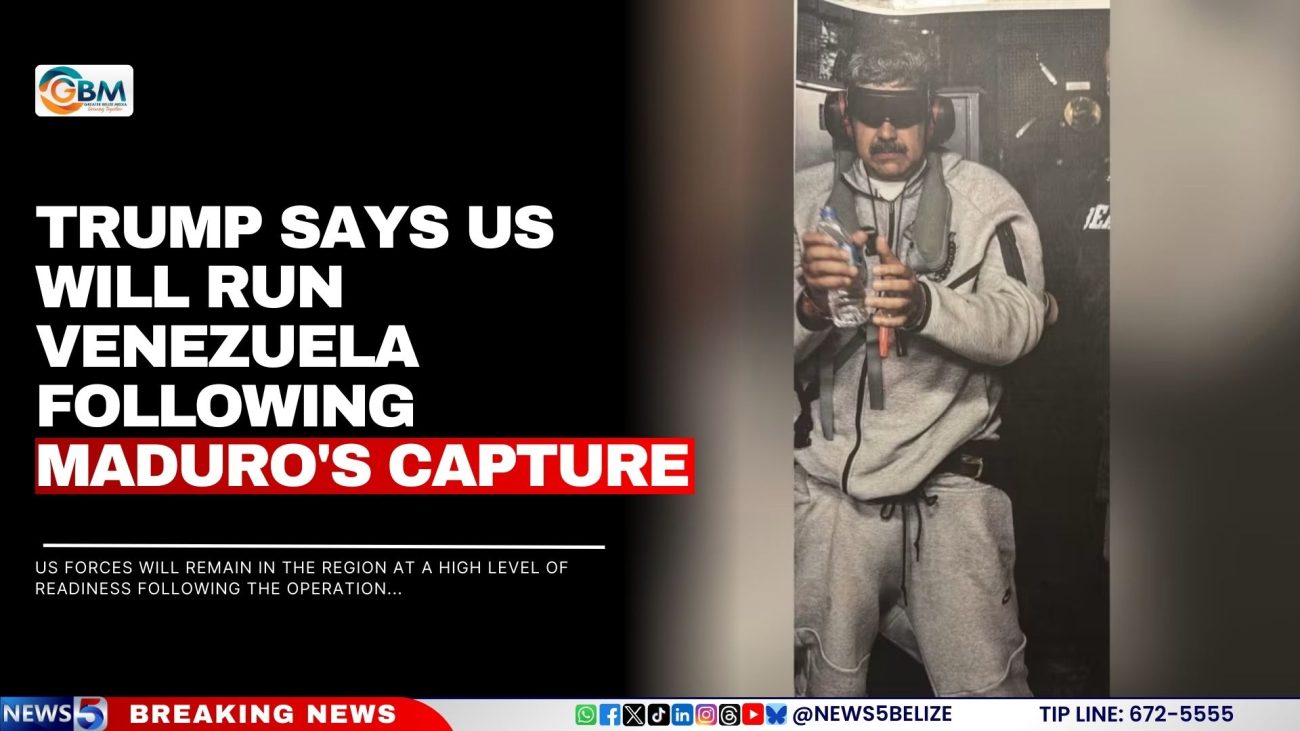
Trump Says US Will Run Venezuela Following Maduro’s Capture
The United States deployed more than 150 aircraft in a coordinated, hourslong military operation overnight to capture Venezuelan President Nicolás Maduro, an action senior US officials described as months in the making and unprecedented in scale.
Chairman of the Joint Chiefs of Staff Gen. Dan Caine said the mission, dubbed Operation Absolute Resolve, involved all branches of the US military and intelligence community and required extensive preparation before being executed in the early hours of Saturday.
Speaking at a press conference at President Donald Trump’s Mar-a-Lago estate in Florida, Caine said planning included detailed intelligence gathering on Maduro’s movements, routines and security. CNN has previously reported that the CIA placed a small team inside Venezuela over the summer to closely monitor the Venezuelan leader’s activities.
According to Caine, more than 150 aircraft launched late Friday night from 20 land and sea-based locations across the Western Hemisphere. Helicopters carrying the extraction force entered Venezuelan airspace flying as low as 100 feet above the water. The aircraft were supported by strikes intended to protect the force as it approached Maduro’s compound.
The helicopters reached the compound at approximately 1 a.m. Eastern Time. US forces encountered resistance during the operation, resulting in multiple self-defense engagements, Caine said. Maduro and his wife were taken into custody and flown out of Venezuela by 3:29 a.m.
They were later transferred to the USS Iwo Jima and are being transported to New York, where Maduro is expected to face charges stemming from a federal indictment filed in 2020 in the Southern District of New York. A superseding indictment was unsealed Saturday. He is expected to be briefly routed through the US military base at Guantanamo Bay before arriving in New York.
Caine confirmed that one US aircraft was struck during the mission but remained operational and returned safely. He said no American service members were killed and all aircraft involved in the operation returned home.
“Our air and ground intelligence teams provided real-time updates to the ground force, ensuring those forces could safely navigate the complex environment without unnecessary risk,” Caine said, adding that US forces also faced resistance while withdrawing from the country.
US forces will remain in the region at a high level of readiness following the operation, Caine said, describing the mission as a demonstration of US resolve to hold accountable those it considers threats to regional stability.
President Trump praised the operation, calling it a “pinpoint” mission and saying the United States was prepared to launch a second wave of attacks if necessary, though he suggested that may no longer be required. He said Caracas experienced widespread power outages during the operation and claimed Venezuelan military capabilities were neutralized.
Trump also said the US oil embargo on Venezuela remains in effect and warned political and military figures linked to Maduro that further action could follow. He declared that the United States will assume control of Venezuela indefinitely to oversee a transition of power, though he provided no timeline.
“We’re going to run the country until such time as we can do a safe, proper and judicious transition,” Trump said, adding that he plans to authorize US oil companies to take over Venezuela’s energy infrastructure.
The operation has sparked protests across the United States, with demonstrations planned in cities including New York, Chicago and Washington, DC, under the banner “No War on Venezuela.”
Gen. Caine said any failure during the mission could have jeopardized the entire operation.
“Failure of one component of this well-oiled machine would have endangered the entire mission, and failure is never an option for America’s joint force,” he said.
Facebook Comments