


When Can A Police Officer Use a Chokehold?
The Belize Police Department’s (BPD) policies classify chokeholds as deadly force, limiting their use to circumstances involving an imminent threat to life or grievous bodily harm.
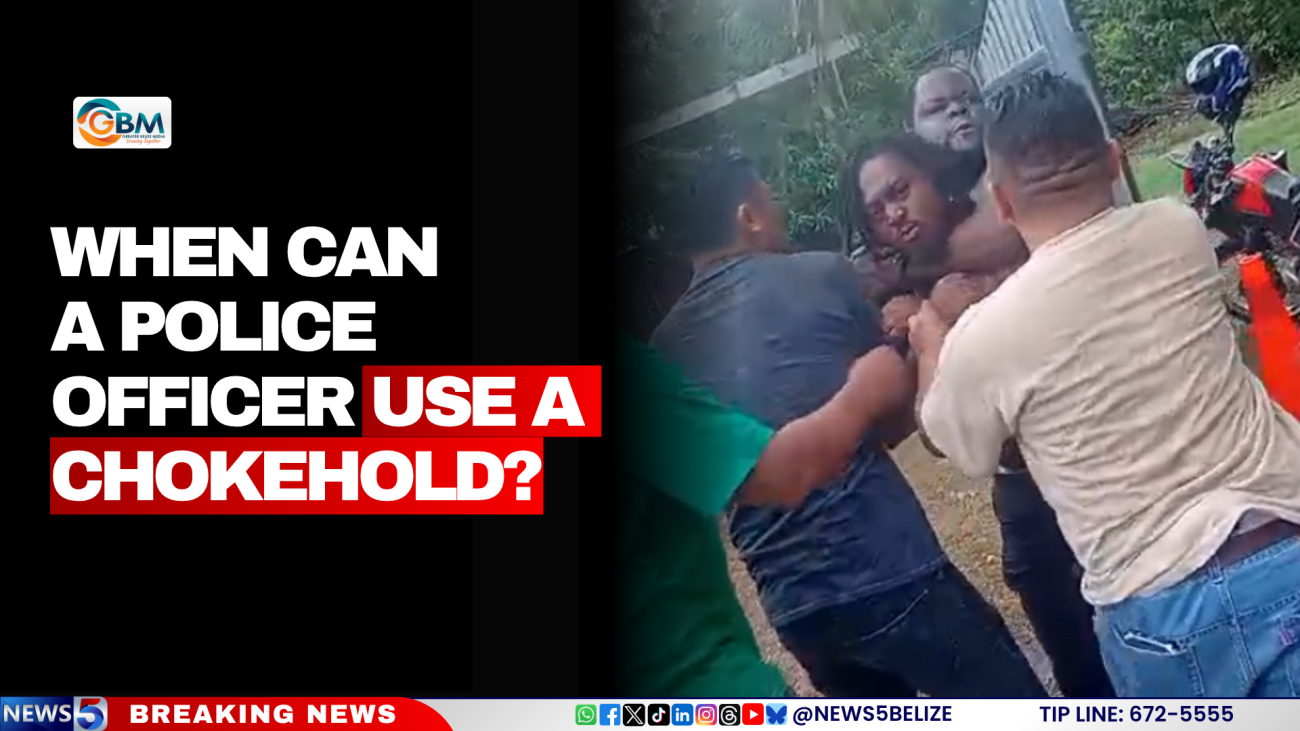
The policy has come under scrutiny following a viral video showing an encounter between police and Samuel Parham in Unitedville last week. Parham has since been charged with grievous harm.
ASP Stacy Smith, the BPD’s Staff Officer, explained that the department’s policies and procedures manual places chokeholds in the same category as firing a weapon at someone or striking them in the head with a baton.
“It must be used only as a last resort when there is an imminent threat to life or to injury in terms of grievous bodily harm,” Smith said.
She added that the manual also provides for the use of deadly force, including a chokehold, when a person resists arrest and there is a risk of death or grievous bodily harm.
The officer involved in the Unitedville incident is under internal investigation by the Professional Standards Branch. Smith confirmed that the officer sustained a broken arm and that Parham was charged with grievous harm.
“It is under this backdrop an internal investigation is being conducted to determine whether the circumstances at hand warranted the use of such force,” she said.
The incident has since raised questions about when officers are permitted to use chokeholds and how the BPD determines whether their use is justified. Nikkita Perez, Parham’s cousin, said the incident raised concerns about whether the chokehold was legal and whether officers were trained to use it.
“We want to know if that is legal in Belize. We want to know if it is something they were trained to do in the Police Academy,” Perez said.
Minister of National Security Michel Chebat described the incident as unfortunate and said police arrest strategies need to be reviewed.
“I think we have to train them so that when they meet these circumstances, they know what the appropriate reaction is,” Chebat said, adding that officers must consider proportionality when deciding how to respond.