



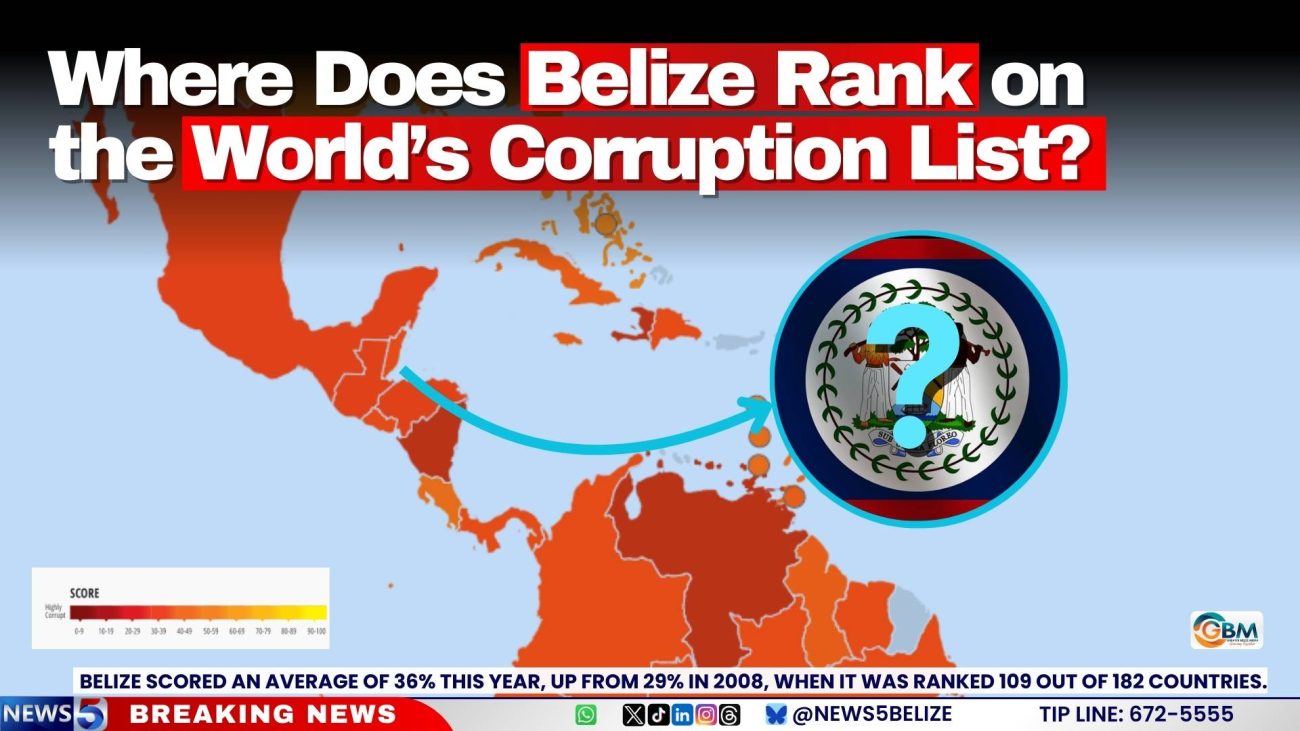
Where Does Belize Rank on the World’s Corruption List?
Belize has reappeared on the global Corruption Perceptions Index (CPI) for the first time since 2008, a development officials say offers both progress and a warning.
On February 10, Transparency International released its latest index, listing Belize after years of absence due to insufficient data. According to the Good Governance Unit, the ranking provides an outside view of how corruption and governance in Belize are seen internationally.
Director of the Good Governance Unit, Cesar Ross, said the index serves as a kind of international report card. “The importance of the CPI, apart from doing a comparative with the rest of the countries in the world, is that it gives a sort of external diagnostics of how the rest of the world perceives the level of corruption, the level of good governance in the country of Belize,” he said.
Belize scored an average of 36% this year, up from 29% in 2008, when it was ranked 109 out of 182 countries. The country now ranks 104 out of 182. Ross noted, “While there is an improvement of 7 percentage points, what we also have to take in contact is the development across the world and why we have not been moving faster.”

Ross explained that Belize’s absence from the CPI was due to a lack of sufficient international analysis. “What had happened is that only two agencies have been actually developing data analysis of Belize,” he said. Transparency International requires at least three agencies to study a country before it can be ranked. That changed after Belize reached out to additional organisations to begin analysing local data, allowing the country to meet the minimum threshold for inclusion.
Ross added that the index now puts pressure on Belize to show results, not just pass laws. He pointed to legislation such as the Civil Asset Recovery and Unexplained Wealth Act, passed in 2023, as an example of laws that must now demonstrate real impact.
According to Ross, Belize’s return to the index is not a stamp of approval but a tool to show where improvements are needed and to guide future reforms.
Facebook Comments