


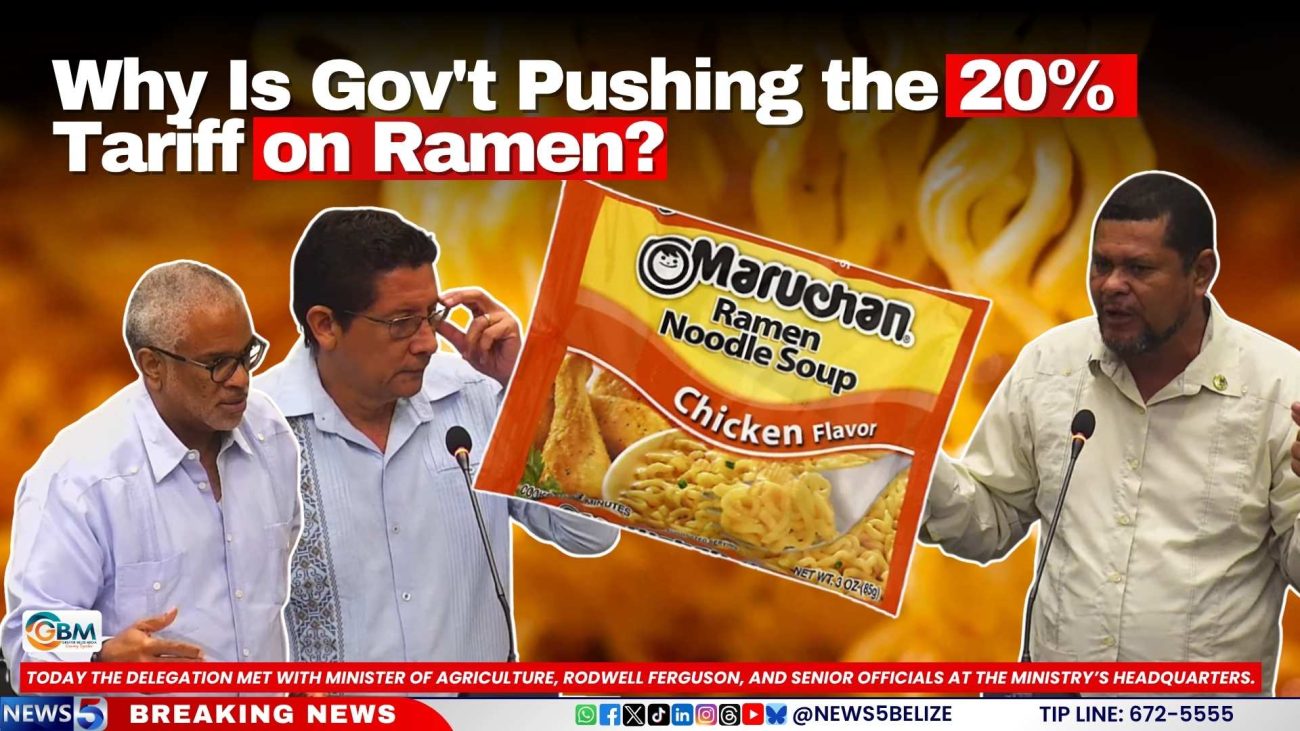
Why Is Gov’t Pushing the 20% Tariff on Ramen?
Church Senator Louis Wade placed strong emphasis on the economic potential of ramen. He argued that it should not only be seen as a “cheap meal” but also as a “foundation” for entrepreneurship opportunities.
Wade addressed UDP senator Sheena Pitts’s argument that ramen is an unhealthy “empty food” that is contributing to the rising cases of lifestyle diseases in the region.
“If Belizeans are eating only ramen, that may in itself be a low-nutrient food. But if they drop an egg in there… it changes everything because the protein content is now in the egg along with the base food of ramen,” Wade said.
He argued that with local ingredients, the product could be transformed into small business opportunities. “There is no reason why we can’t be like Vietnam and South Korea, where one dollar, you grab a ramen… Add something to it and you can start selling a breakfast for $3 and you become an entrepreneur with ramen,” he said. “You can start a business with ramen.”
Wade also pointed to the wider impact of local production through Manna Noodles, produced by Caribbean Organic Food Stuff Company, saying it would eventually stimulate agriculture, jobs, and small-scale enterprise.
“Here we have an entrepreneur who now will either source raw materials from in-country, which are the same farmers that we are talking about, and convert that into ramen… He will eventually have to buy from these Belizean farmers,” Wade said.
He made it clear that his support to amend the bill is tied to the economic possibilities of local manufacturing and the idea of moving Belizeans from consumption to production.
The Government is proposing a 20% tariff on imported ramen and similar products under the Customs and Excise Duties Act as part of this broader policy direction.
PUP Senator Christopher Coye defended the move, saying it is not protectionism but an effort to correct an imbalance in the tax structure, which he referred to as “reversed discrimination.” He explained that local producers such as Manna noodles face higher costs because imported raw materials are taxed, while finished imported ramen products do not carry the same burden. This, he said, places local manufacturing at a competitive disadvantage.
Meanwhile, Senator for Government Business Eamon Courtenay also rejected criticism by the UDP Senator Patrick Faber that the policy would harm Belize’s relationship with Taiwan. He clarified that the tariff does not breach Belize’s agreement with Taiwan.
Courtenay said that while Belize has an economic cooperation agreement that allows certain goods to enter duty-free, ramen is not included in that list of preferential products. The Government remains within its rights under international trade rules to apply the 20% tariff, according to him.